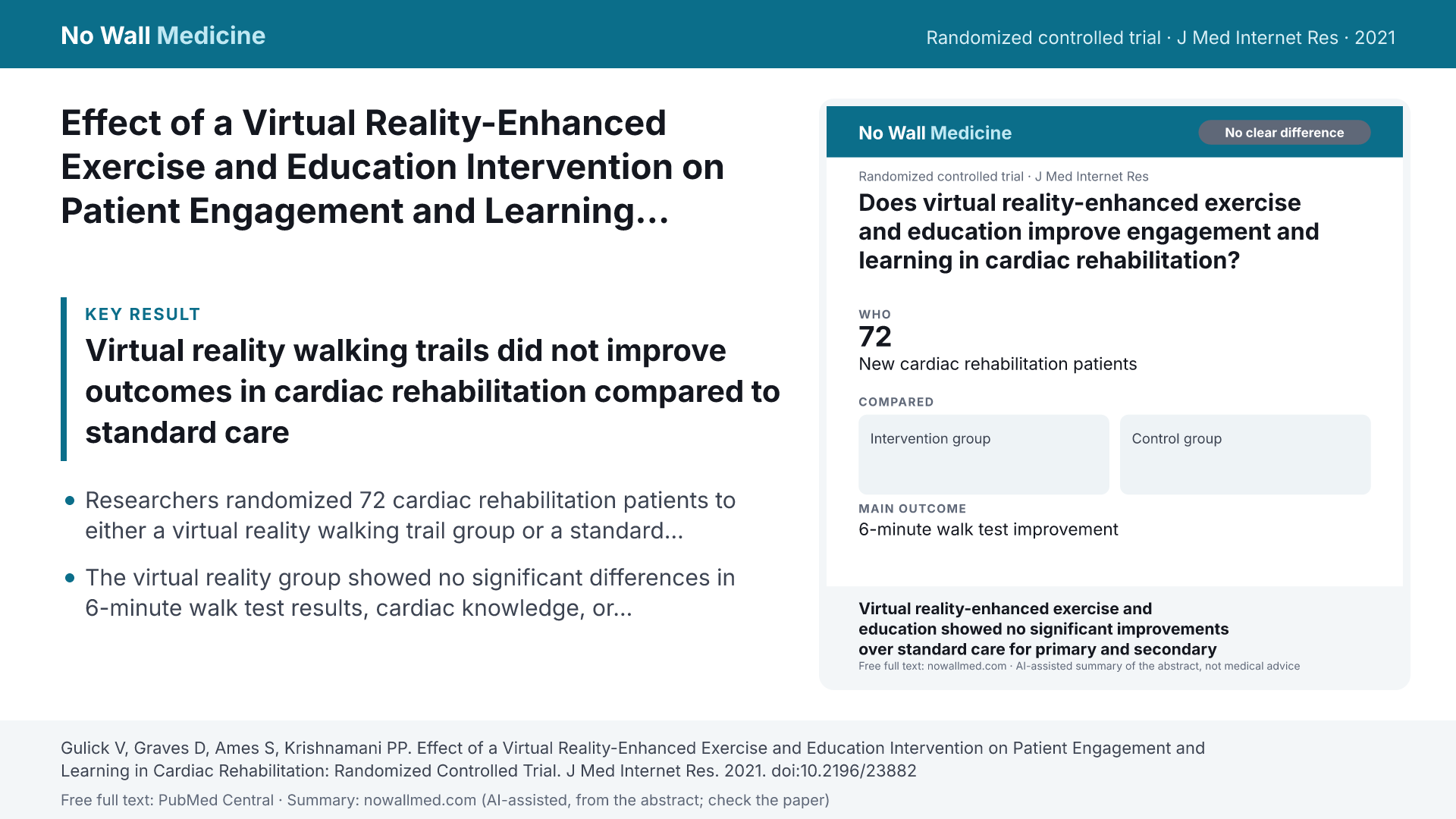
Effect of a Virtual Reality-Enhanced Exercise and Education Intervention on Patient Engagement and Learning in Cardiac Rehabilitation: Randomized Controlled Trial
Key result: Virtual reality walking trails did not improve outcomes in cardiac rehabilitation compared to standard care
Key points
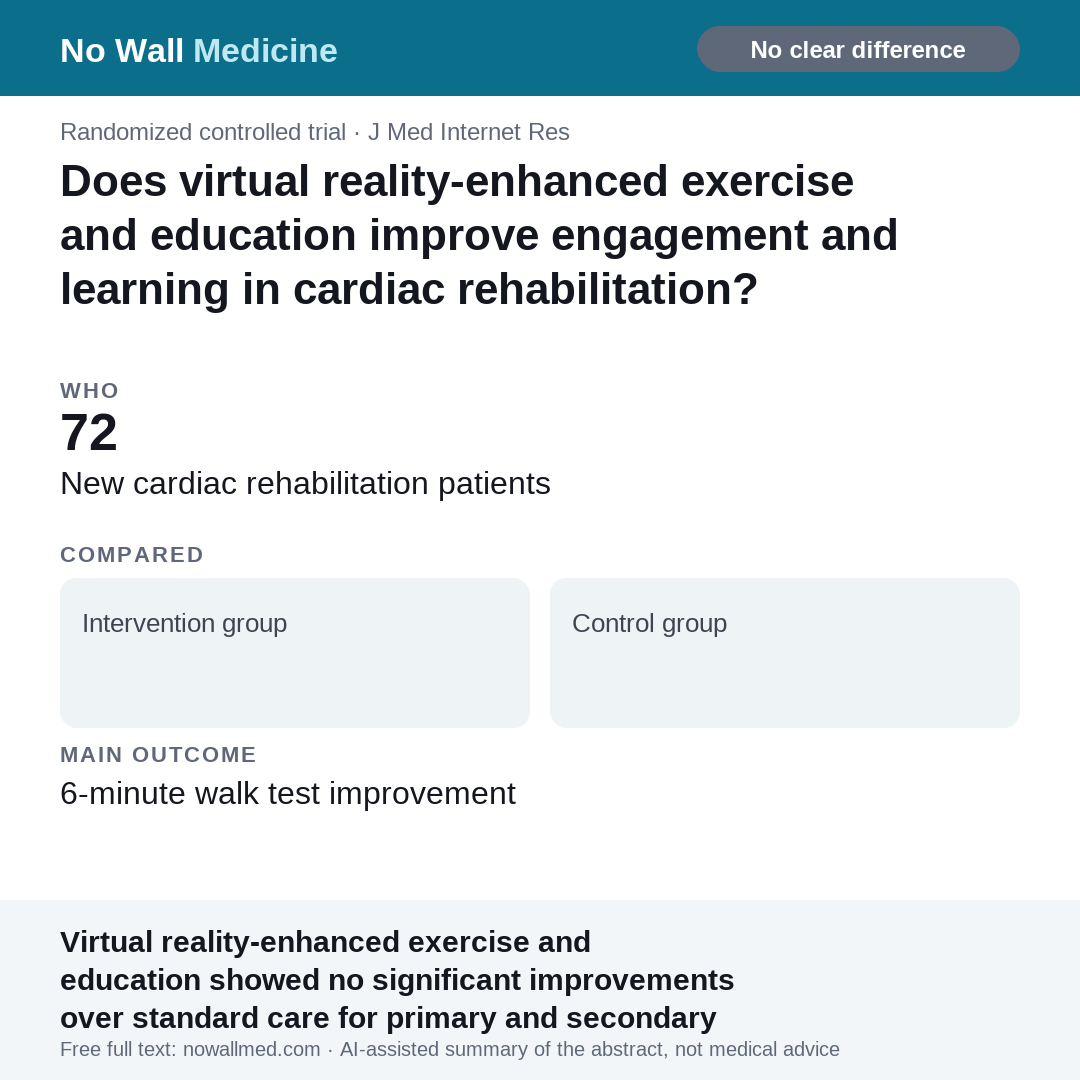
- Researchers randomized 72 cardiac rehabilitation patients to either a virtual reality walking trail group or a standard care control group.
- The virtual reality group showed no significant differences in 6-minute walk test results, cardiac knowledge, or satisfaction compared to the control group.
- The control group had statistically more favorable rates of attendance and session completion than the virtual reality group.
Why it matters: It is unknown if using virtual reality walking trails with audio education can improve patient knowledge, satisfaction, or attendance during cardiac rehabilitation.
Discussion prompts
- Would these patients look like yours? Who was left out?
- Is the main outcome one that matters to patients?
- Is the difference large enough to change what you do?
Cite: Gulick V, Graves D, Ames S, Krishnamani PP. Effect of a Virtual Reality-Enhanced Exercise and Education Intervention on Patient Engagement and Learning in Cardiac Rehabilitation: Randomized Controlled Trial. J Med Internet Res. 2021. doi:10.2196/23882
Free full text: PubMed Central · Summary and visual abstract: nowallmed.com/a/effect-of-a-virtual-reality-enhanced-exercise-and-education-19rn7nw/ (AI-assisted from the abstract; check the paper before relying on it).