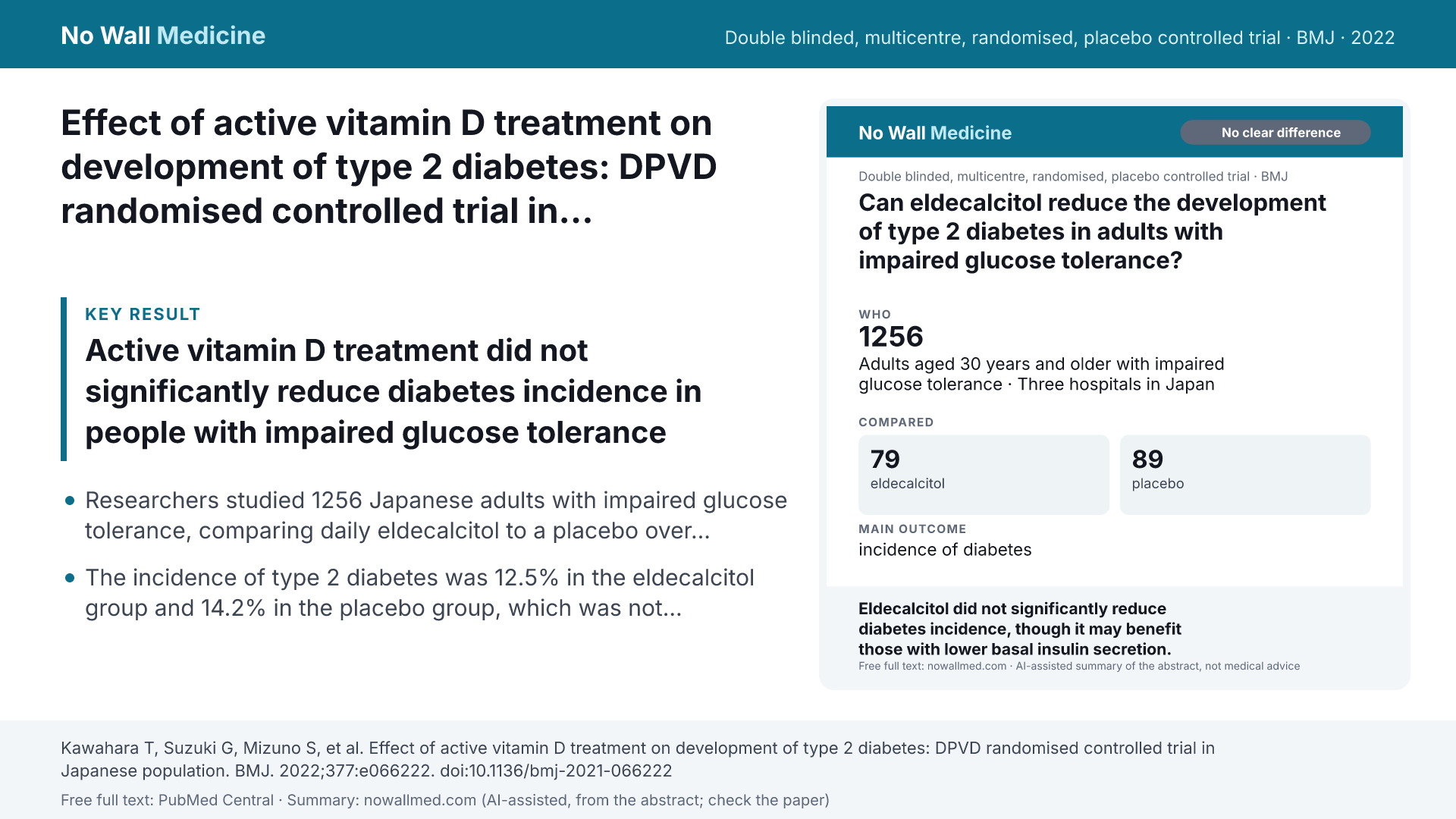
Effect of active vitamin D treatment on development of type 2 diabetes: DPVD randomised controlled trial in Japanese population
Key result: Active vitamin D treatment did not significantly reduce diabetes incidence in people with impaired glucose tolerance
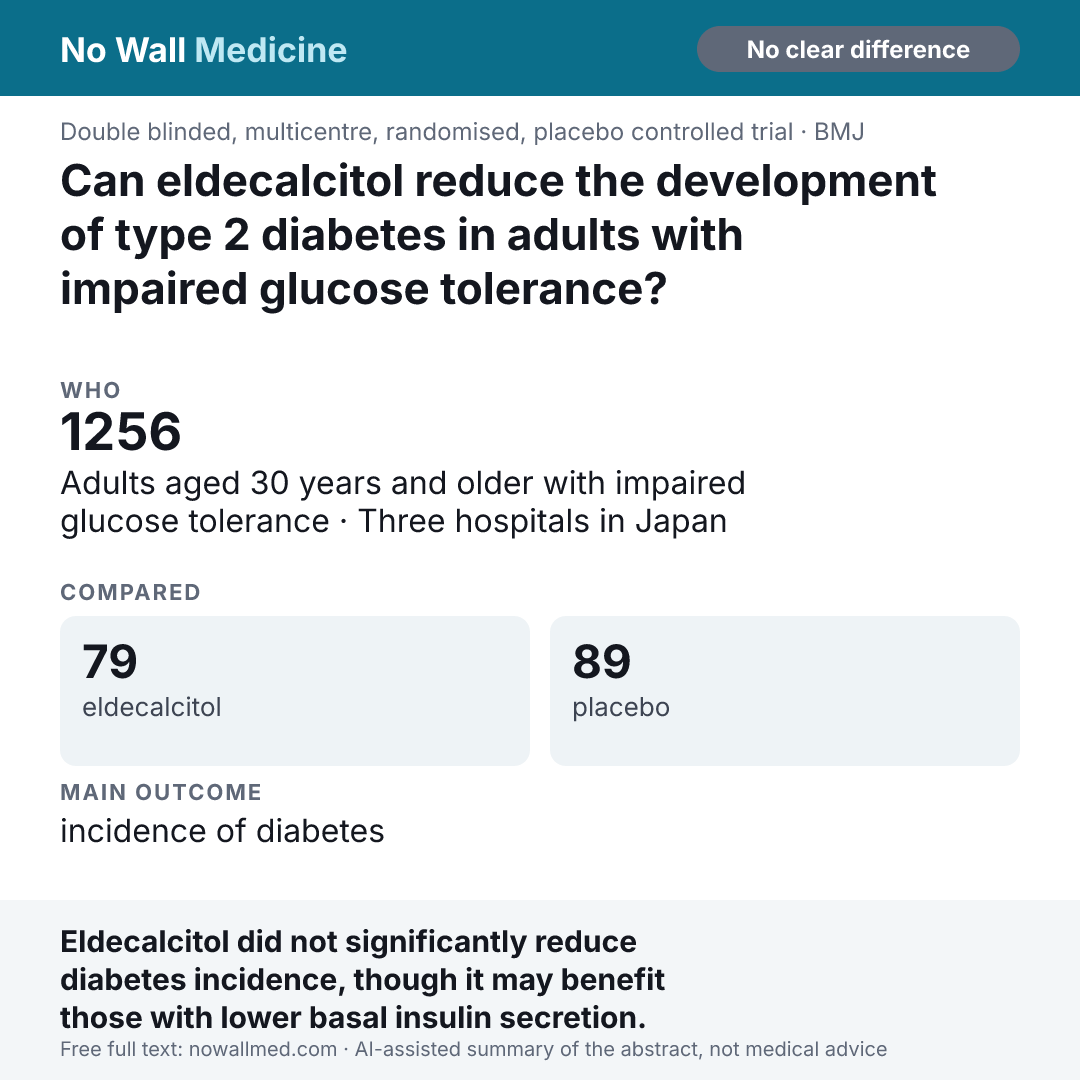
Double blinded, multicentre, randomised, placebo controlled trialNo clear difference
Can eldecalcitol reduce the development of type 2 diabetes in adults with impaired glucose tolerance?
Who
1256
Adults aged 30 years and older with impaired glucose tolerance · Three hospitals in Japan
Compared
79eldecalcitol (12.5%)
89placebo (14.2%)
Main outcome
incidence of diabetes
Result: hazard ratio 0.87 (95% confidence interval 0.67 to 1.17)
Bottom line: Eldecalcitol did not significantly reduce diabetes incidence, though it may benefit those with lower basal insulin secretion.
BMJ · 2022-05-25 · Save PNG
Key points
- Researchers studied 1256 Japanese adults with impaired glucose tolerance, comparing daily eldecalcitol to a placebo over a median of 2.9 years.
- The incidence of type 2 diabetes was 12.5% in the eldecalcitol group and 14.2% in the placebo group, which was not a statistically significant difference.
- After adjusting for confounding factors, the development of diabetes was significantly lower in the eldecalcitol group, especially among those with lower basal insulin secretion.
Discussion prompts
- Would these patients look like yours? Who was left out?
- Is the main outcome one that matters to patients?
- Is the difference large enough to change what you do?
Cite: Kawahara T, Suzuki G, Mizuno S, et al. Effect of active vitamin D treatment on development of type 2 diabetes: DPVD randomised controlled trial in Japanese population. BMJ. 2022;377:e066222. doi:10.1136/bmj-2021-066222
Free full text: PubMed Central · Summary and visual abstract: nowallmed.com/a/effect-of-active-vitamin-d-treatment-on-development-of-type-2-qlm00y/ (AI-assisted from the abstract; check the paper before relying on it).