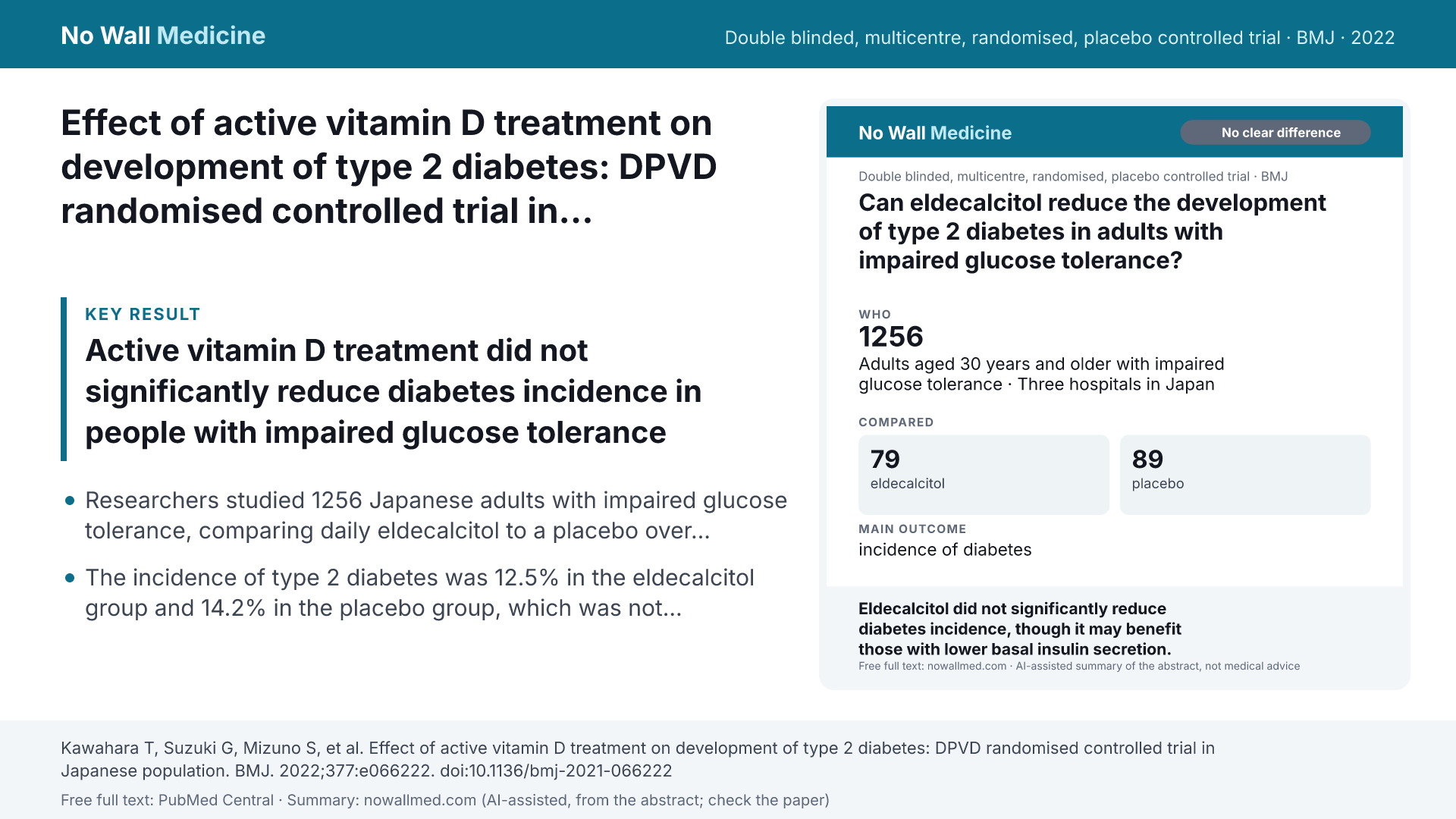
Active vitamin D treatment did not significantly reduce diabetes incidence in people with impaired glucose tolerance
Effect of active vitamin D treatment on development of type 2 diabetes: DPVD randomised controlled trial in Japanese population
Double blinded, multicentre, randomised, placebo controlled trialNo clear difference
Can eldecalcitol reduce the development of type 2 diabetes in adults with impaired glucose tolerance?
Who
1256
Adults aged 30 years and older with impaired glucose tolerance · Three hospitals in Japan
Compared
79eldecalcitol (12.5%)
89placebo (14.2%)
Main outcome
incidence of diabetes
Result: hazard ratio 0.87 (95% confidence interval 0.67 to 1.17)
Bottom line: Eldecalcitol did not significantly reduce diabetes incidence, though it may benefit those with lower basal insulin secretion.
BMJ · 2022-05-25Download image
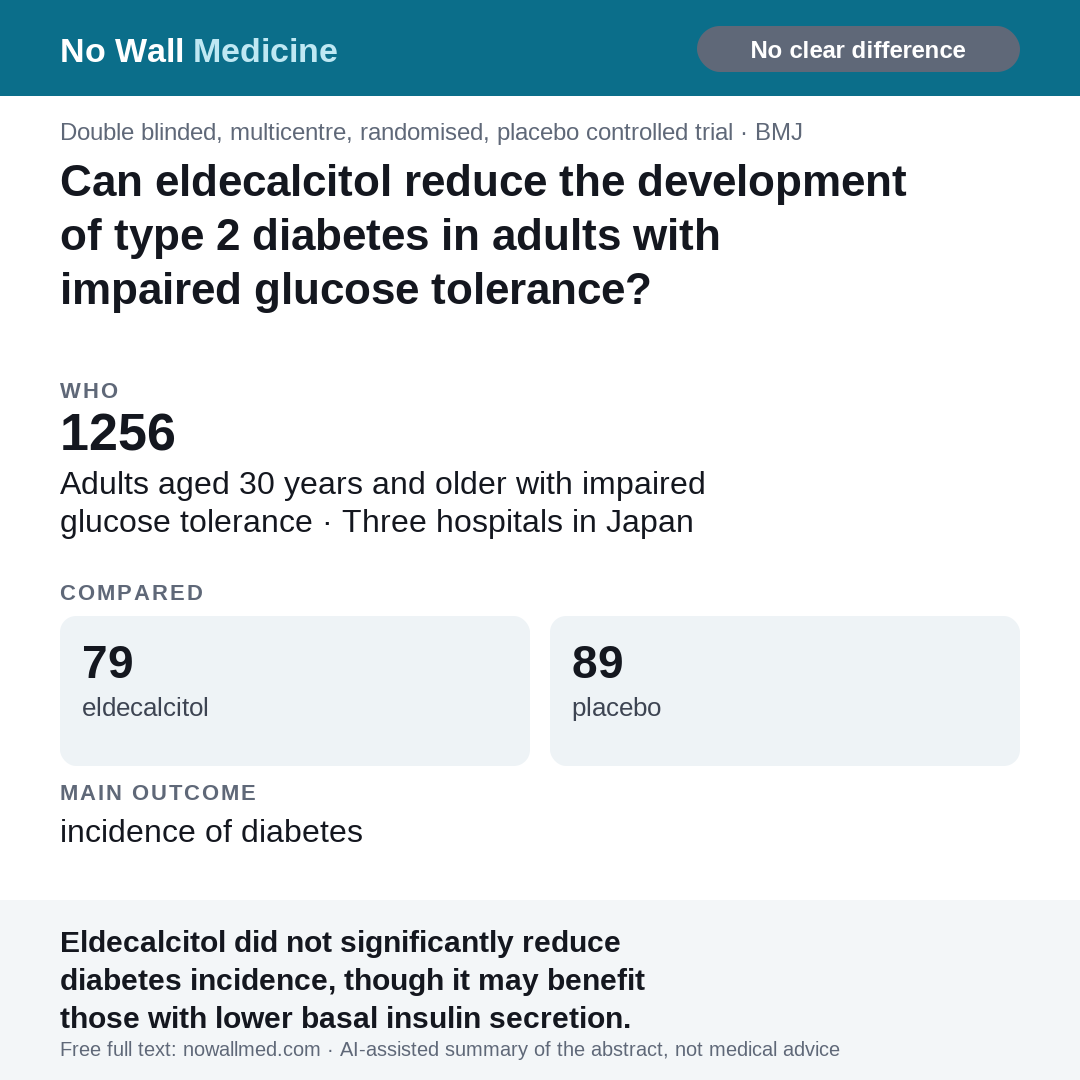
Clinical question: Can eldecalcitol reduce the development of type 2 diabetes in adults with impaired glucose tolerance?
Why it matters: It was unknown if the active vitamin D analogue eldecalcitol could prevent the development of type 2 diabetes in adults with impaired glucose tolerance.
Key points
- Researchers studied 1256 Japanese adults with impaired glucose tolerance, comparing daily eldecalcitol to a placebo over a median of 2.9 years.
- The incidence of type 2 diabetes was 12.5% in the eldecalcitol group and 14.2% in the placebo group, which was not a statistically significant difference.
- After adjusting for confounding factors, the development of diabetes was significantly lower in the eldecalcitol group, especially among those with lower basal insulin secretion.
Headline and key points written with AI from the paper’s abstract, with every number checked against it. Read the paper before relying on them.
Was this summary helpful?
Abstract
Objective
To assess whether eldecalcitol, an active vitamin D analogue2, can reduce the development of type 2 diabetes among adults with impaired glucose tolerance. Design
Double blinded, multicentre, randomised, placebo controlled trial. Setting
Three hospitals in Japan, between June 2013 and August 2019. Participants
People aged 30 years and older who had impaired glucose tolerance defined by using a 75 g oral glucose tolerance test and glycated haemoglobin level. Interventions
Participants were randomised to receive active vitamin D (eldecalcitol 0.75 μg per day; n=630) or matching placebo (n=626) for three years. Main outcomes
The primary endpoint was incidence of diabetes. Prespecified secondary endpoints were regression to normoglycaemia and incidence of type 2 diabetes after adjustment for confounding factors at baseline. In addition, bone densities and bone and glucose metabolism markers were assessed. Results
Of the 1256 participants, 571 (45.5%) were women and 742 (59.1%) had a family history of type 2 diabetes. The mean age of participants was 61.3 years. The mean serum 25-hydroxyvitamin D concentration at baseline was 20.9 ng/mL (52.2 nmol/L); 548 (43.6%) participants had concentrations below 20 ng/mL (50 nmol/L). During a median follow-up of 2.9 years, 79 (12.5%) of 630 participants in the eldecalcitol group and 89 (14.2%) of 626 in the placebo group developed type 2 diabetes (hazard ratio 0.87, 95% confidence interval 0.67 to 1.17; P=0.39). Regression to normoglycaemia was achieved in 145 (23.0%) of 630 participants in the eldecalcitol group and 126 (20.1%) of 626 in the placebo group (hazard ratio 1.15, 0.93 to 1.41; P=0.21). After adjustment for confounding factors by multivariable fractional polynomial Cox regression analysis, eldecalcitol significantly lowered the development of diabetes (hazard ratio 0.69, 0.51 to 0.95; P=0.020). In addition, eldecalcitol showed its beneficial effect among the participants with the lower level of basal insulin secretion (hazard ratio 0.41, 0.23 to 0.71; P=0.001). During follow-up, bone mineral densities of the lumbar spine and femoral neck and serum osteocalcin concentrations significantly increased with eldecalcitol compared with placebo (all P<0.001). No significant difference in serious adverse events was observed. Conclusions
Although treatment with eldecalcitol did not significantly reduce the incidence of diabetes among people with pre-diabetes, the results suggested the potential for a beneficial effect of eldecalcitol on people with insufficient insulin secretion. Trial registration
UMIN Clinical Trials Registry UMIN000010758.
Abstract reproduced under the article’s CC BY NC licence.
Subject terms
Cite this article
Kawahara T, Suzuki G, Mizuno S, et al. Effect of active vitamin D treatment on development of type 2 diabetes: DPVD randomised controlled trial in Japanese population. BMJ. 2022. doi:10.1136/bmj-2021-066222
Spotted a mistake? Suggest a correction