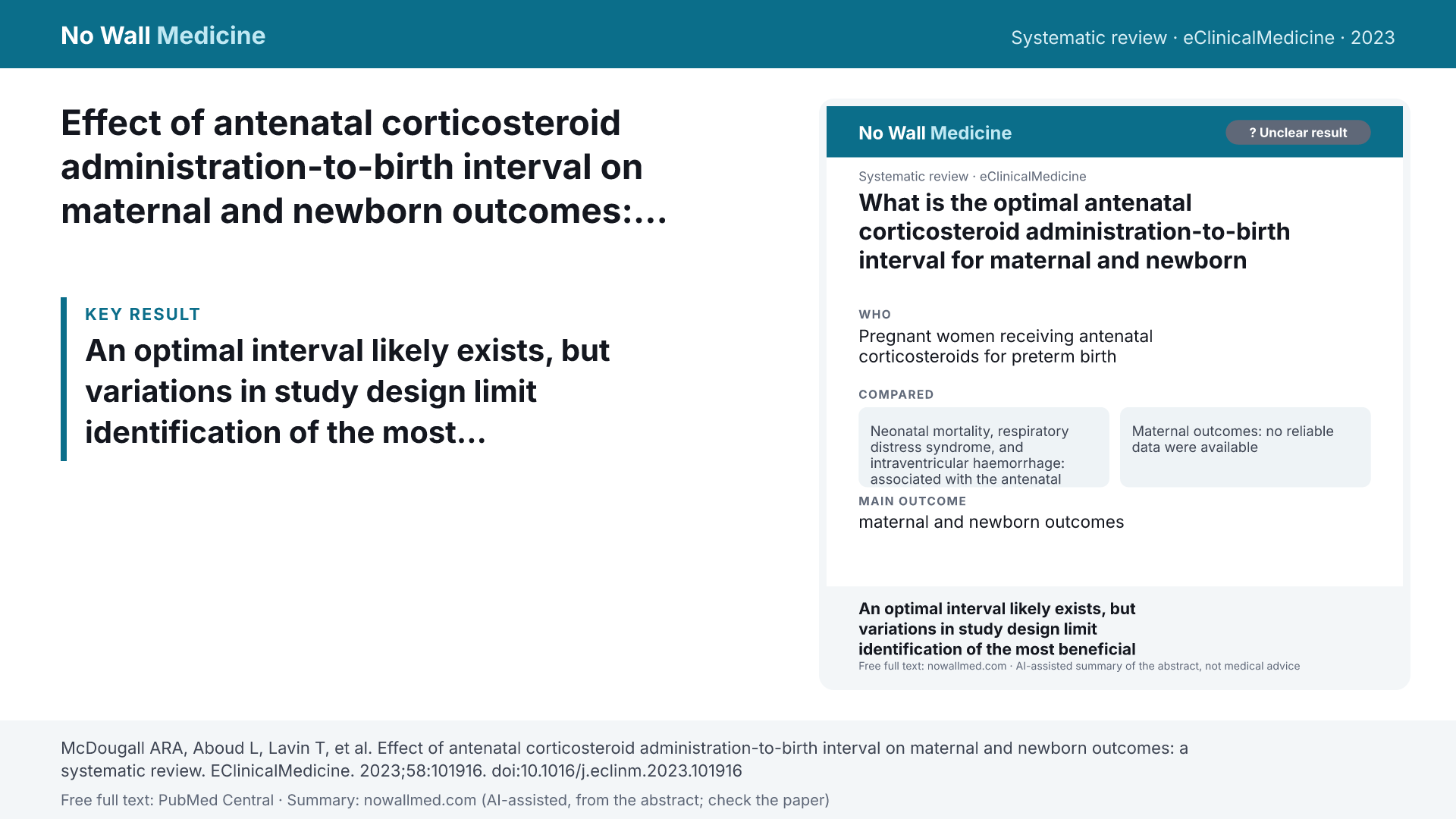
Effect of antenatal corticosteroid administration-to-birth interval on maternal and newborn outcomes: a systematic review
Systematic reviewUnclear result
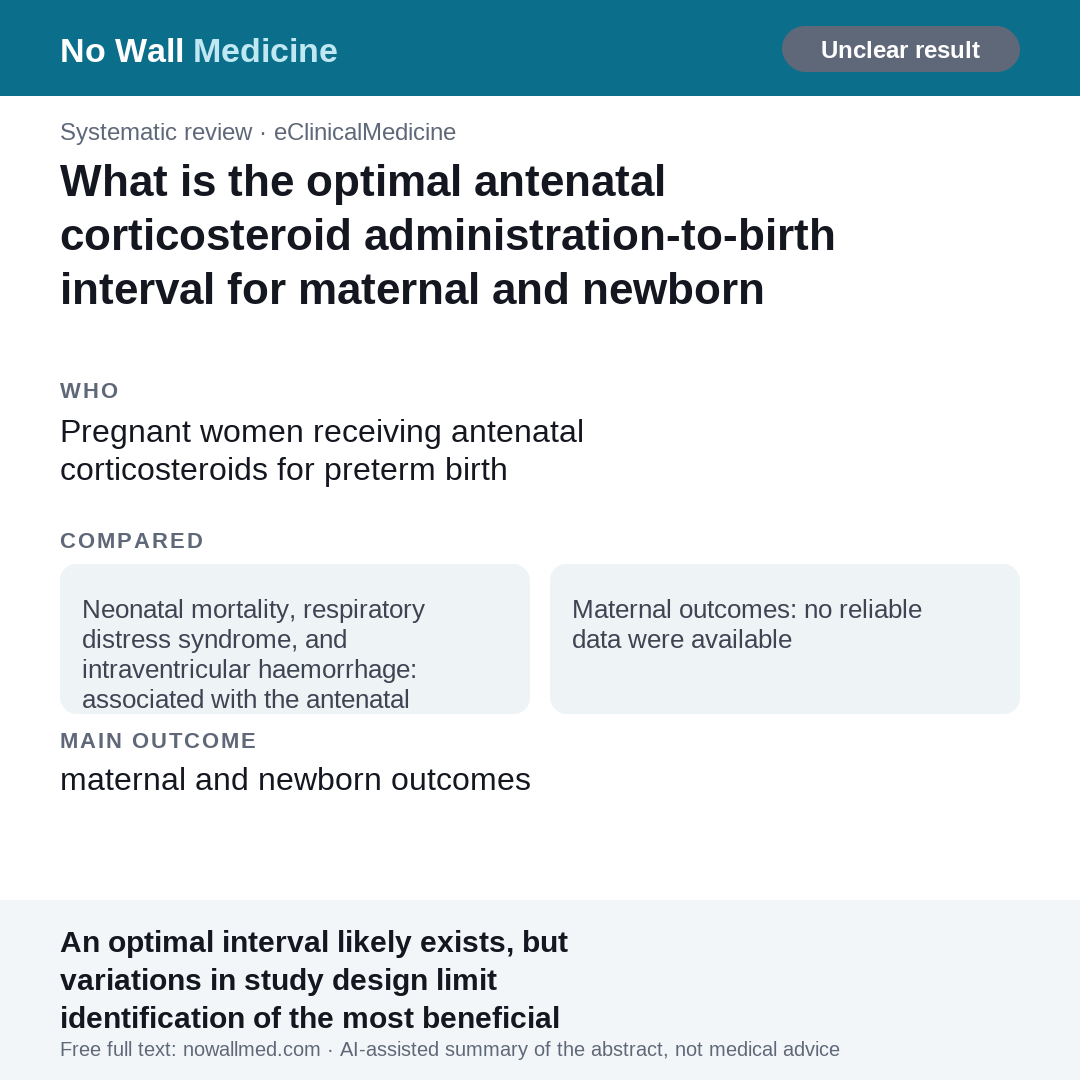
What is the optimal antenatal corticosteroid administration-to-birth interval for maternal and newborn outcomes?
Who
Pregnant women receiving antenatal corticosteroids for preterm birth
Compared
Neonatal mortality, respiratory distress syndrome, and intraventricular haemorrhage: associated with the antenatal corticosteroid administration-to-birth interval
Maternal outcomes: no reliable data were available
Main outcome
maternal and newborn outcomes
Bottom line: An optimal interval likely exists, but variations in study design limit identification of the most beneficial interval.
Limitation: Considerable heterogeneity in included administration-to-birth intervals and populations.
Funded by: UNDP-UNFPA-UNICEF-WHO-World Bank Special Programme of Research, Development and Research Training in Human Reproduction
eClinicalMedicine · 2023-03-24Download image
Clinical question: What is the optimal antenatal corticosteroid administration-to-birth interval for maternal and newborn outcomes?
Abstract
Background
Antenatal corticosteroids (ACS) are highly effective at improving outcomes for preterm newborns. Evidence suggests the benefits of ACS may vary with the time interval between administration-to-birth. However, the optimal ACS administration-to-birth interval is not yet known. In this systematic review, we synthesised available evidence on the relationship between ACS administration-to-birth interval and maternal and newborn outcomes. Methods
This review was registered with PROSPERO (CRD42021253379). We searched Medline, Embase, CINAHL, Cochrane Library, Global Index Medicus on 11 Nov 2022 with no date or language restrictions. Randomised and non-randomised studies of pregnant women receiving ACS for preterm birth where maternal and newborn outcomes were reported for different administration-to-birth intervals were eligible. Eligibility screening, data extraction and risk of bias assessment were performed by two authors independently. Fetal and neonatal outcomes included perinatal and neonatal mortality, preterm birth-related morbidity outcomes and mean birthweight. Maternal outcomes included chorioamnionitis, maternal mortality, endometritis, and maternal intensive care unit admission. Findings
Ten trials (4592 women; 5018 neonates), 45 cohort studies (at least 22,992 women; 30,974 neonates) and two case-control studies (355 women; 360 neonates) met the eligibility criteria. Across studies, 37 different time interval combinations were identified. There was considerable heterogeneity in included administration-to-birth intervals and populations. The odds of neonatal mortality, respiratory distress syndrome and intraventricular haemorrhage were associated with the ACS administration-to-birth interval. However, the interval associated with the greatest improvements in newborn outcomes was not consistent across studies. No reliable data were available for maternal outcomes, though odds of chorioamnionitis might be associated with longer intervals. Intepretation
An optimal ACS administration-to-birth interval likely exists, however variations in study design limit identification of this interval from available evidence. Future research should consider advanced analysis techniques such as individual patient data meta-analysis to identify which ACS administration-to-birth intervals are most beneficial, and how these benefits can be optimised for women and newborns. Funding
This study was conducted with funding support from the UNDP-UNFPA-UNICEF-WHO-World Bank Special Programme of Research, Development and Research Training in Human Reproduction (HRP), Department of Sexual and Reproductive Health and Research (SRH), a co-sponsored programme executed by the World Health Organization.
Cite this article
McDougall ARA, Aboud L, Lavin T, Cao J, Dore G, Ramson J. Effect of antenatal corticosteroid administration-to-birth interval on maternal and newborn outcomes: a systematic review. eClinicalMedicine. 2023. doi:10.1016/j.eclinm.2023.101916
Spotted a mistake? Suggest a correction
Top studies every Monday
The week’s key trials and guidelines in your specialties, plus any topics you follow. By email, free.
Get the weekly digest