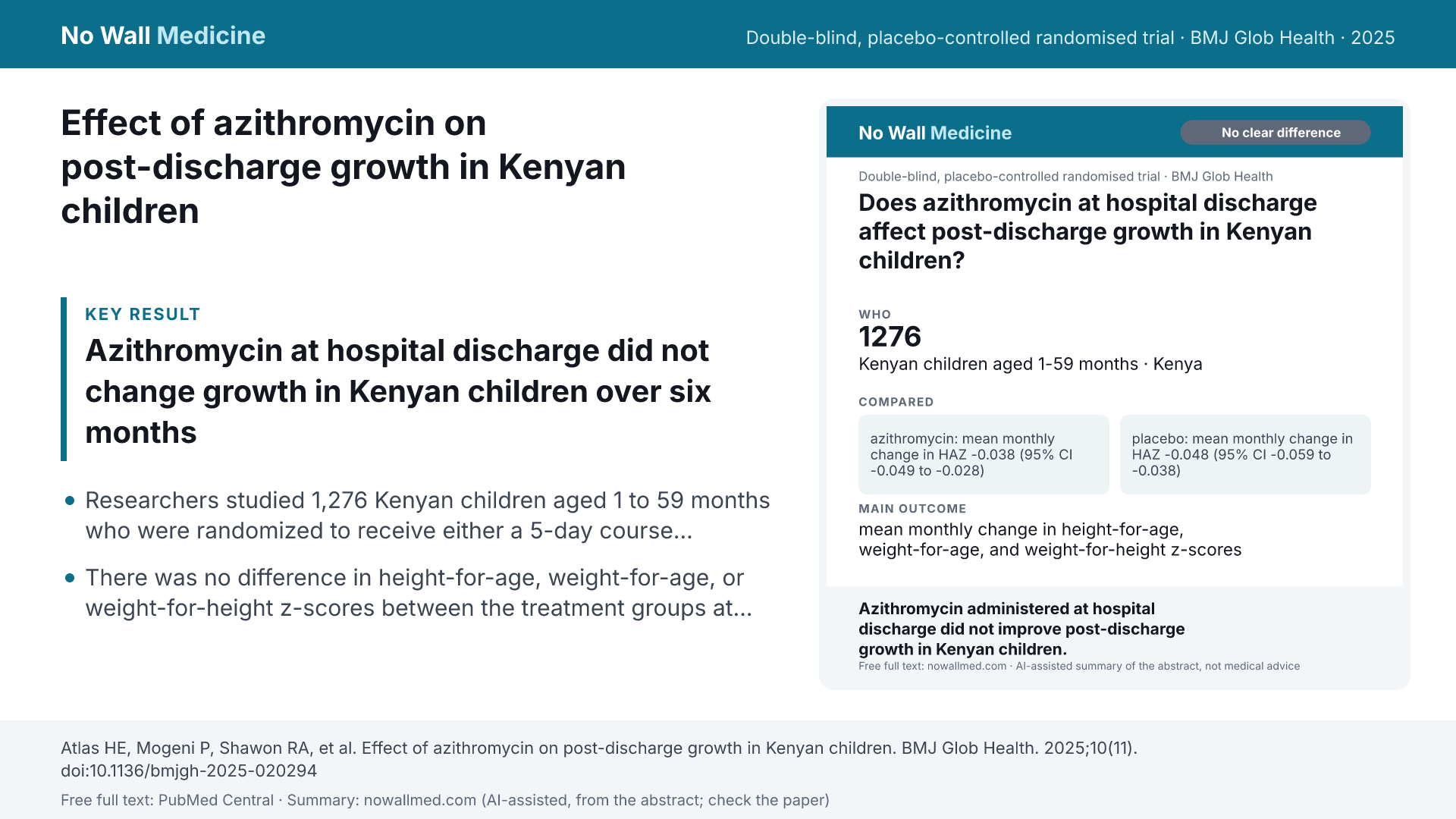
Azithromycin at hospital discharge did not change growth in Kenyan children over six months
Effect of azithromycin on post-discharge growth in Kenyan children
Double-blind, placebo-controlled randomised trialNo clear difference
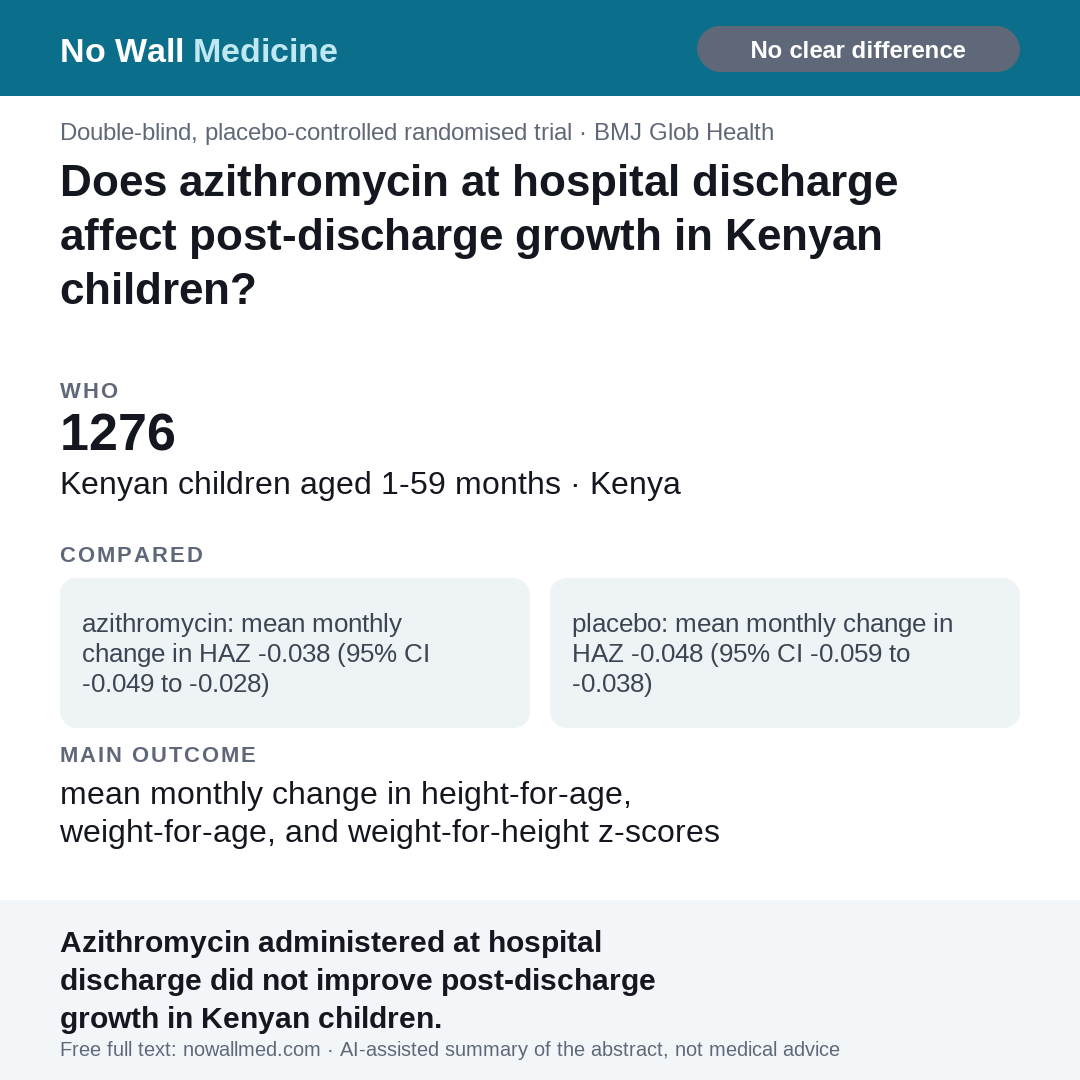
Does azithromycin at hospital discharge affect post-discharge growth in Kenyan children?
Who
1276
Kenyan children aged 1-59 months · Kenya
Compared
azithromycin: mean monthly change in HAZ -0.038 (95% CI -0.049 to -0.028)
placebo: mean monthly change in HAZ -0.048 (95% CI -0.059 to -0.038)
Main outcome
mean monthly change in height-for-age, weight-for-age, and weight-for-height z-scores
Result: mean difference: HAZ, 0.010 (95% CI -0.005 to 0.025)
Bottom line: Azithromycin administered at hospital discharge did not improve post-discharge growth in Kenyan children.
BMJ Glob Health · 2025-11-23Download image
Clinical question: Does azithromycin at hospital discharge affect post-discharge growth in Kenyan children?
Why it matters: Children discharged after acute illness in low- and middle-income settings face an increased risk of poor growth, specifically linear growth faltering.
Key points
- Researchers studied 1,276 Kenyan children aged 1 to 59 months who were randomized to receive either a 5-day course of azithromycin or a placebo.
- There was no difference in height-for-age, weight-for-age, or weight-for-height z-scores between the treatment groups at six months post-discharge.
- Mean monthly height-for-age z-score declined among all children in the six months following discharge regardless of the treatment group.
Headline and key points written with AI from the paper’s abstract, with every number checked against it. Read the paper before relying on them.
Was this summary helpful?
Abstract
Introduction
Children discharged following hospitalisation for acute illnesses in low- and middle-income settings are at increased risk of poor growth, particularly linear growth faltering. We aimed to determine the effect of azithromycin administered at hospital discharge on post-discharge growth. Methods
Using data from the Toto Bora Trial (NCT02414399), a double-blind, placebo-controlled randomised trial of a 5-day course of azithromycin in Kenyan children aged 1-59 months, we assessed differences in mean monthly change in growth (height-for-age z-score (HAZ), weight-for-height z-score (WHZ), weight-for-age z-score (WAZ)) in the 6 months following hospital discharge. Results
This analysis included 1276 children who survived to 6 months post-discharge (640 randomised to azithromycin and 636 to placebo). At discharge, 285 (22%) of children were stunted, 64 (5%) were wasted and 156 (12%) were underweight. There was no difference in 6-month post-discharge growth (mean difference: HAZ, 0.010 (95% CI -0.005 to 0.025); WAZ, 0.003 (95% CI -0.013 to 0.019); WHZ, -0.003 (95% CI -0.025, 0.019)) between treatment groups. Further, no differences in mean monthly change in HAZ, WAZ or WHZ were observed between randomisation groups when stratified by age, nutritional status at discharge or discharge diagnosis. Mean monthly change in HAZ declined among all children in the 6 months post-discharge, irrespective of the treatment group (azithromycin group: -0.038 (95% CI -0.049 to -0.028); placebo group: -0.048 (95% CI -0.059 to -0.038). Mean monthly change in WAZ did not differ significantly by treatment group (0.025 (95% CI 0.013 to 0.037) in the azithromycin group and 0.022 (95% CI 0.011 to 0.033) in placebo (p=0.688)). Monthly WAZ and WHZ gains were similar in both groups, with greater weight gains among older children (6-11, 12-23, 24-59 months). Conclusion
We did not observe statistically significant improvements in post-discharge growth among children receiving azithromycin at hospital discharge. Trial registration number
NCT02414399.
Abstract reproduced under the article’s CC BY NC licence.
Subject terms
Cite this article
Atlas HE, Mogeni P, Shawon RA, et al. Effect of azithromycin on post-discharge growth in Kenyan children. BMJ Glob Health. 2025. doi:10.1136/bmjgh-2025-020294
Spotted a mistake? Suggest a correction