Effect of Bamlanivimab as Monotherapy or in Combination With Etesevimab on Viral Load in Patients With Mild to Moderate COVID-19: A Randomized Clinical Trial
Randomized phase 2/3 trialMixed results
Does bamlanivimab monotherapy or combination therapy reduce SARS-CoV-2 viral load?
Who
577
Ambulatory patients with mild to moderate COVID-19 symptoms · 49 US centers
Compared
-3.72Bamlanivimab 700 mg
-4.08Bamlanivimab 2800 mg
-3.49Bamlanivimab 7000 mg
-4.37Combination treatment
Main outcome
Change in SARS-CoV-2 log viral load at day 11
Result: -0.57 (95% CI, -1.00 to -0.14)
Bottom line: Combination therapy reduced viral load, but bamlanivimab monotherapy showed no significant difference compared to placebo.
JAMA · 2021-01-22Download image
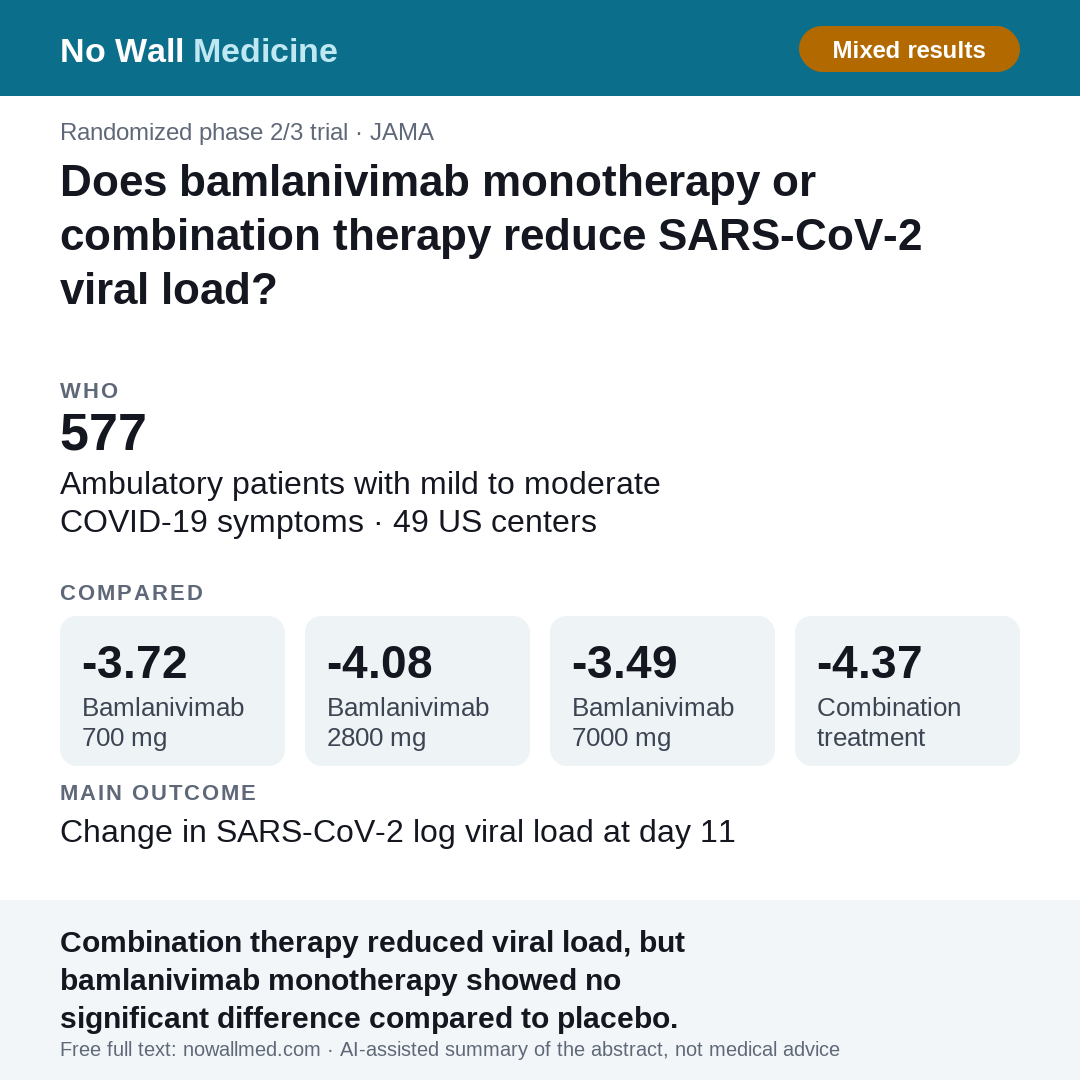
Clinical question: Does bamlanivimab monotherapy or combination therapy reduce SARS-CoV-2 viral load?
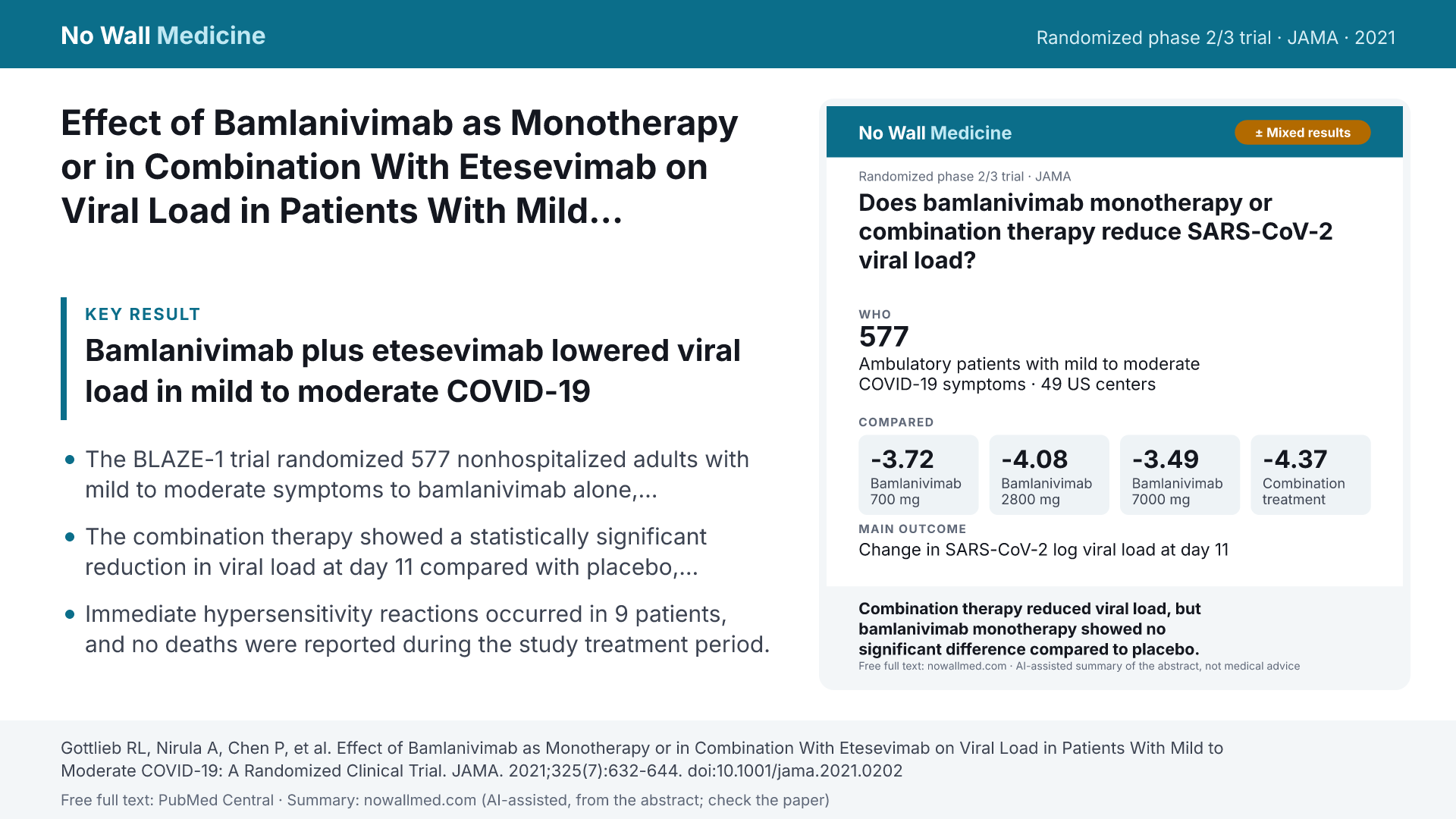
Abstract
Importance
Coronavirus disease 2019 (COVID-19) continues to spread rapidly worldwide. Neutralizing antibodies are a potential treatment for COVID-19. Objective
To determine the effect of bamlanivimab monotherapy and combination therapy with bamlanivimab and etesevimab on severe acute respiratory syndrome coronavirus 2 (SARS-CoV-2) viral load in mild to moderate COVID-19. Design, setting, and participants
The BLAZE-1 study is a randomized phase 2/3 trial at 49 US centers including ambulatory patients (N = 613) who tested positive for SARS-CoV-2 infection and had 1 or more mild to moderate symptoms. Patients who received bamlanivimab monotherapy or placebo were enrolled first (June 17-August 21, 2020) followed by patients who received bamlanivimab and etesevimab or placebo (August 22-September 3). These are the final analyses and represent findings through October 6, 2020. Interventions
Patients were randomized to receive a single infusion of bamlanivimab (700 mg [n = 101], 2800 mg [n = 107], or 7000 mg [n = 101]), the combination treatment (2800 mg of bamlanivimab and 2800 mg of etesevimab [n = 112]), or placebo (n = 156). Main outcomes and measures
The primary end point was change in SARS-CoV-2 log viral load at day 11 (±4 days). Nine prespecified secondary outcome measures were evaluated with comparisons between each treatment group and placebo, and included 3 other measures of viral load, 5 on symptoms, and 1 measure of clinical outcome (the proportion of patients with a COVID-19-related hospitalization, an emergency department [ED] visit, or death at day 29). Results
Among the 577 patients who were randomized and received an infusion (mean age, 44.7 [SD, 15.7] years; 315 [54.6%] women), 533 (92.4%) completed the efficacy evaluation period (day 29). The change in log viral load from baseline at day 11 was -3.72 for 700 mg, -4.08 for 2800 mg, -3.49 for 7000 mg, -4.37 for combination treatment, and -3.80 for placebo. Compared with placebo, the differences in the change in log viral load at day 11 were 0.09 (95% CI, -0.35 to 0.52; P = .69) for 700 mg, -0.27 (95% CI, -0.71 to 0.16; P = .21) for 2800 mg, 0.31 (95% CI, -0.13 to 0.76; P = .16) for 7000 mg, and -0.57 (95% CI, -1.00 to -0.14; P = .01) for combination treatment. Among the secondary outcome measures, differences between each treatment group vs the placebo group were statistically significant for 10 of 84 end points. The proportion of patients with COVID-19-related hospitalizations or ED visits was 5.8% (9 events) for placebo, 1.0% (1 event) for 700 mg, 1.9% (2 events) for 2800 mg, 2.0% (2 events) for 7000 mg, and 0.9% (1 event) for combination treatment. Immediate hypersensitivity reactions were reported in 9 patients (6 bamlanivimab, 2 combination treatment, and 1 placebo). No deaths occurred during the study treatment. Conclusions and relevance
Among nonhospitalized patients with mild to moderate COVID-19 illness, treatment with bamlanivimab and etesevimab, compared with placebo, was associated with a statistically significant reduction in SARS-CoV-2 viral load at day 11; no significant difference in viral load reduction was observed for bamlanivimab monotherapy. Further ongoing clinical trials will focus on assessing the clinical benefit of antispike neutralizing antibodies in patients with COVID-19 as a primary end point. Trial registration
ClinicalTrials.gov Identifier: NCT04427501.
Subject terms
Cite this article
Gottlieb RL, Nirula A, Chen P, et al. Effect of Bamlanivimab as Monotherapy or in Combination With Etesevimab on Viral Load in Patients With Mild to Moderate COVID-19: A Randomized Clinical Trial. JAMA. 2021. doi:10.1001/jama.2021.0202
Spotted a mistake? Suggest a correction