Effect of Behaviorally Designed Gamification With a Social Support Partner to Increase Mobility After Hospital Discharge: A Randomized Clinical Trial
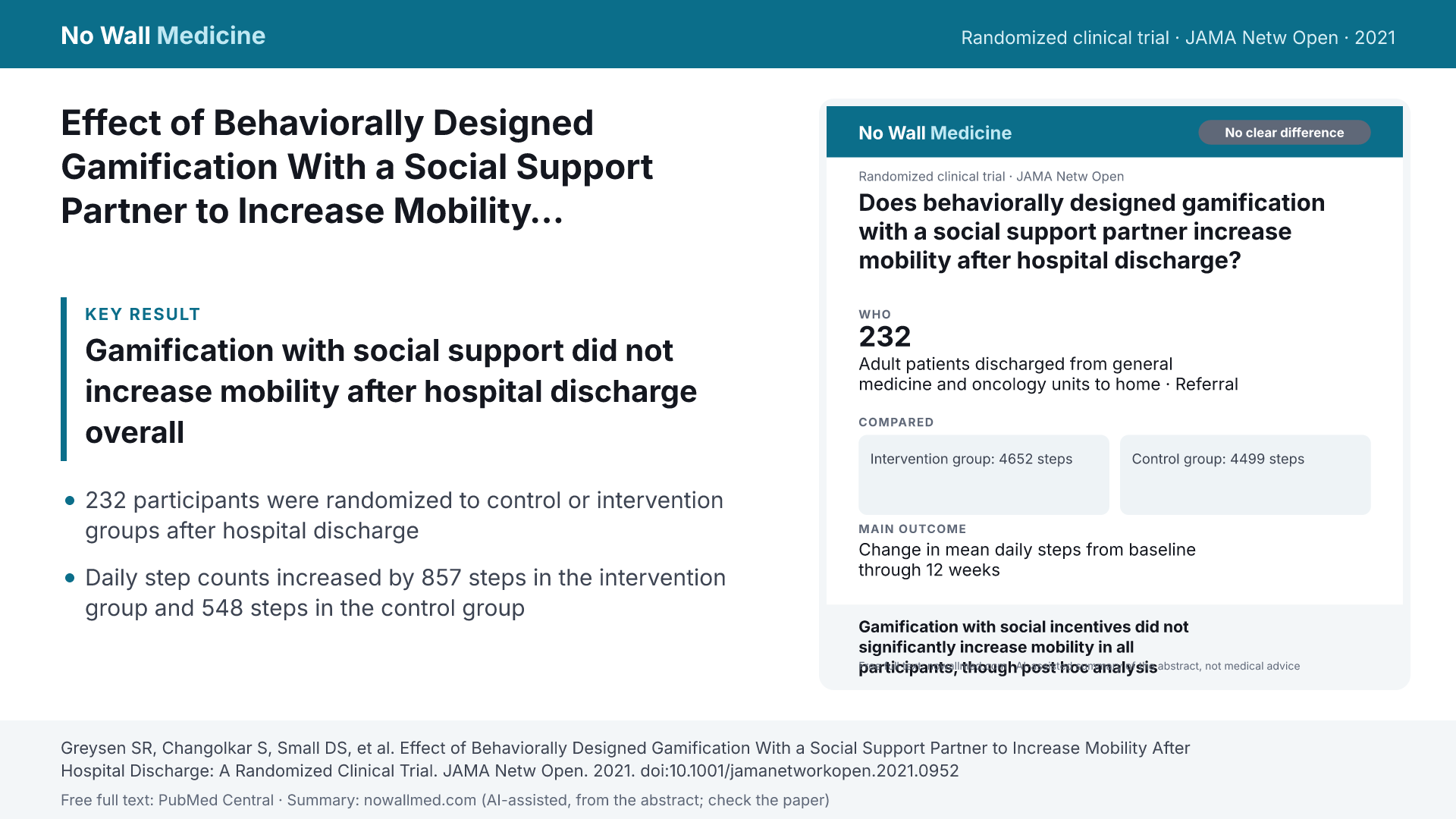
Key result: Gamification with social support did not increase mobility after hospital discharge overall
Randomized clinical trialNo clear difference
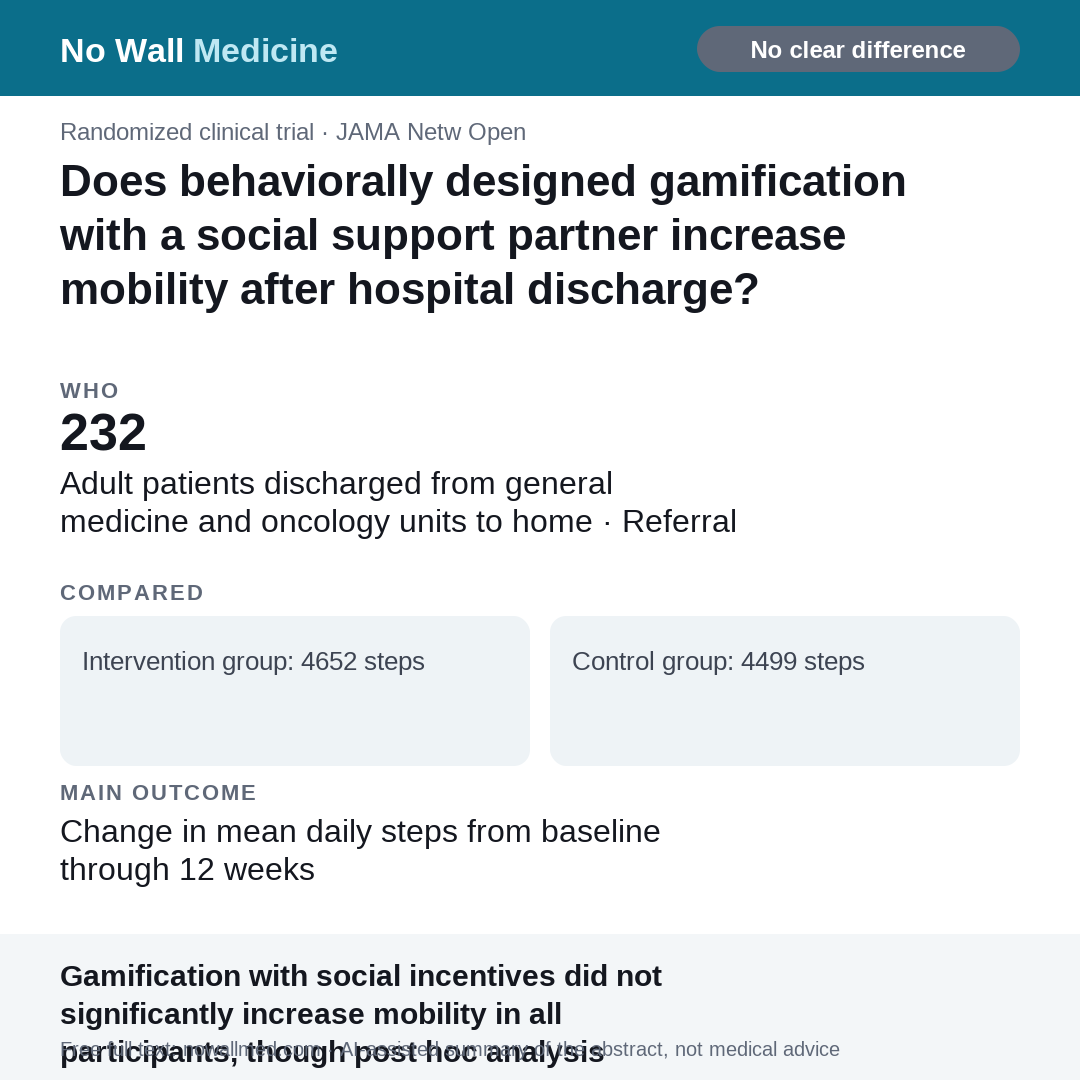
Does behaviorally designed gamification with a social support partner increase mobility after hospital discharge?
Who
232
Adult patients discharged from general medicine and oncology units to home · Referral hospital and remote at-home monitoring in three states
Compared
Intervention group: 4652 steps
Control group: 4499 steps
Main outcome
Change in mean daily steps from baseline through 12 weeks
Result: adjusted difference, 270 steps; 95% CI, -214 to 754 steps
Bottom line: Gamification with social incentives did not significantly increase mobility in all participants, though post hoc analysis suggested benefits for highly socially engaged patients.
JAMA Netw Open · 2021-03-01Download image
Key points
- 232 participants were randomized to control or intervention groups after hospital discharge.
- Daily step counts increased by 857 steps in the intervention group and 548 steps in the control group.
- Among participants with higher social engagement, the intervention was associated with a significant increase in mobility.
Discussion prompts
- Would these patients look like yours? Who was left out?
- Is the main outcome one that matters to patients?
- Is the difference large enough to change what you do?
Cite: Greysen SR, Changolkar S, Small DS, et al. Effect of Behaviorally Designed Gamification With a Social Support Partner to Increase Mobility After Hospital Discharge: A Randomized Clinical Trial. JAMA Netw Open. 2021. doi:10.1001/jamanetworkopen.2021.0952
Free full text: PubMed Central · Summary and visual abstract: nowallmed.com/a/effect-of-behaviorally-designed-gamification-with-a-social-support-1wsndbl/ (AI-assisted from the abstract; check the paper before relying on it).