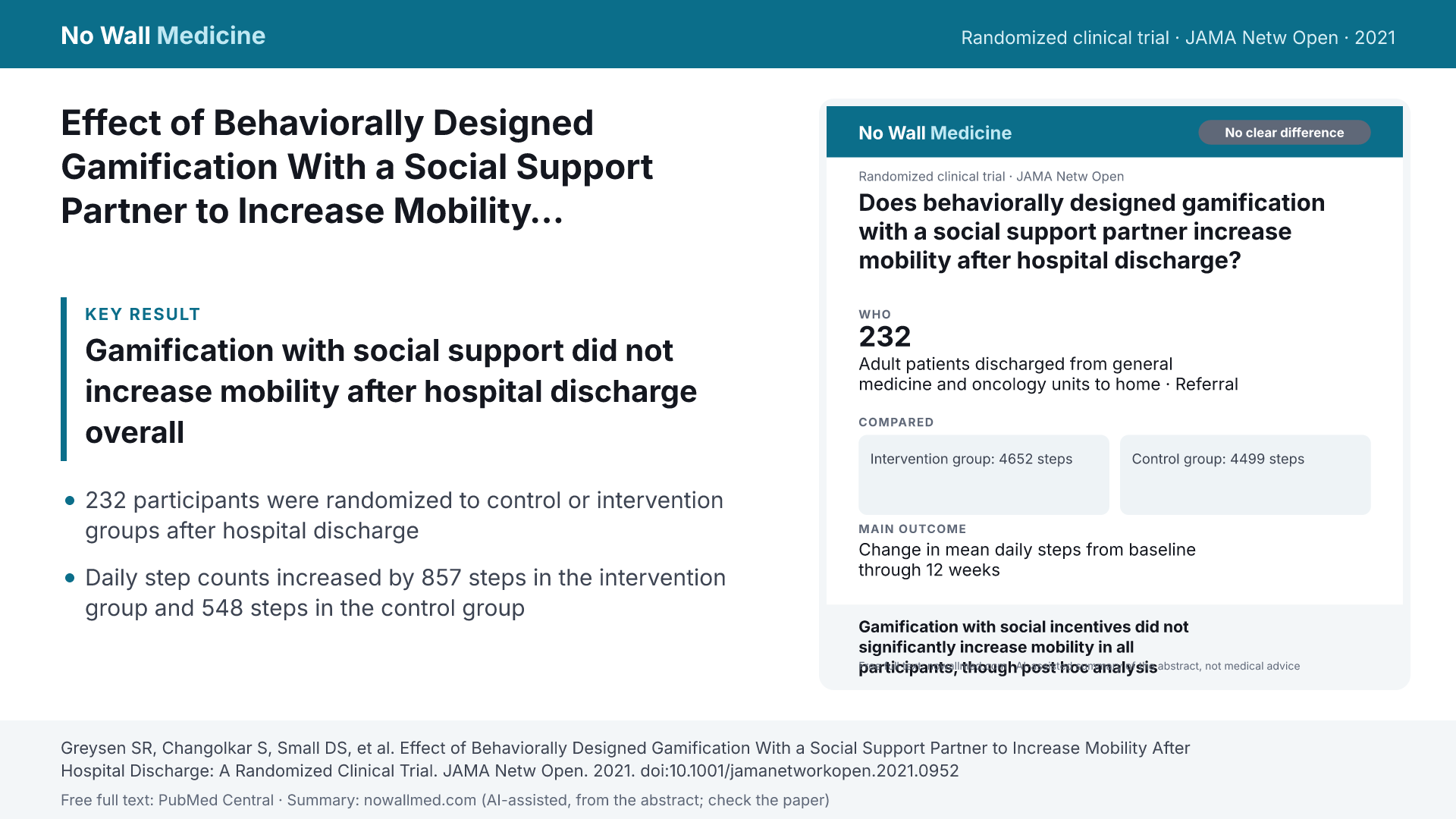
Gamification with social support did not increase mobility after hospital discharge overall
Effect of Behaviorally Designed Gamification With a Social Support Partner to Increase Mobility After Hospital Discharge: A Randomized Clinical Trial
Randomized clinical trialNo clear difference
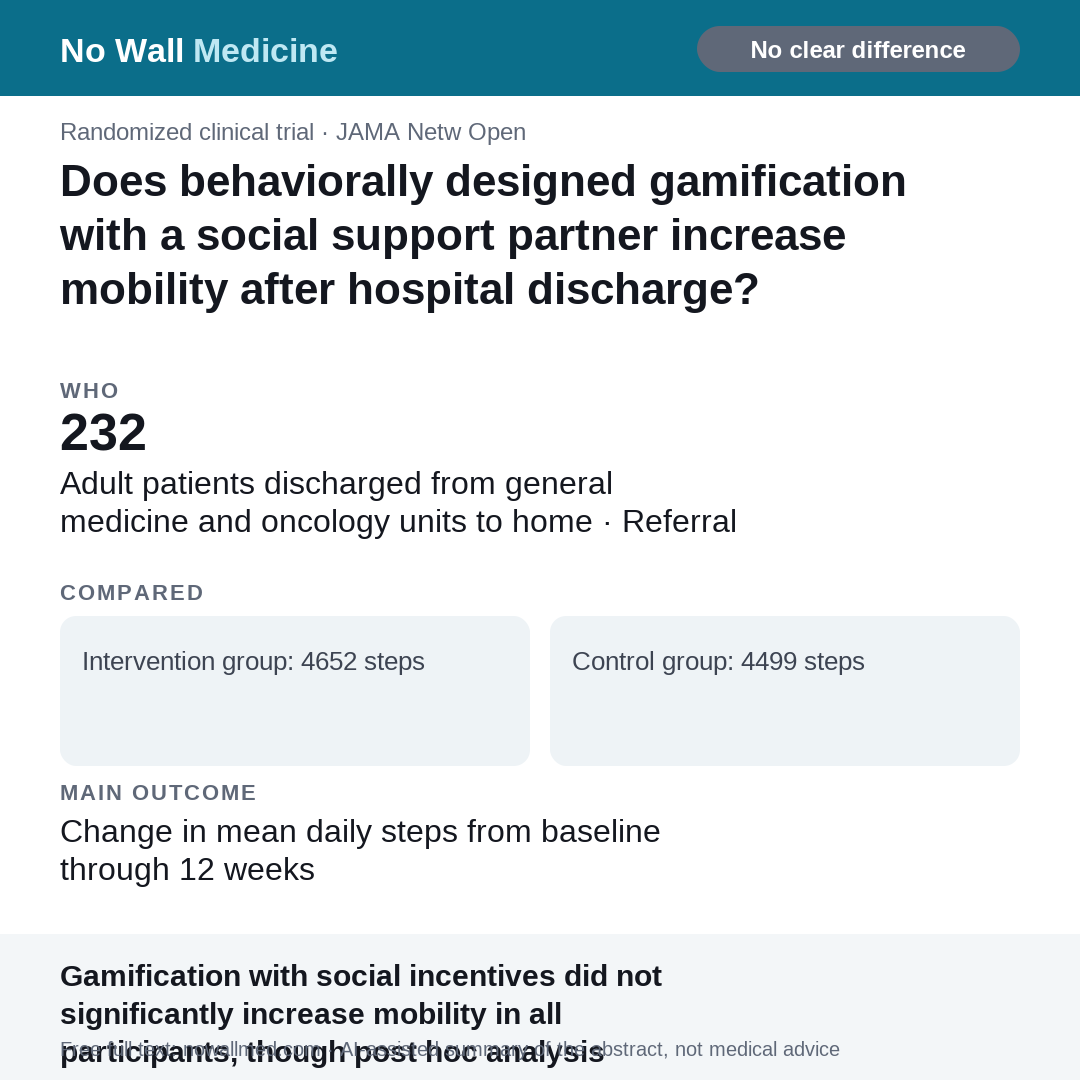
Does behaviorally designed gamification with a social support partner increase mobility after hospital discharge?
Who
232
Adult patients discharged from general medicine and oncology units to home · Referral hospital and remote at-home monitoring in three states
Compared
Intervention group: 4652 steps
Control group: 4499 steps
Main outcome
Change in mean daily steps from baseline through 12 weeks
Result: adjusted difference, 270 steps; 95% CI, -214 to 754 steps
Bottom line: Gamification with social incentives did not significantly increase mobility in all participants, though post hoc analysis suggested benefits for highly socially engaged patients.
JAMA Netw Open · 2021-03-01Download image
Clinical question: Does behaviorally designed gamification with a social support partner increase mobility after hospital discharge?
Key points
- 232 participants were randomized to control or intervention groups after hospital discharge.
- Daily step counts increased by 857 steps in the intervention group and 548 steps in the control group.
- Among participants with higher social engagement, the intervention was associated with a significant increase in mobility.
Headline and key points written with AI from the paper’s abstract, with every number checked against it. Read the paper before relying on them.
Was this summary helpful?
Subject terms
Cite this article
Greysen SR, Changolkar S, Small DS, et al. Effect of Behaviorally Designed Gamification With a Social Support Partner to Increase Mobility After Hospital Discharge: A Randomized Clinical Trial. JAMA Netw Open. 2021. doi:10.1001/jamanetworkopen.2021.0952
Spotted a mistake? Suggest a correction