Effect of Behaviorally Designed Gamification With Social Incentives on Lifestyle Modification Among Adults With Uncontrolled Diabetes: A Randomized Clinical Trial
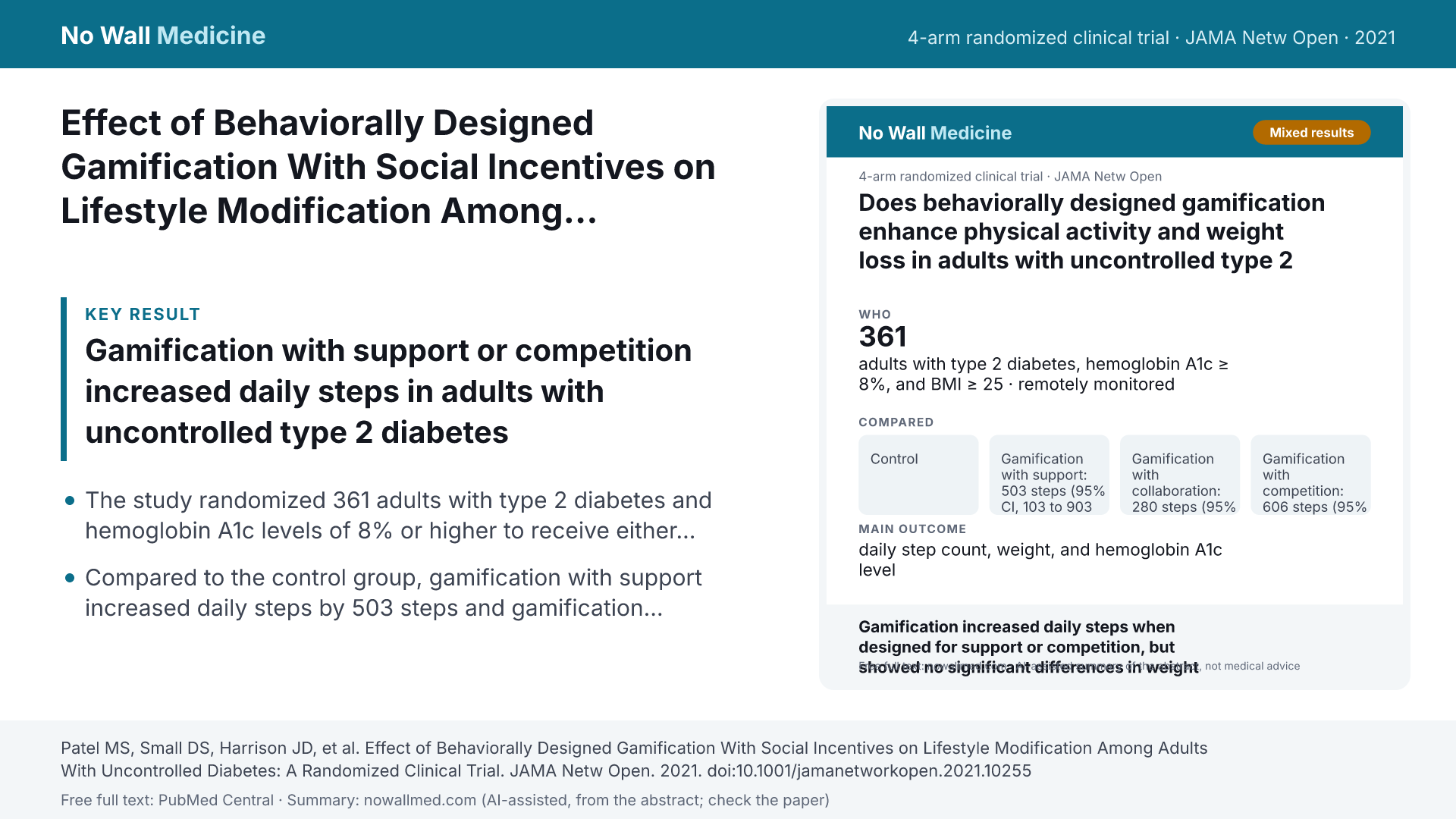
Key result: Gamification with support or competition increased daily steps in adults with uncontrolled type 2 diabetes
4-arm randomized clinical trialMixed results
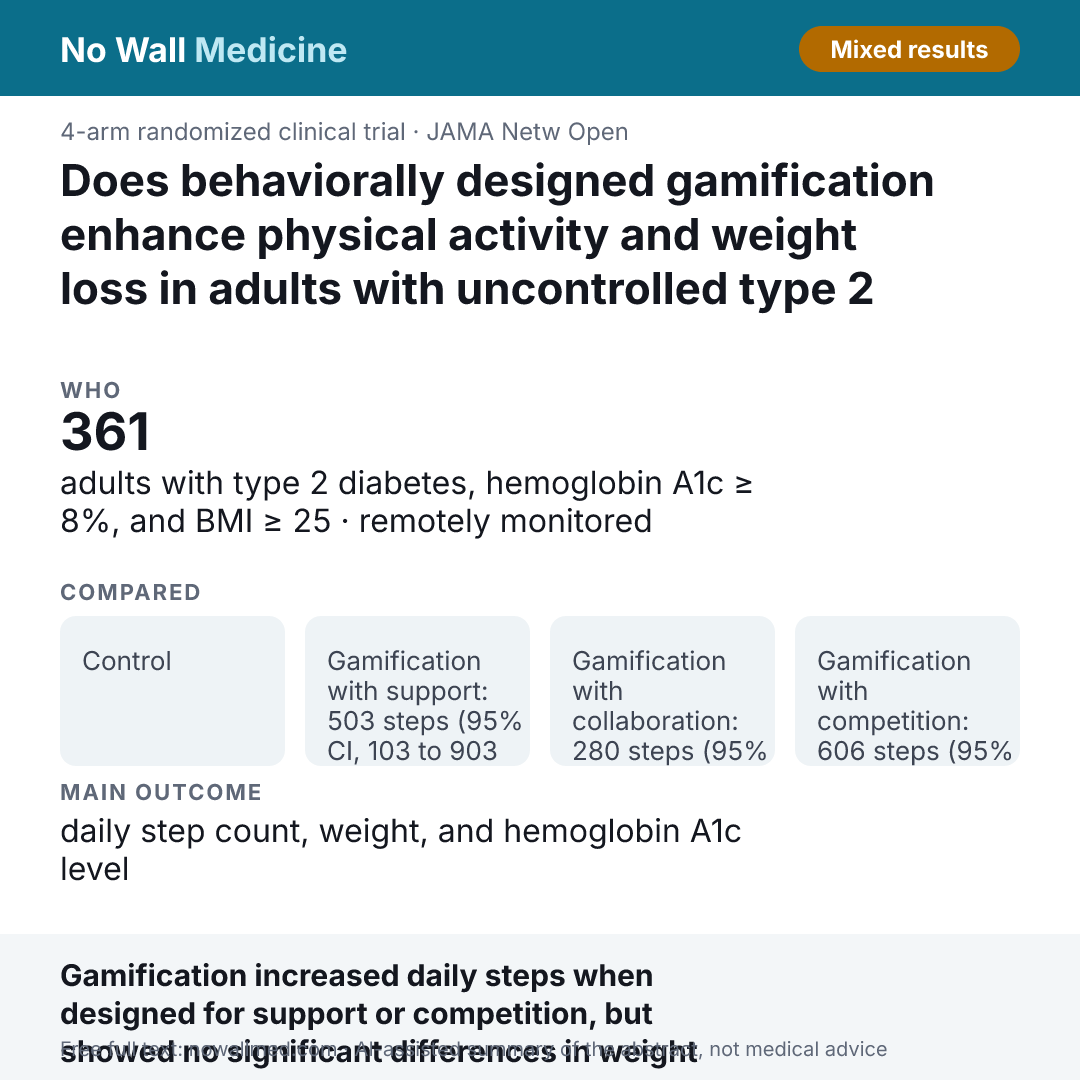
Does behaviorally designed gamification enhance physical activity and weight loss in adults with uncontrolled type 2 diabetes?
Who
361
adults with type 2 diabetes, hemoglobin A1c ≥ 8%, and BMI ≥ 25 · remotely monitored intervention
Compared
Control
Gamification with support: 503 steps (95% CI, 103 to 903 steps)
Gamification with collaboration: 280 steps (95% CI, -115 to 674 steps)
Gamification with competition: 606 steps (95% CI, 201 to 1011 steps)
Main outcome
daily step count, weight, and hemoglobin A1c level
Bottom line: Gamification increased daily steps when designed for support or competition, but showed no significant differences in weight or hemoglobin A1c.
JAMA Netw Open · 2021-05-03 · Save PNG
Key points
- The study randomized 361 adults with type 2 diabetes and hemoglobin A1c levels of 8% or higher to receive either device feedback alone or gamified interventions involving support, collaboration, or competition.
- Compared to the control group, gamification with support increased daily steps by 503 steps and gamification with competition increased daily steps by 606 steps over one year.
- While all groups showed reductions in weight and hemoglobin A1c levels from baseline, there were no significant differences between the gamification arms and the control group for those outcomes.
Discussion prompts
- Would these patients look like yours? Who was left out?
- Is the main outcome one that matters to patients?
- Is the difference large enough to change what you do?
Cite: Patel MS, Small DS, Harrison JD, et al. Effect of Behaviorally Designed Gamification With Social Incentives on Lifestyle Modification Among Adults With Uncontrolled Diabetes: A Randomized Clinical Trial. JAMA Netw Open. 2021. doi:10.1001/jamanetworkopen.2021.10255
Free full text: PubMed Central · Summary and visual abstract: nowallmed.com/a/effect-of-behaviorally-designed-gamification-with-social-incentives-sxe6i4/ (AI-assisted from the abstract; check the paper before relying on it).