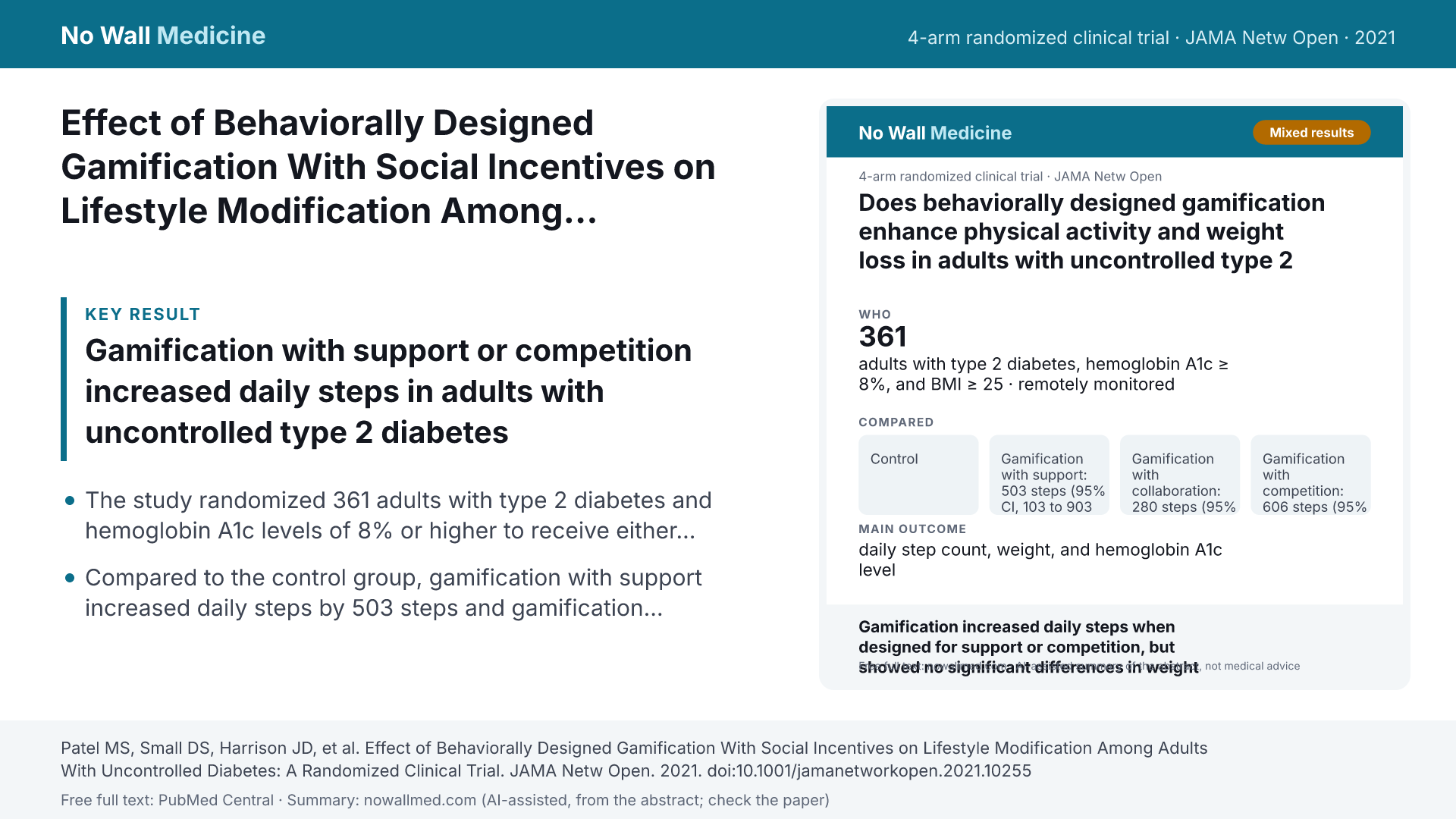
Gamification with support or competition increased daily steps in adults with uncontrolled type 2 diabetes
Effect of Behaviorally Designed Gamification With Social Incentives on Lifestyle Modification Among Adults With Uncontrolled Diabetes: A Randomized Clinical Trial
4-arm randomized clinical trialMixed results
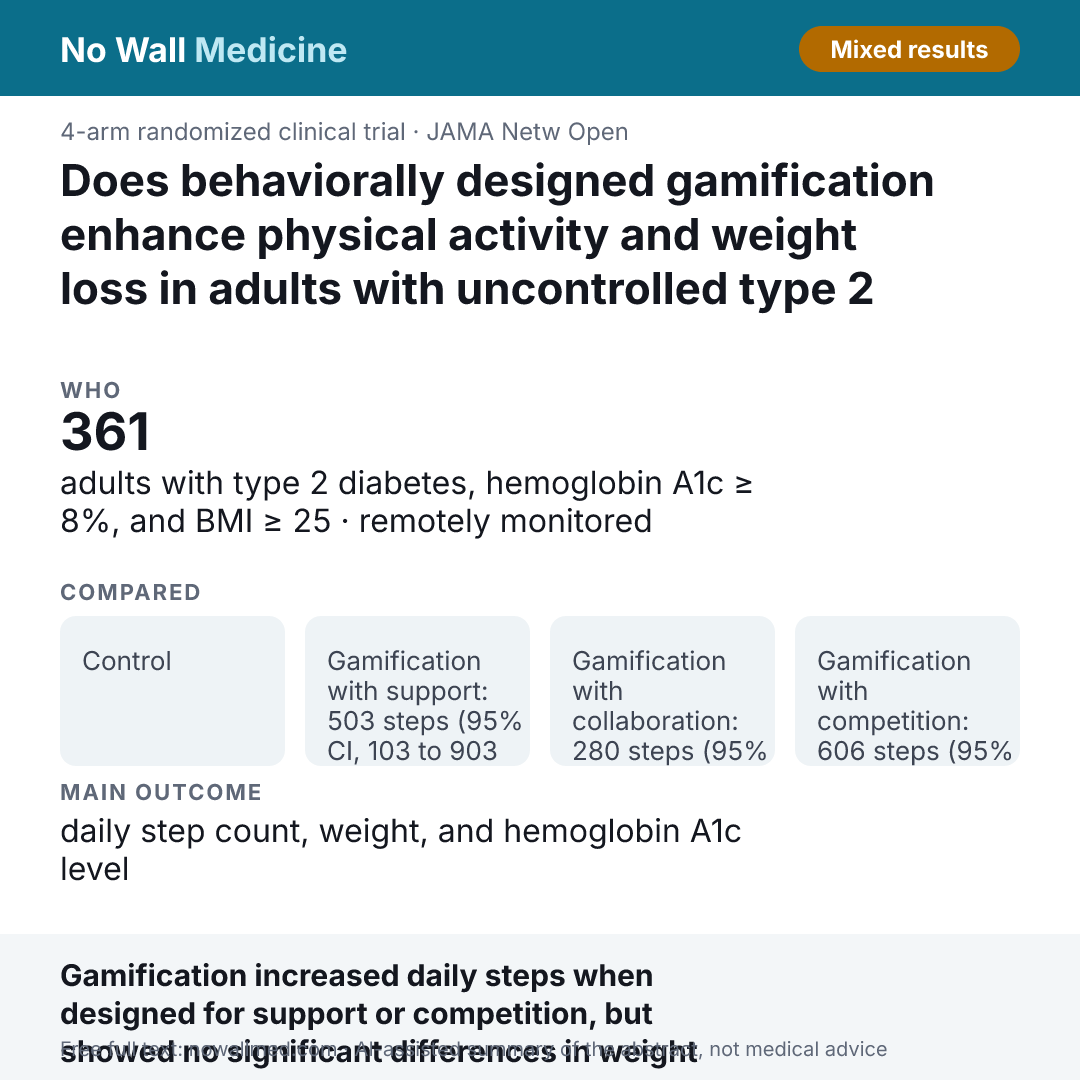
Does behaviorally designed gamification enhance physical activity and weight loss in adults with uncontrolled type 2 diabetes?
Who
361
adults with type 2 diabetes, hemoglobin A1c ≥ 8%, and BMI ≥ 25 · remotely monitored intervention
Compared
Control
Gamification with support: 503 steps (95% CI, 103 to 903 steps)
Gamification with collaboration: 280 steps (95% CI, -115 to 674 steps)
Gamification with competition: 606 steps (95% CI, 201 to 1011 steps)
Main outcome
daily step count, weight, and hemoglobin A1c level
Bottom line: Gamification increased daily steps when designed for support or competition, but showed no significant differences in weight or hemoglobin A1c.
JAMA Netw Open · 2021-05-03 · Save PNG
Clinical question: Does behaviorally designed gamification enhance physical activity and weight loss in adults with uncontrolled type 2 diabetes?
Key points
- The study randomized 361 adults with type 2 diabetes and hemoglobin A1c levels of 8% or higher to receive either device feedback alone or gamified interventions involving support, collaboration, or competition.
- Compared to the control group, gamification with support increased daily steps by 503 steps and gamification with competition increased daily steps by 606 steps over one year.
- While all groups showed reductions in weight and hemoglobin A1c levels from baseline, there were no significant differences between the gamification arms and the control group for those outcomes.
Headline and key points written with AI from the paper’s abstract, with every number checked against it. Read the paper before relying on them.
Was this summary helpful?
Subject terms
Headline, design, result, key points, caveat and citation as plain text.
Cite this article
Patel MS, Small DS, Harrison JD, et al. Effect of Behaviorally Designed Gamification With Social Incentives on Lifestyle Modification Among Adults With Uncontrolled Diabetes: A Randomized Clinical Trial. JAMA Netw Open. 2021. doi:10.1001/jamanetworkopen.2021.10255
Spotted a mistake? Suggest a correction