Effect of Brief Interpersonal Therapy on Depression During Pregnancy: A Randomized Clinical Trial
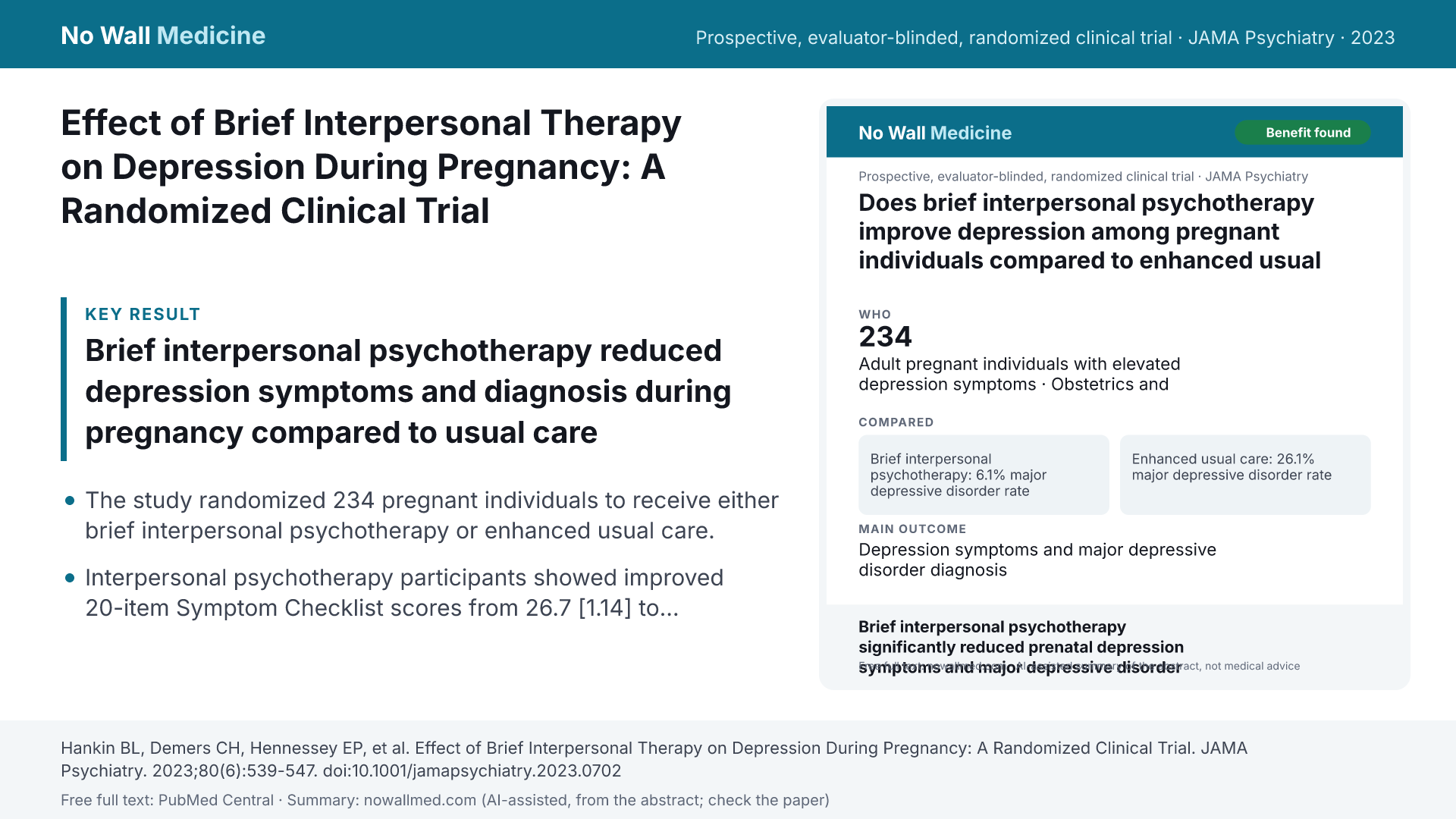
Key result: Brief interpersonal psychotherapy reduced depression symptoms and diagnosis during pregnancy compared to usual care
Key points
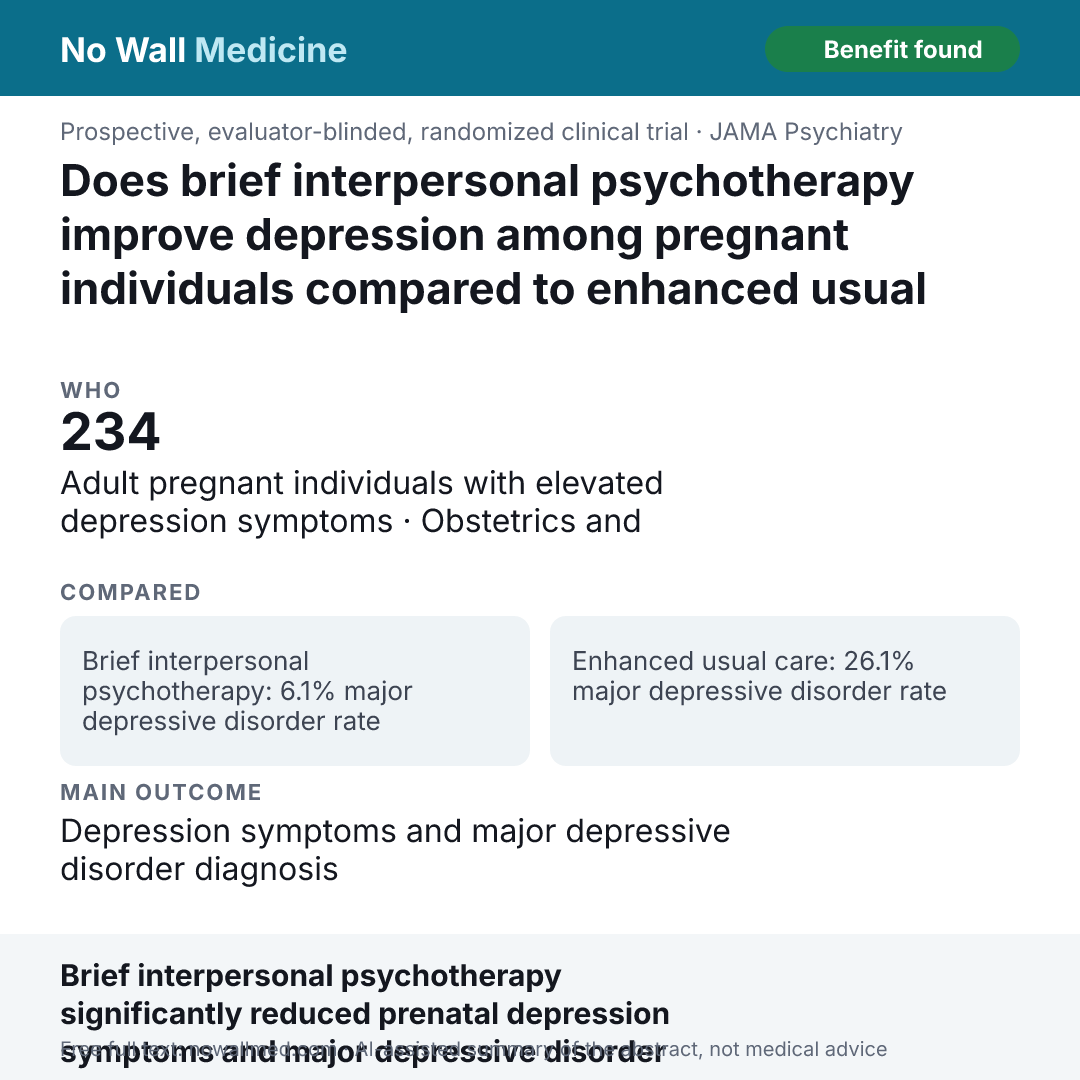
- The study randomized 234 pregnant individuals to receive either brief interpersonal psychotherapy or enhanced usual care.
- Interpersonal psychotherapy participants showed improved 20-item Symptom Checklist scores from 26.7 [1.14] to 13.6 [1.40] compared to 27.1 [1.12] to 23.5 [1.34] in the usual care group.
- The rate of major depressive disorder at the end of pregnancy was 6.1% for the psychotherapy group versus 26.1% for the usual care group.
In absolute numbers: Brief interpersonal psychotherapy 6.1% vs Enhanced usual care 26.1%, a difference of 20 percentage points (about 5 people treated for one more to benefit).
Why it matters: Brief, effective, and safe interventions to reduce depression during pregnancy are needed because prenatal depression has negative consequences for mothers and developing fetuses.
Discussion prompts
- Would these patients look like yours? Who was left out?
- Is the main outcome one that matters to patients?
- Is the difference large enough to change what you do?
Cite: Hankin BL, Demers CH, Hennessey EP, et al. Effect of Brief Interpersonal Therapy on Depression During Pregnancy: A Randomized Clinical Trial. JAMA Psychiatry. 2023;80(6):539-547. doi:10.1001/jamapsychiatry.2023.0702
Free full text: PubMed Central · Summary and visual abstract: nowallmed.com/a/effect-of-brief-interpersonal-therapy-on-depression-during-pregnancy-1hbm3ew/ (AI-assisted from the abstract; check the paper before relying on it).