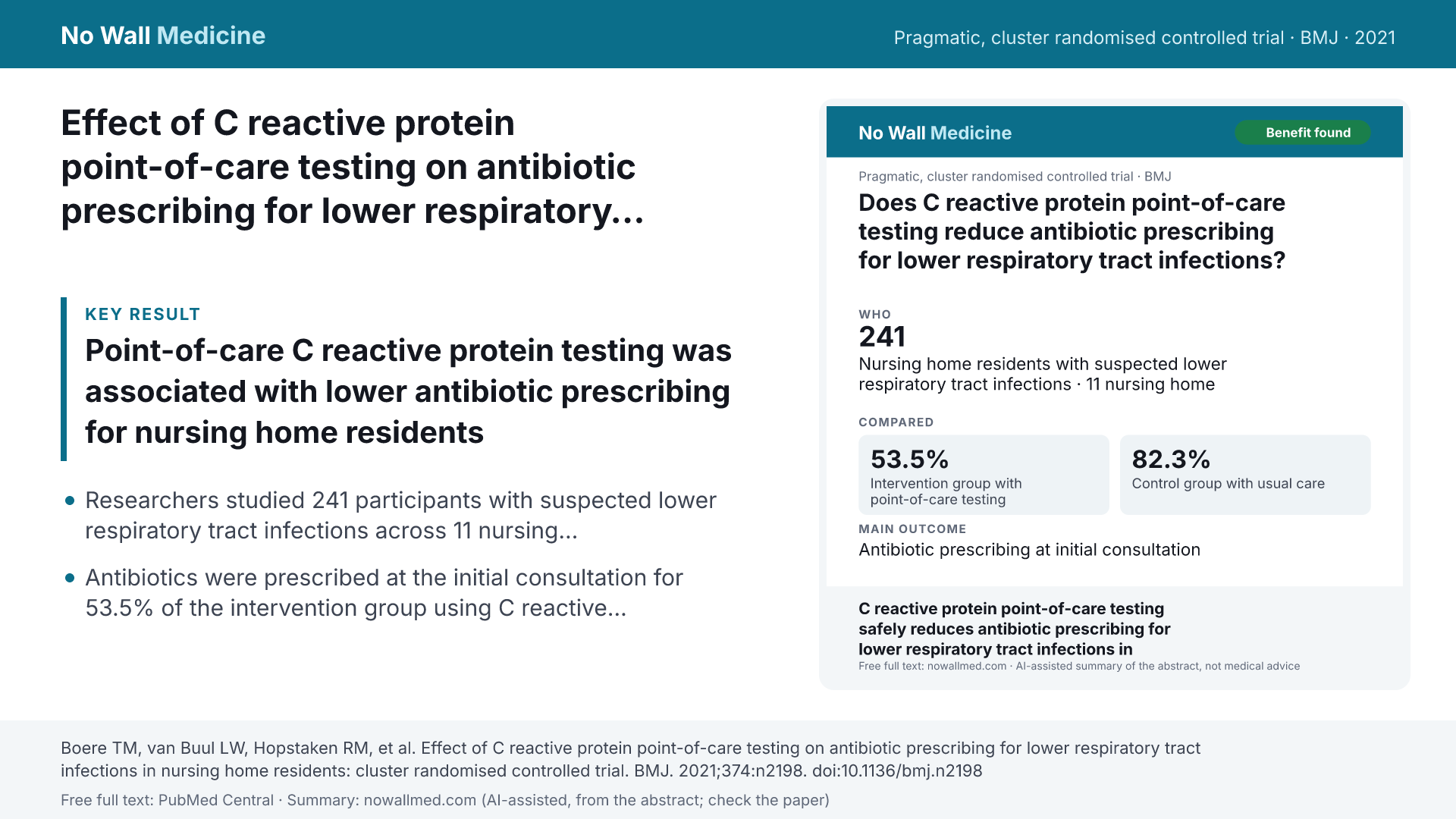
Point-of-care C reactive protein testing was associated with lower antibiotic prescribing for nursing home residents
Effect of C reactive protein point-of-care testing on antibiotic prescribing for lower respiratory tract infections in nursing home residents: cluster randomised controlled trial
Pragmatic, cluster randomised controlled trialBenefit found
Does C reactive protein point-of-care testing reduce antibiotic prescribing for lower respiratory tract infections?
Who
241
Nursing home residents with suspected lower respiratory tract infections · 11 nursing home organisations in the Netherlands
Compared
53.5%Intervention group with point-of-care testing
82.3%Control group with usual care
Main outcome
Antibiotic prescribing at initial consultation
Result: 4.93 higher odds (95% confidence interval 1.91 to 12.73)
Bottom line: C reactive protein point-of-care testing safely reduces antibiotic prescribing for lower respiratory tract infections in nursing home residents.
BMJ · 2021-09-21 · Save PNG
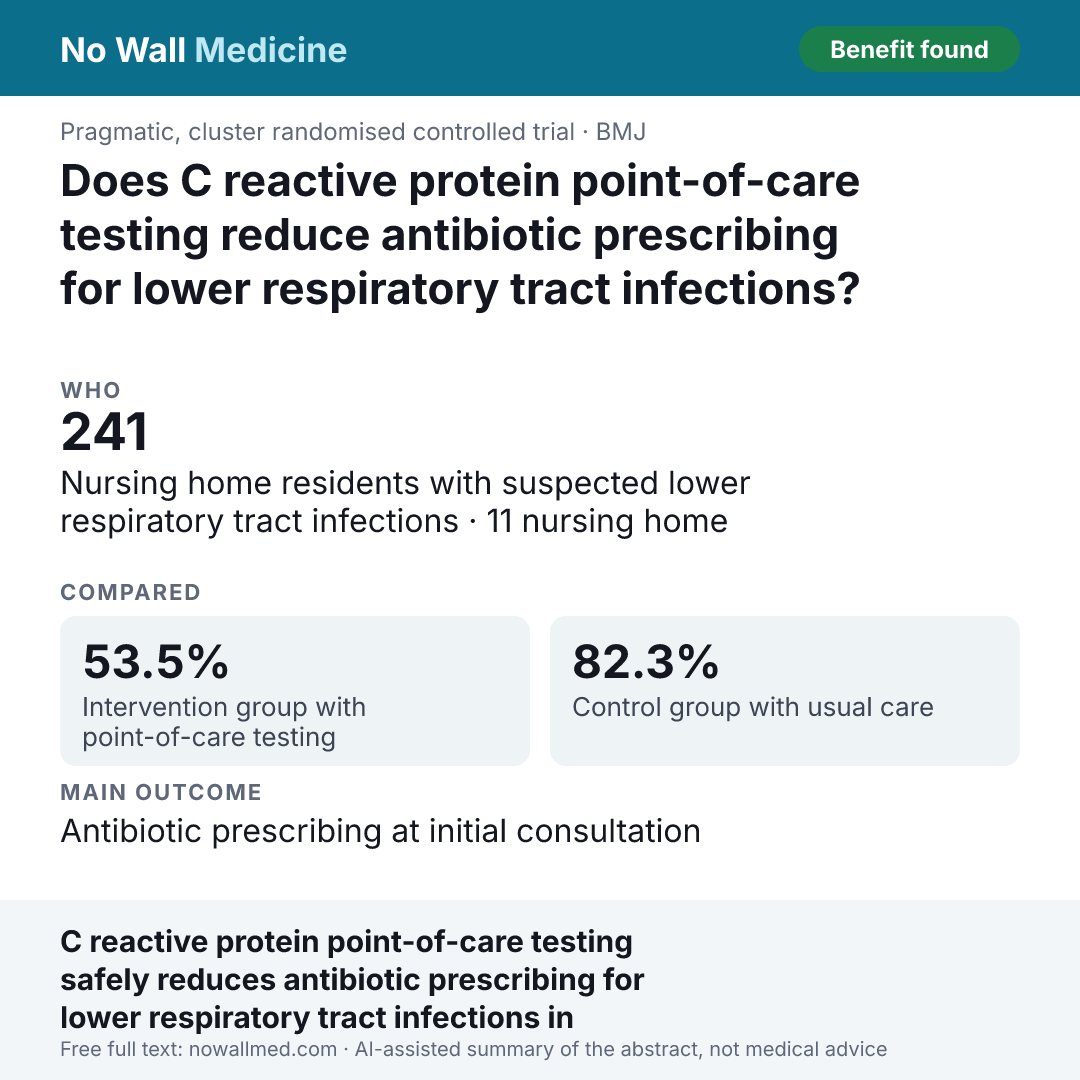
Clinical question: Does C reactive protein point-of-care testing reduce antibiotic prescribing for lower respiratory tract infections?
In absolute numbers
Intervention group with point-of-care testing: 53.5% · Control group with usual care: 82.3% → a difference of 28.8 percentage points, so about 4 people would need the treatment for 1 more to benefit (number needed to treat) over the trial’s follow-up.
Worked out by us from the two group results above, not reported by the authors. Check the paper for the exact outcome and timing.
Key points
- Researchers studied 241 participants with suspected lower respiratory tract infections across 11 nursing home organisations in the Netherlands.
- Antibiotics were prescribed at the initial consultation for 53.5% of the intervention group using C reactive protein point-of-care testing compared to 82.3% in the control group.
- There were no significant differences between groups regarding full recovery rates at three weeks, all-cause mortality, or hospital admission rates.
Headline and key points written with AI from the paper’s abstract, with every number checked against it. Read the paper before relying on them.
Was this summary helpful?
Abstract
Objective
To evaluate whether C reactive protein point-of-care testing (CRP POCT) safely reduces antibiotic prescribing for lower respiratory tract infections in nursing home residents. Design
Pragmatic, cluster randomised controlled trial. Setting
The UPCARE study included 11 nursing home organisations in the Netherlands. Participants
84 physicians from 11 nursing home organisations included 241 participants with suspected lower respiratory tract infections from September 2018 to the end of March 2020. Interventions
Nursing homes allocated to the intervention group had access to CRP POCT. The control group provided usual care without CRP POCT for patients with suspected lower respiratory tract infections. Main outcome measures
The primary outcome measure was antibiotic prescribing at initial consultation. Secondary outcome measures were full recovery at three weeks, changes in antibiotic management and additional diagnostics during follow-up at one week and three weeks, and hospital admission and all cause mortality at any point (initial consultation, one week, or three weeks). Results
Antibiotics were prescribed at initial consultation for 84 (53.5%) patients in the intervention group and 65 (82.3%) in the control group. Patients in the intervention group had 4.93 higher odds (95% confidence interval 1.91 to 12.73) of not being prescribed antibiotics at initial consultation compared with the control group, irrespective of treating physician and baseline characteristics. The between group difference in antibiotic prescribing at any point from initial consultation to follow-up was 23.6%. Differences in secondary outcomes between the intervention and control groups were 4.4% in full recovery rates at three weeks (86.4% v 90.8%), 2.2% in all cause mortality rates (3.5% v 1.3%), and 0.7% in hospital admission rates (7.2% v 6.5%). The odds of full recovery at three weeks, and the odds of mortality and hospital admission at any point did not significantly differ between groups. Conclusions
CRP POCT for suspected lower respiratory tract infection safely reduced antibiotic prescribing compared with usual care in nursing home residents. The findings suggest that implementing CRP POCT in nursing homes might contribute to reduced antibiotic use in this setting and help to combat antibiotic resistance. Trial registration
Netherlands Trial Register NL5054.
Abstract reproduced under the article’s CC BY licence.
Subject terms
Headline, design, result, key points, caveat and citation as plain text.
Cite this article
Boere TM, van Buul LW, Hopstaken RM, et al. Effect of C reactive protein point-of-care testing on antibiotic prescribing for lower respiratory tract infections in nursing home residents: cluster randomised controlled trial. BMJ. 2021;374:n2198. doi:10.1136/bmj.n2198
Spotted a mistake? Suggest a correction