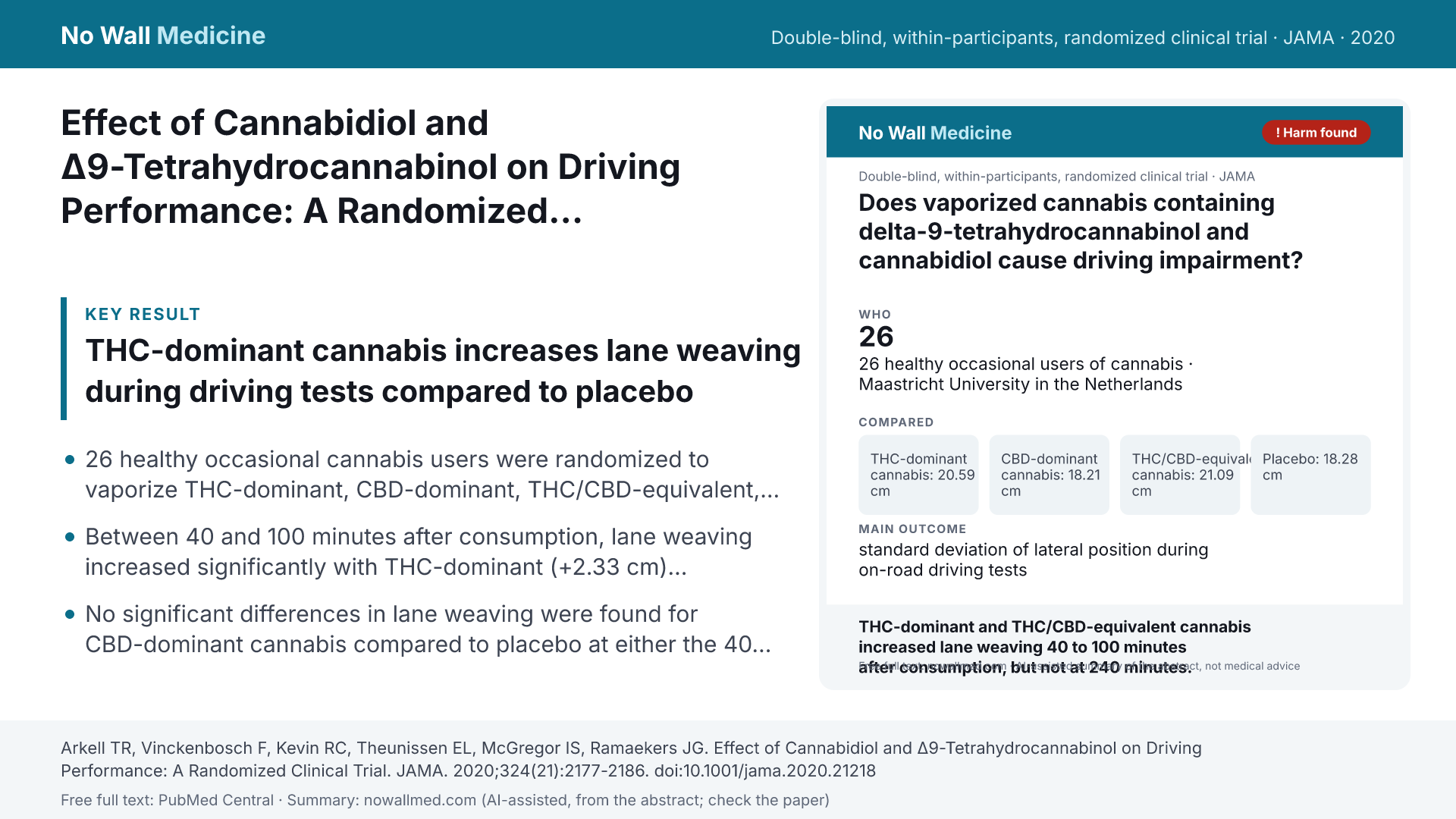
THC-dominant cannabis increases lane weaving during driving tests compared to placebo
Effect of Cannabidiol and Δ9-Tetrahydrocannabinol on Driving Performance: A Randomized Clinical Trial
Double-blind, within-participants, randomized clinical trialHarm found
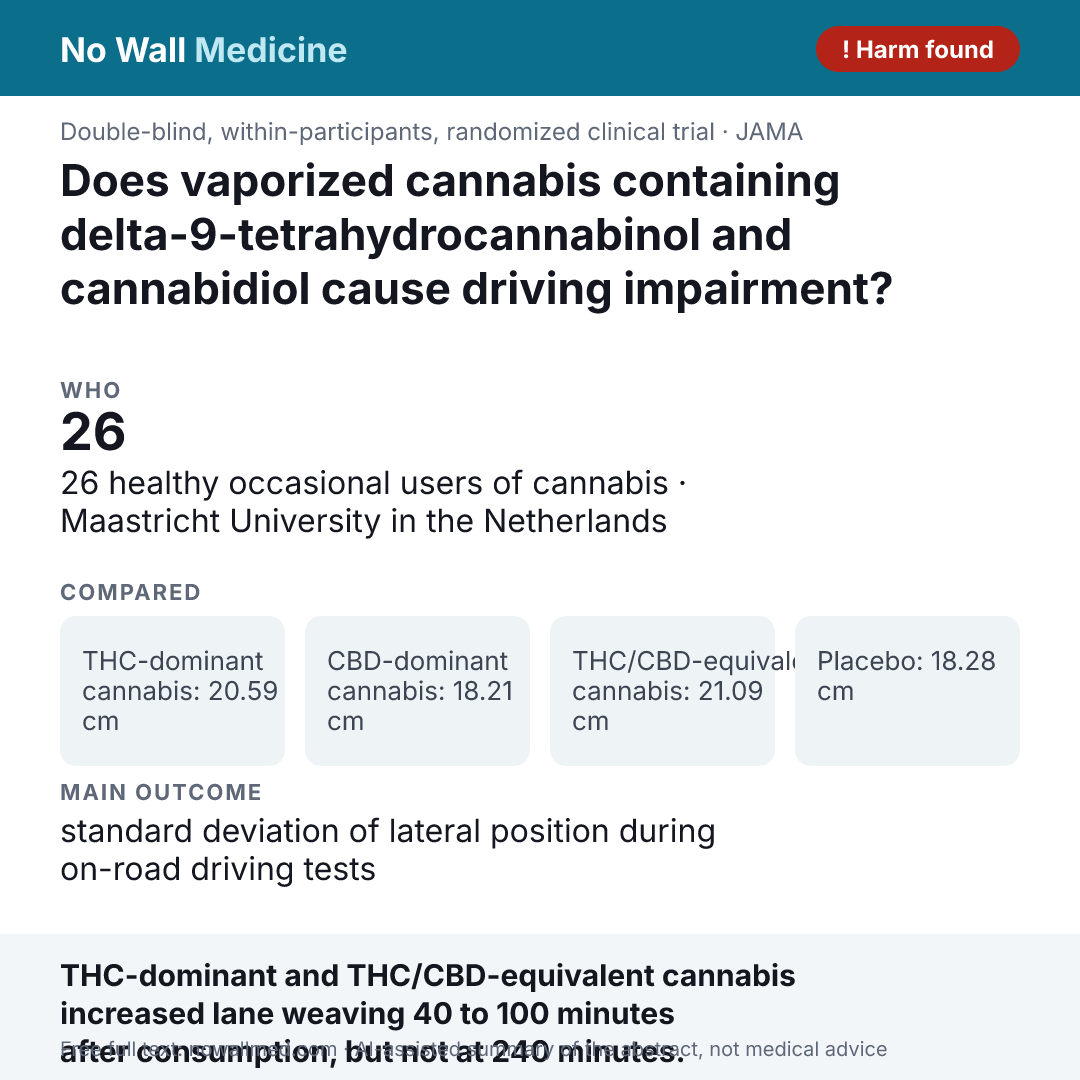
Does vaporized cannabis containing delta-9-tetrahydrocannabinol and cannabidiol cause driving impairment?
Who
26
26 healthy occasional users of cannabis · Maastricht University in the Netherlands
Compared
THC-dominant cannabis: 20.59 cm
CBD-dominant cannabis: 18.21 cm
THC/CBD-equivalent cannabis: 21.09 cm
Placebo: 18.28 cm
Main outcome
standard deviation of lateral position during on-road driving tests
Result: +2.33 cm [95% CI, 0.80 to 3.86] for THC-dominant
Bottom line: THC-dominant and THC/CBD-equivalent cannabis increased lane weaving 40 to 100 minutes after consumption, but not at 240 minutes.
Limitation: The effect size for CBD-dominant cannabis may not have excluded clinically important impairment.
JAMA · 2020-12-01 · Save PNG
Clinical question: Does vaporized cannabis containing delta-9-tetrahydrocannabinol and cannabidiol cause driving impairment?
Why it matters: The effect of cannabidiol on driving impairment remains unclear despite the known association between cannabis use and increased crash risk.
Key points
- 26 healthy occasional cannabis users were randomized to vaporize THC-dominant, CBD-dominant, THC/CBD-equivalent, or placebo cannabis.
- Between 40 and 100 minutes after consumption, lane weaving increased significantly with THC-dominant (+2.33 cm) and THC/CBD-equivalent (+2.83 cm) cannabis compared to placebo.
- No significant differences in lane weaving were found for CBD-dominant cannabis compared to placebo at either the 40 to 100 minute or 240 to 300 minute intervals.
Headline and key points written with AI from the paper’s abstract, with every number checked against it. Read the paper before relying on them.
Was this summary helpful?
Subject terms
Headline, design, result, key points, caveat and citation as plain text.
Cite this article
Arkell TR, Vinckenbosch F, Kevin RC, Theunissen EL, McGregor IS, Ramaekers JG. Effect of Cannabidiol and Δ9-Tetrahydrocannabinol on Driving Performance: A Randomized Clinical Trial. JAMA. 2020;324(21):2177-2186. doi:10.1001/jama.2020.21218
Spotted a mistake? Suggest a correction