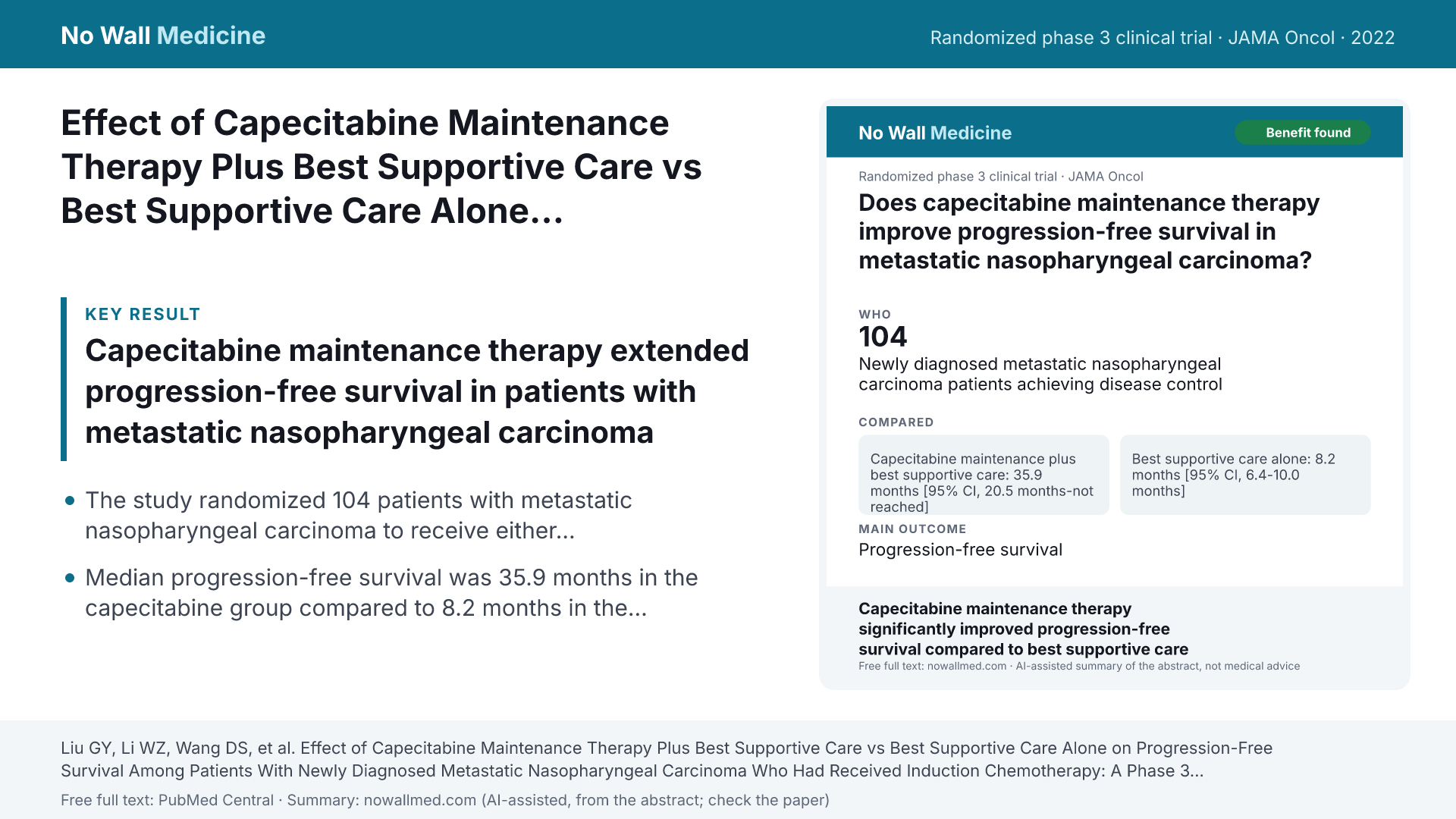
Capecitabine maintenance therapy extended progression-free survival in patients with metastatic nasopharyngeal carcinoma
Effect of Capecitabine Maintenance Therapy Plus Best Supportive Care vs Best Supportive Care Alone on Progression-Free Survival Among Patients With Newly Diagnosed Metastatic Nasopharyngeal Carcinoma Who Had Received Induction Chemotherapy: A Phase 3 Randomized Clinical Trial
Randomized phase 3 clinical trialBenefit found
Does capecitabine maintenance therapy improve progression-free survival in metastatic nasopharyngeal carcinoma?
Who
104
Newly diagnosed metastatic nasopharyngeal carcinoma patients achieving disease control after induction chemotherapy · Sun Yat-sen University Cancer Center
Compared
Capecitabine maintenance plus best supportive care: 35.9 months [95% CI, 20.5 months-not reached]
Best supportive care alone: 8.2 months [95% CI, 6.4-10.0 months]
Main outcome
Progression-free survival
Result: hazard ratio 0.44 (95% CI 0.26-0.74)
Bottom line: Capecitabine maintenance therapy significantly improved progression-free survival compared to best supportive care alone in metastatic nasopharyngeal carcinoma.
JAMA Oncol · 2022-02-18Download image
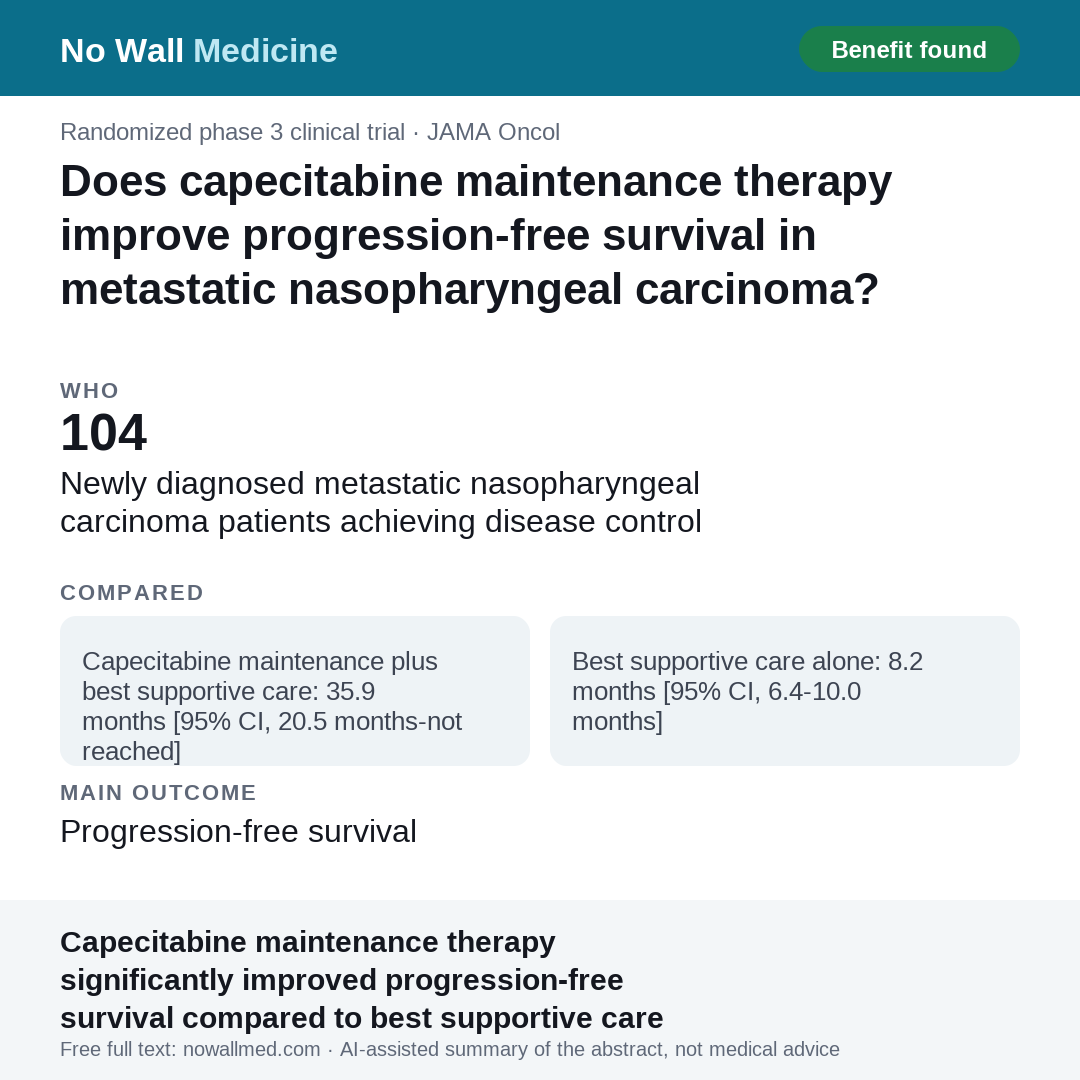
Clinical question: Does capecitabine maintenance therapy improve progression-free survival in metastatic nasopharyngeal carcinoma?
Why it matters: It was unknown if adding capecitabine maintenance therapy after induction chemotherapy improves outcomes for patients with metastatic nasopharyngeal carcinoma.
Key points
- The study randomized 104 patients with metastatic nasopharyngeal carcinoma to receive either capecitabine maintenance therapy plus best supportive care or best supportive care alone.
- Median progression-free survival was 35.9 months in the capecitabine group compared to 8.2 months in the best supportive care group.
- Common grade 3 or 4 adverse events in the maintenance group included anemia at 12.0%, hand-foot syndrome at 10.0%, and nausea or vomiting at 6.0%.
Headline and key points written with AI from the paper’s abstract, with every number checked against it. Read the paper before relying on them.
Was this summary helpful?
Subject terms
Cite this article
Liu GY, Li WZ, Wang DS, et al. Effect of Capecitabine Maintenance Therapy Plus Best Supportive Care vs Best Supportive Care Alone on Progression-Free Survival Among Patients With Newly Diagnosed Metastatic Nasopharyngeal Carcinoma Who Had Received Induction Chemotherapy: A Phase 3 Randomized Clinical Trial. JAMA Oncol. 2022. doi:10.1001/jamaoncol.2021.7366
Spotted a mistake? Suggest a correction