Effect of carbohydrate-restricted dietary interventions on LDL particle size and number in adults in the context of weight loss or weight maintenance: a systematic review and meta-analysis
Systematic review and meta-analysis of 38 randomized trialsBenefit found
Do carbohydrate-restricted diets affect LDL particle size and number in adults?
Who
1785
Adults in the context of weight loss or weight maintenance
Compared
Carbohydrate restriction
Higher carbohydrate intake
Main outcome
LDL peak particle size and LDL particle number
Result: SMD 0.50 (95% CI: 0.15, 0.86) for peak size; SMD -0.24 (95% CI: -0.43, -0.06) for particle number
Bottom line: Carbohydrate-restricted diets increase LDL peak particle size and decrease total and small LDL particle numbers.
Limitation: The effect on LDL peak particle size appeared partially explained by differences in weight loss.
Am J Clin Nutr · 2021-06-24Download image
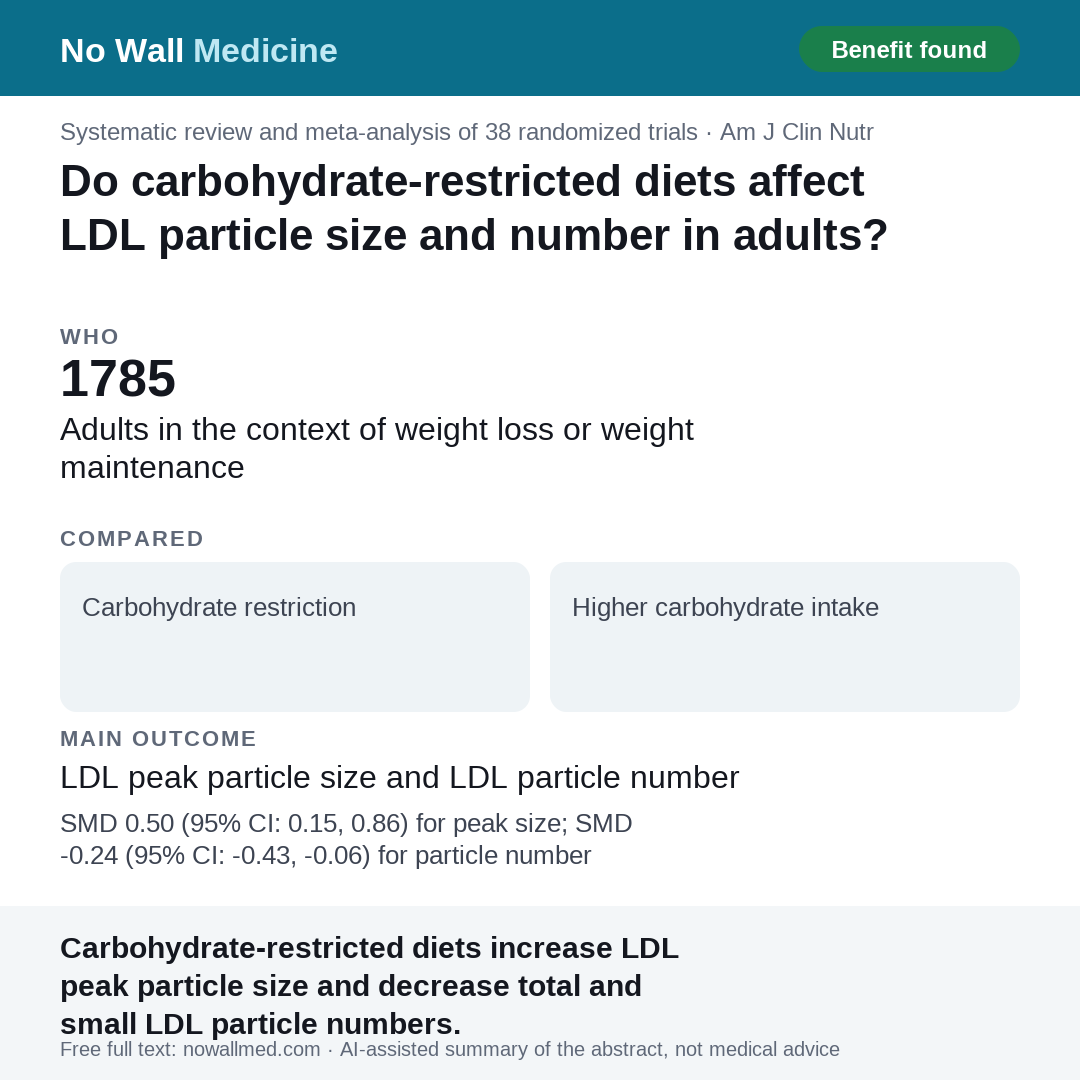
Clinical question: Do carbohydrate-restricted diets affect LDL particle size and number in adults?
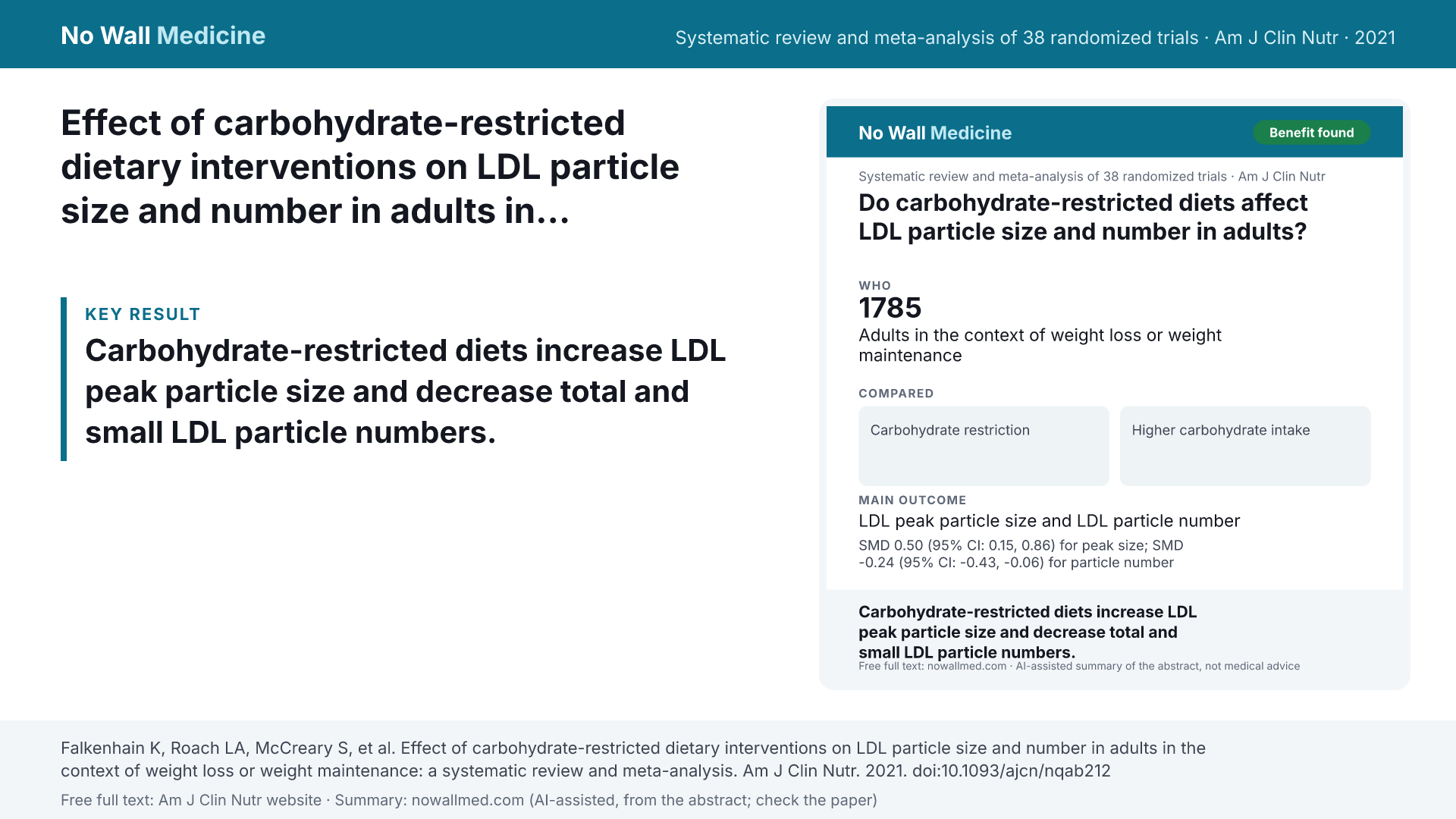
Abstract
Background
LDL particle size and number (LDL-P) are emerging lipid risk factors. Nonsystematic reviews have suggested that diets lower in carbohydrates and higher in fats may result in increased LDL particle size when compared with higher-carbohydrate diets. Objectives
This study aimed to systematically review available evidence and conduct meta-analyses of studies addressing the association of carbohydrate restriction with LDL particle size and LDL-P. Methods
We searched 6 electronic databases on 4 January, 2021 for randomized trials of any length that reported on dietary carbohydrate restriction (intervention) compared with higher carbohydrate intake (control). We calculated standardized mean differences (SMDs) in LDL particle size and LDL-P between the intervention and control groups of eligible studies, and pooled effect sizes using random-effects models. We performed prespecified subgroup analyses and examined the effect of potential explanatory factors. Internal validity and publication bias were assessed using Cochrane's risk-of-bias tool and funnel plots, respectively. Studies that could not be meta-analyzed were summarized qualitatively. Results
This review summarizes findings from 38 randomized trials including a total of 1785 participants. Carbohydrate-restricted dietary interventions were associated with an increase in LDL peak particle size (SMD = 0.50; 95% CI: 0.15, 0.86; P < 0.01) and a reduction in LDL-P (SMD = -0.24; 95% CI: -0.43, -0.06; P = 0.02). The effect of carbohydrate-restricted dietary interventions on LDL peak particle size appeared to be partially explained by differences in weight loss between intervention groups and exploratory analysis revealed a shift from small dense to larger LDL subclasses. No statistically significant association was found between carbohydrate-restricted dietary interventions and mean LDL particle size (SMD = 0.20; 95% CI: -0.29, 0.69; P = 0.37). Conclusions
The available evidence indicates that dietary interventions restricted in carbohydrates increase LDL peak particle size and decrease the numbers of total and small LDL particles.This review was registered at www.crd.york.ac.uk/prospero/ as CRD42020188745.
Subject terms
Cite this article
Falkenhain K, Roach LA, McCreary S, et al. Effect of carbohydrate-restricted dietary interventions on LDL particle size and number in adults in the context of weight loss or weight maintenance: a systematic review and meta-analysis. Am J Clin Nutr. 2021. doi:10.1093/ajcn/nqab212
Spotted a mistake? Suggest a correction