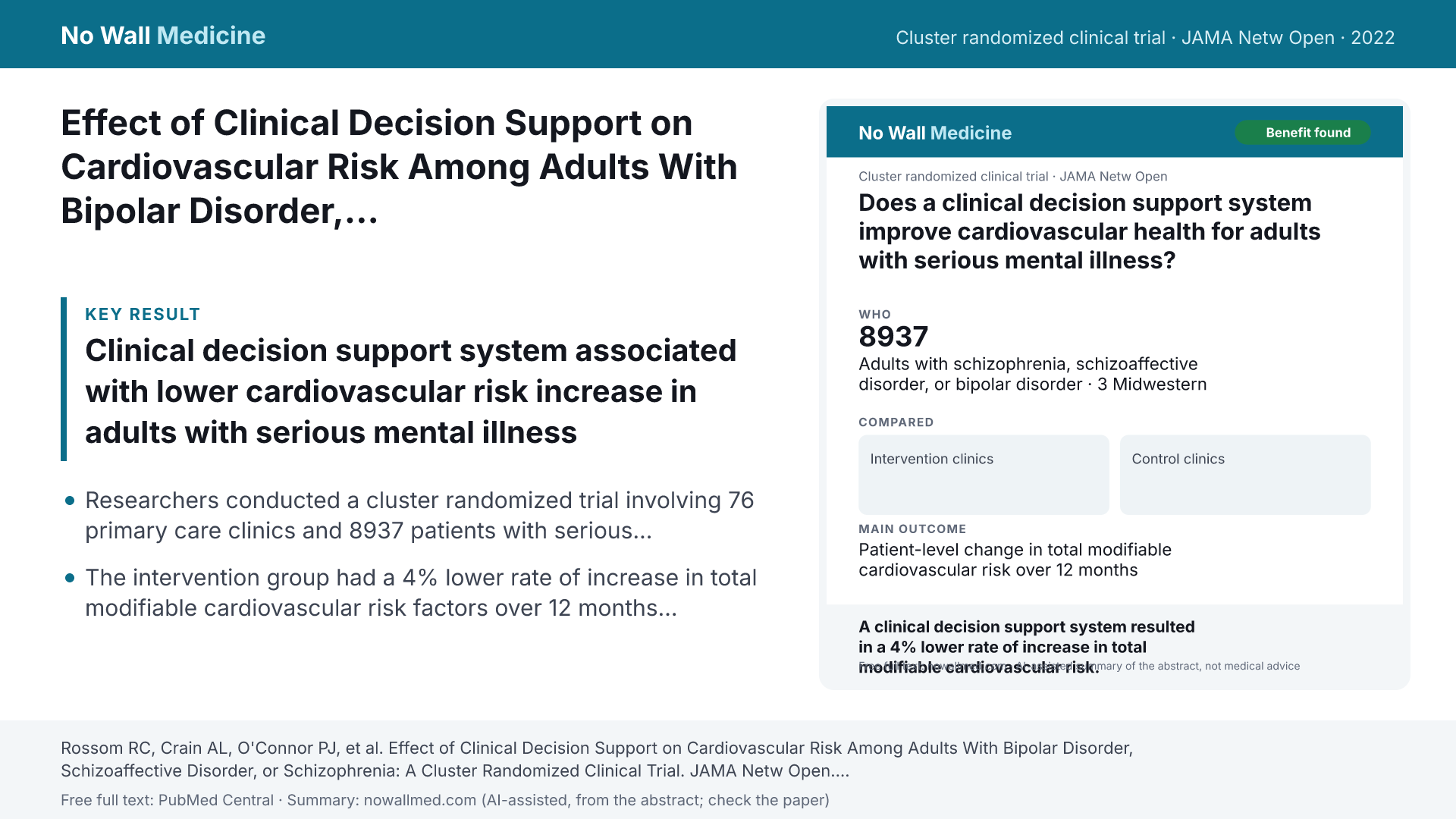
Clinical decision support system associated with lower cardiovascular risk increase in adults with serious mental illness
Effect of Clinical Decision Support on Cardiovascular Risk Among Adults With Bipolar Disorder, Schizoaffective Disorder, or Schizophrenia: A Cluster Randomized Clinical Trial
Cluster randomized clinical trialBenefit found
Does a clinical decision support system improve cardiovascular health for adults with serious mental illness?
Who
8937
Adults with schizophrenia, schizoaffective disorder, or bipolar disorder · 3 Midwestern health care systems
Compared
Intervention clinics
Control clinics
Main outcome
Patient-level change in total modifiable cardiovascular risk over 12 months
Result: relative rate ratio 0.96 (95% CI, 0.94-0.98)
Bottom line: A clinical decision support system resulted in a 4% lower rate of increase in total modifiable cardiovascular risk.
JAMA Netw Open · 2022-03-01 · Save PNG
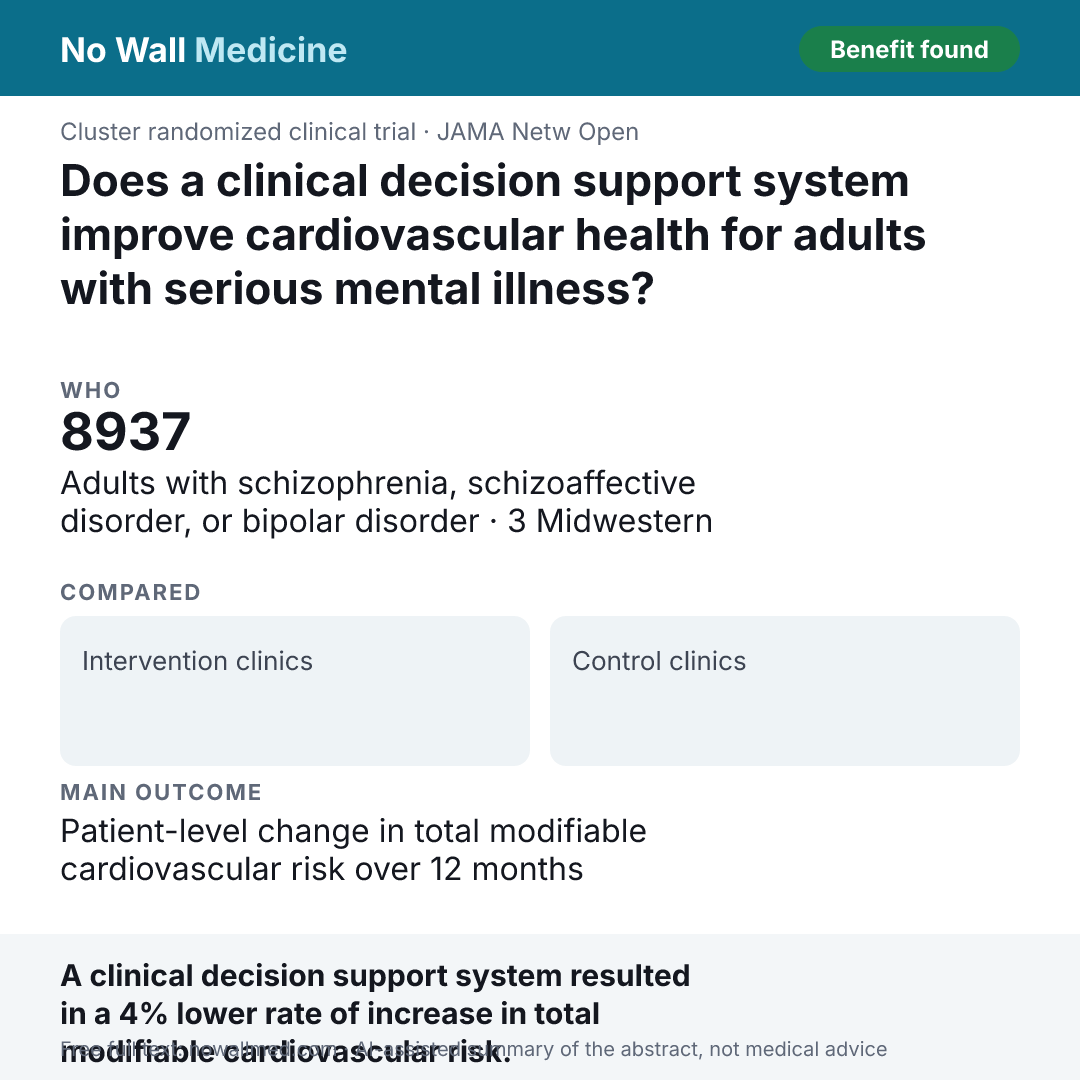
Clinical question: Does a clinical decision support system improve cardiovascular health for adults with serious mental illness?
Why it matters: Adults with serious mental illness have shorter lifespans, and it is unknown if a clinical decision support system can improve their cardiovascular health in primary care settings.
Key points
- Researchers conducted a cluster randomized trial involving 76 primary care clinics and 8937 patients with serious mental illness, including schizophrenia, schizoaffective disorder, or bipolar disorder.
- The intervention group had a 4% lower rate of increase in total modifiable cardiovascular risk factors over 12 months compared to the control group (RR, 0.96; 95% CI, 0.94-0.98).
- While the total risk score changed, there were no significant differences in individual risk factors such as smoking, body mass index, cholesterol, blood pressure, or hemoglobin A1c.
Headline and key points written with AI from the paper’s abstract, with every number checked against it. Read the paper before relying on them.
Was this summary helpful?
Subject terms
Headline, design, result, key points, caveat and citation as plain text.
Cite this article
Rossom RC, Crain AL, O'Connor PJ, et al. Effect of Clinical Decision Support on Cardiovascular Risk Among Adults With Bipolar Disorder, Schizoaffective Disorder, or Schizophrenia: A Cluster Randomized Clinical Trial. JAMA Netw Open. 2022;5(3):e220202. doi:10.1001/jamanetworkopen.2022.0202
Spotted a mistake? Suggest a correction