Effect of Clinical Decision Support on Cardiovascular Risk Among Adults With Bipolar Disorder, Schizoaffective Disorder, or Schizophrenia: A Cluster Randomized Clinical Trial
Key result: Clinical decision support system associated with lower cardiovascular risk increase in adults with serious mental illness
Key points
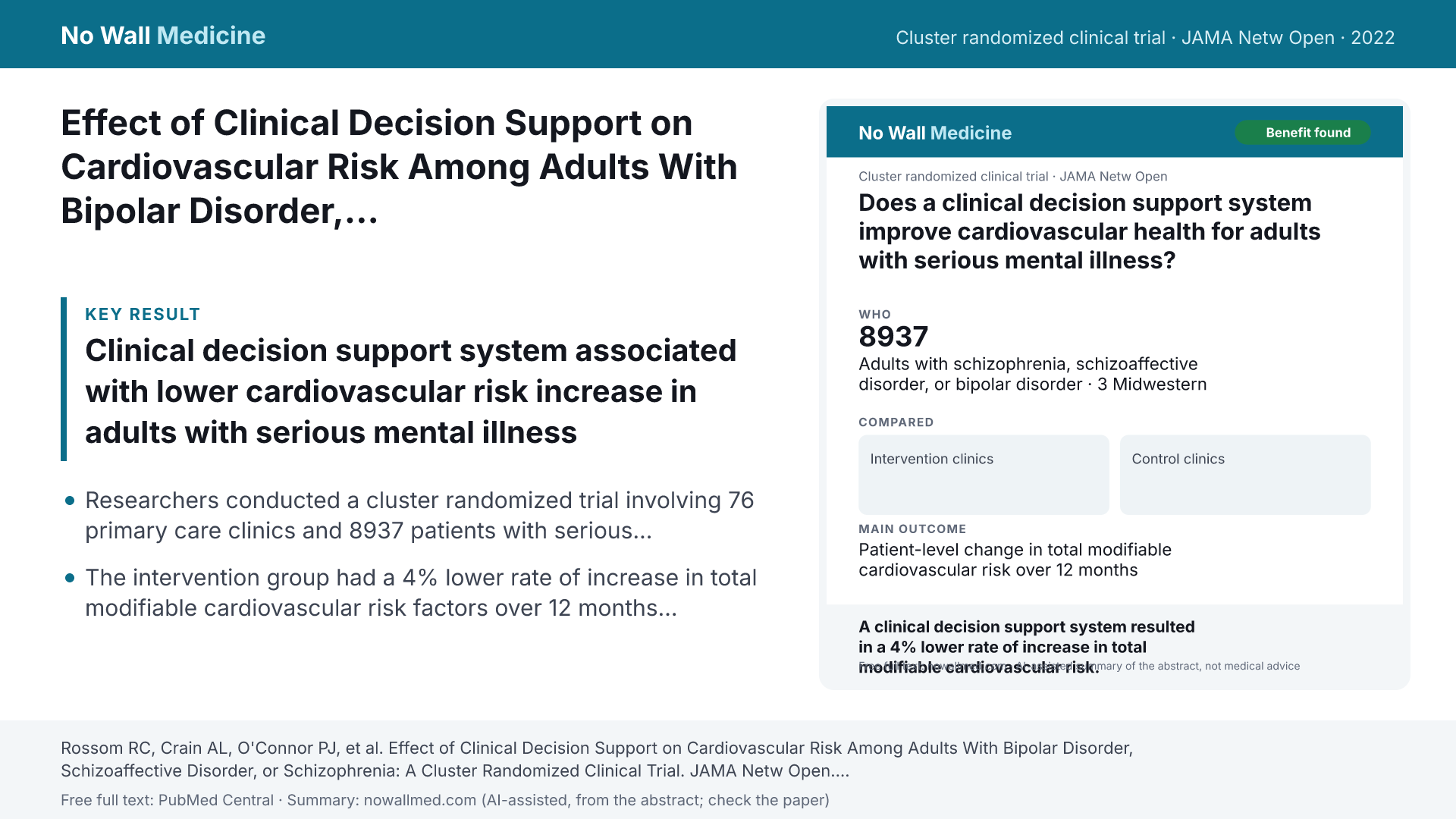
- Researchers conducted a cluster randomized trial involving 76 primary care clinics and 8937 patients with serious mental illness, including schizophrenia, schizoaffective disorder, or bipolar disorder.
- The intervention group had a 4% lower rate of increase in total modifiable cardiovascular risk factors over 12 months compared to the control group (RR, 0.96; 95% CI, 0.94-0.98).
- While the total risk score changed, there were no significant differences in individual risk factors such as smoking, body mass index, cholesterol, blood pressure, or hemoglobin A1c.
Why it matters: Adults with serious mental illness have shorter lifespans, and it is unknown if a clinical decision support system can improve their cardiovascular health in primary care settings.
Discussion prompts
- Would these patients look like yours? Who was left out?
- Is the main outcome one that matters to patients?
- Is the difference large enough to change what you do?
Cite: Rossom RC, Crain AL, O'Connor PJ, et al. Effect of Clinical Decision Support on Cardiovascular Risk Among Adults With Bipolar Disorder, Schizoaffective Disorder, or Schizophrenia: A Cluster Randomized Clinical Trial. JAMA Netw Open. 2022;5(3):e220202. doi:10.1001/jamanetworkopen.2022.0202
Free full text: PubMed Central · Summary and visual abstract: nowallmed.com/a/effect-of-clinical-decision-support-on-cardiovascular-risk-among-zmrge6/ (AI-assisted from the abstract; check the paper before relying on it).