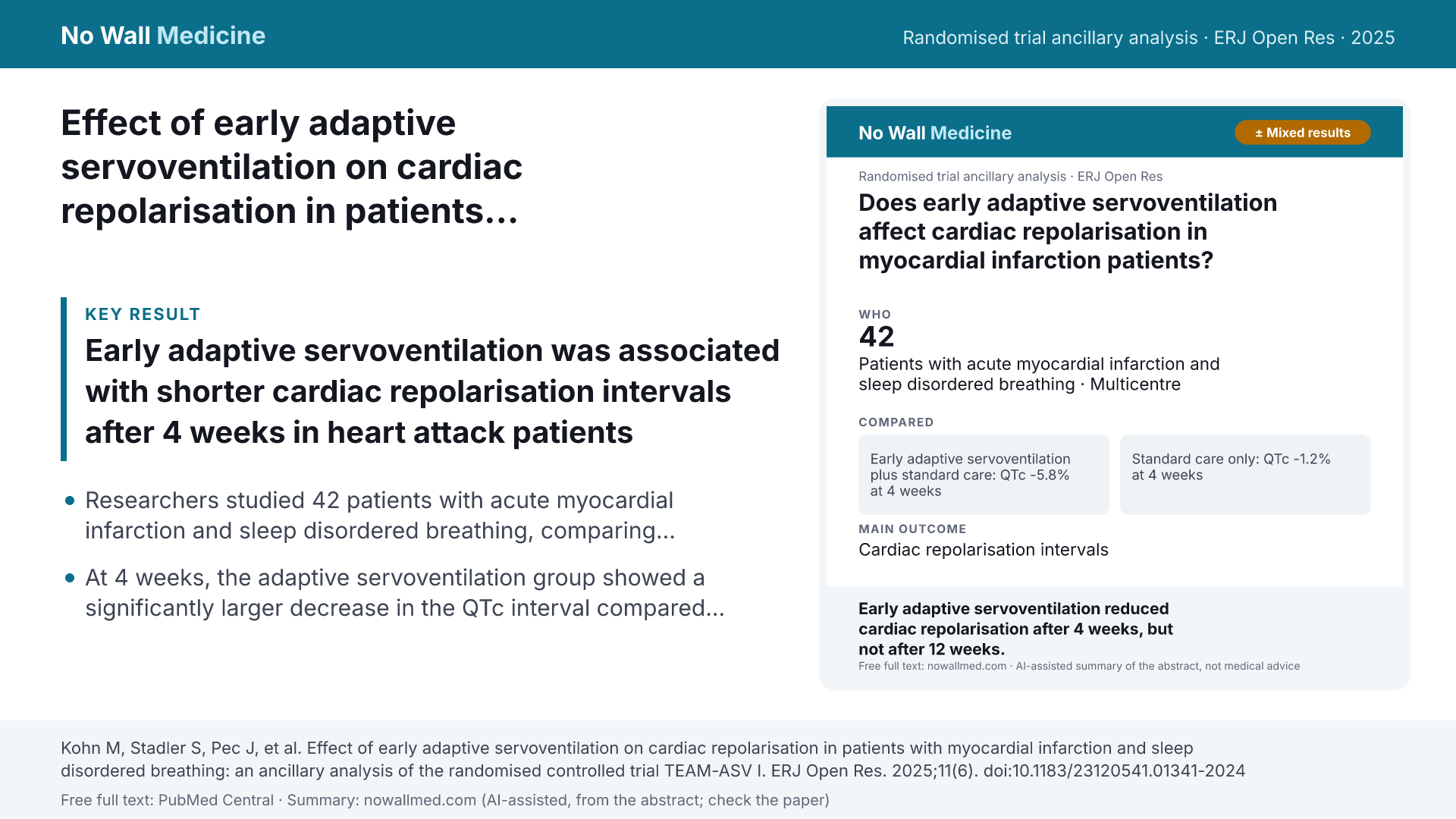
Early adaptive servoventilation was associated with shorter cardiac repolarisation intervals after 4 weeks in heart attack patients
Effect of early adaptive servoventilation on cardiac repolarisation in patients with myocardial infarction and sleep disordered breathing: an ancillary analysis of the randomised controlled trial TEAM-ASV I
Randomised trial ancillary analysisMixed results
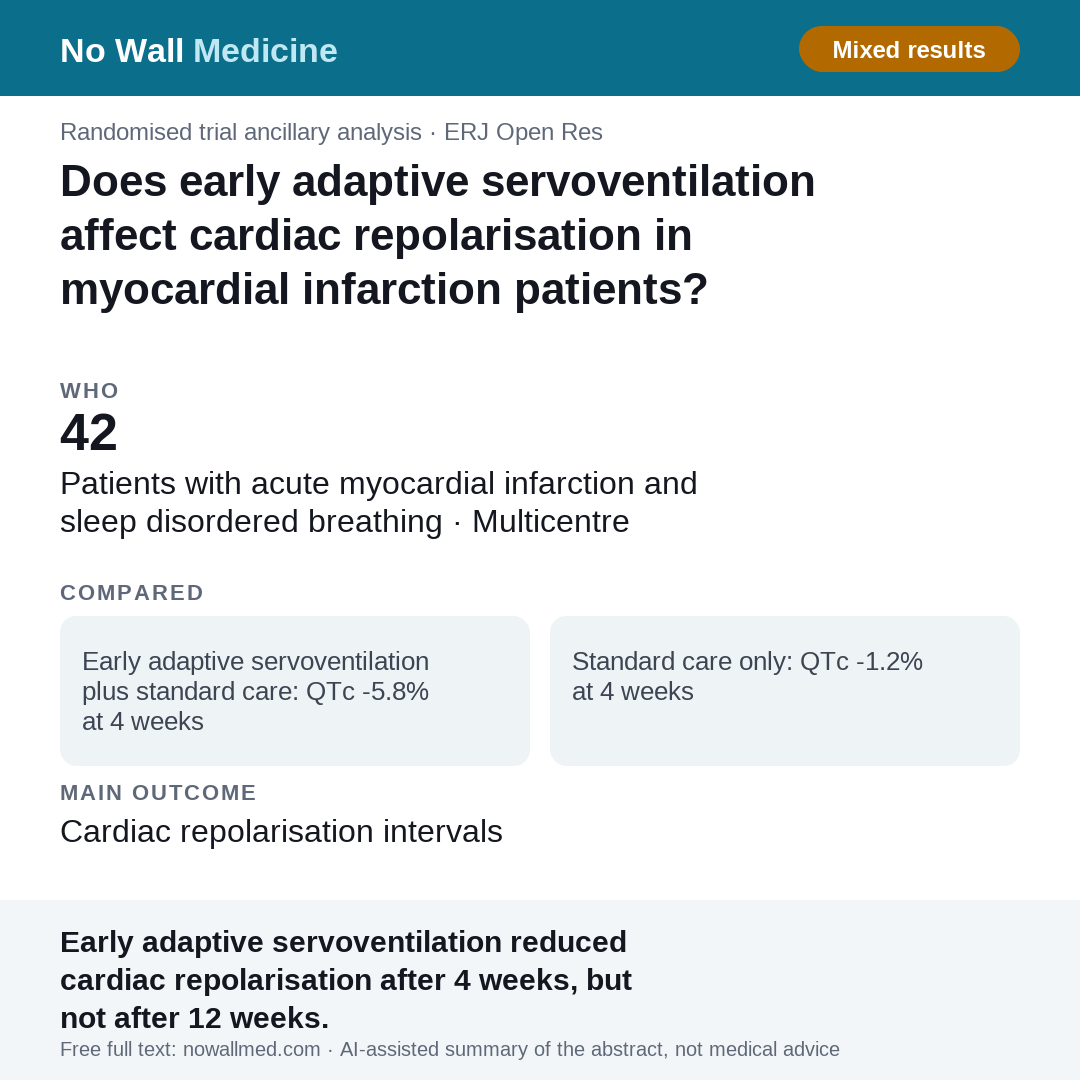
Does early adaptive servoventilation affect cardiac repolarisation in myocardial infarction patients?
Who
42
Patients with acute myocardial infarction and sleep disordered breathing · Multicentre
Compared
Early adaptive servoventilation plus standard care: QTc -5.8% at 4 weeks
Standard care only: QTc -1.2% at 4 weeks
Main outcome
Cardiac repolarisation intervals
Bottom line: Early adaptive servoventilation reduced cardiac repolarisation after 4 weeks, but not after 12 weeks.
ERJ Open Res · 2025-11-03Download image
Clinical question: Does early adaptive servoventilation affect cardiac repolarisation in myocardial infarction patients?
Why it matters: Altered cardiac repolarisation, the process where heart cells reset after a beat, is linked to dangerous heart rhythms in patients after a heart attack.
Key points
- Researchers studied 42 patients with acute myocardial infarction and sleep disordered breathing, comparing 22 receiving adaptive servoventilation to 20 receiving standard care.
- At 4 weeks, the adaptive servoventilation group showed a significantly larger decrease in the QTc interval compared to the control group (-5.8% versus -1.2%, p=0.041).
- At 12 weeks, there were no significant differences between the groups for QTc, TpTec, or TpTe/QT intervals.
Headline and key points written with AI from the paper’s abstract, with every number checked against it. Read the paper before relying on them.
Was this summary helpful?
Cite this article
Kohn M, Stadler S, Pec J, Kassim A, Koller M, Buchner S. Effect of early adaptive servoventilation on cardiac repolarisation in patients with myocardial infarction and sleep disordered breathing: an ancillary analysis of the randomised controlled trial TEAM-ASV I. ERJ Open Res. 2025. doi:10.1183/23120541.01341-2024
Spotted a mistake? Suggest a correction
Top studies every Monday
The week’s key trials and guidelines in your specialties, plus any topics you follow. By email, free.
Get the weekly digest