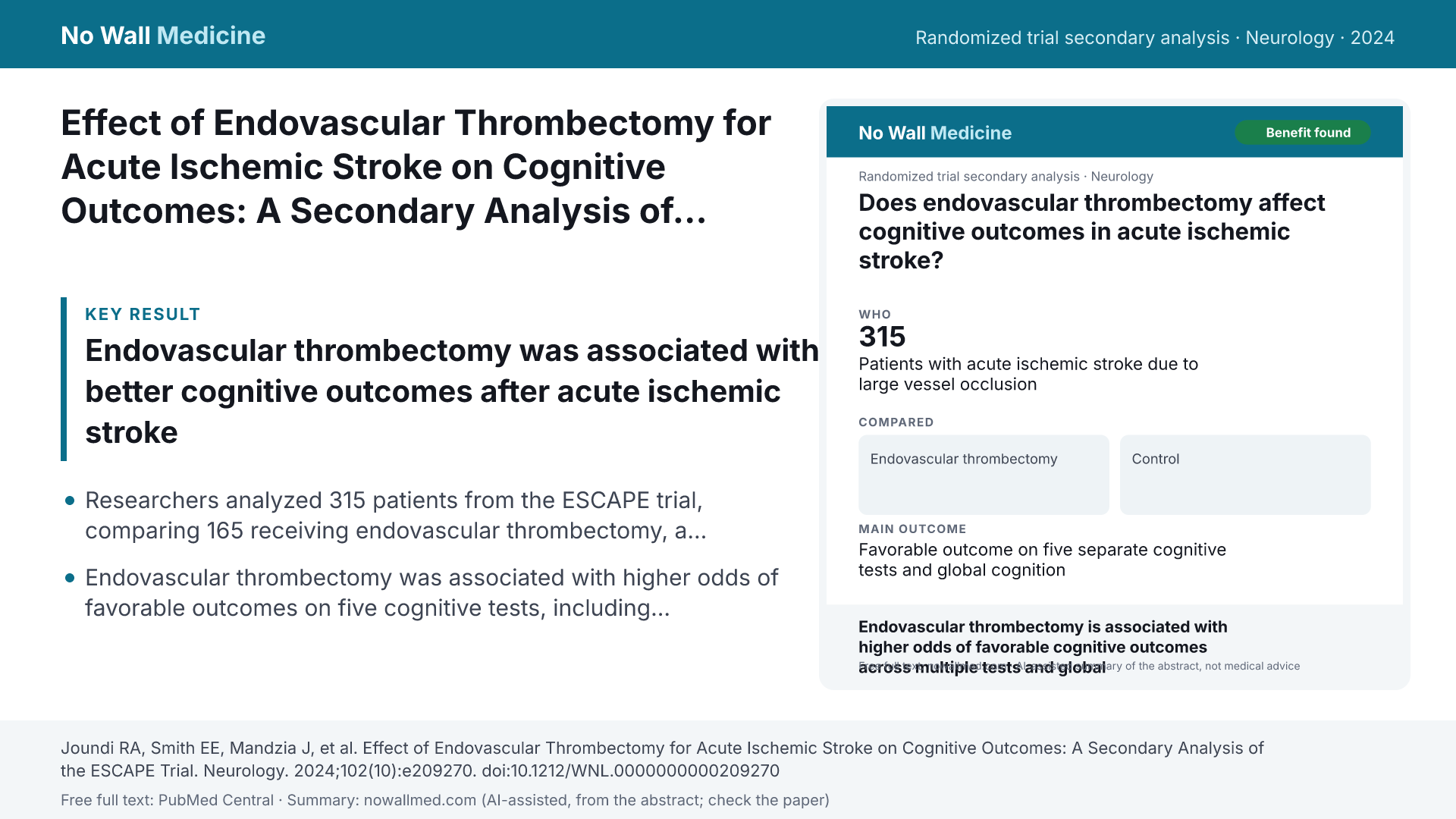
Effect of Endovascular Thrombectomy for Acute Ischemic Stroke on Cognitive Outcomes: A Secondary Analysis of the ESCAPE Trial
Key result: Endovascular thrombectomy was associated with better cognitive outcomes after acute ischemic stroke
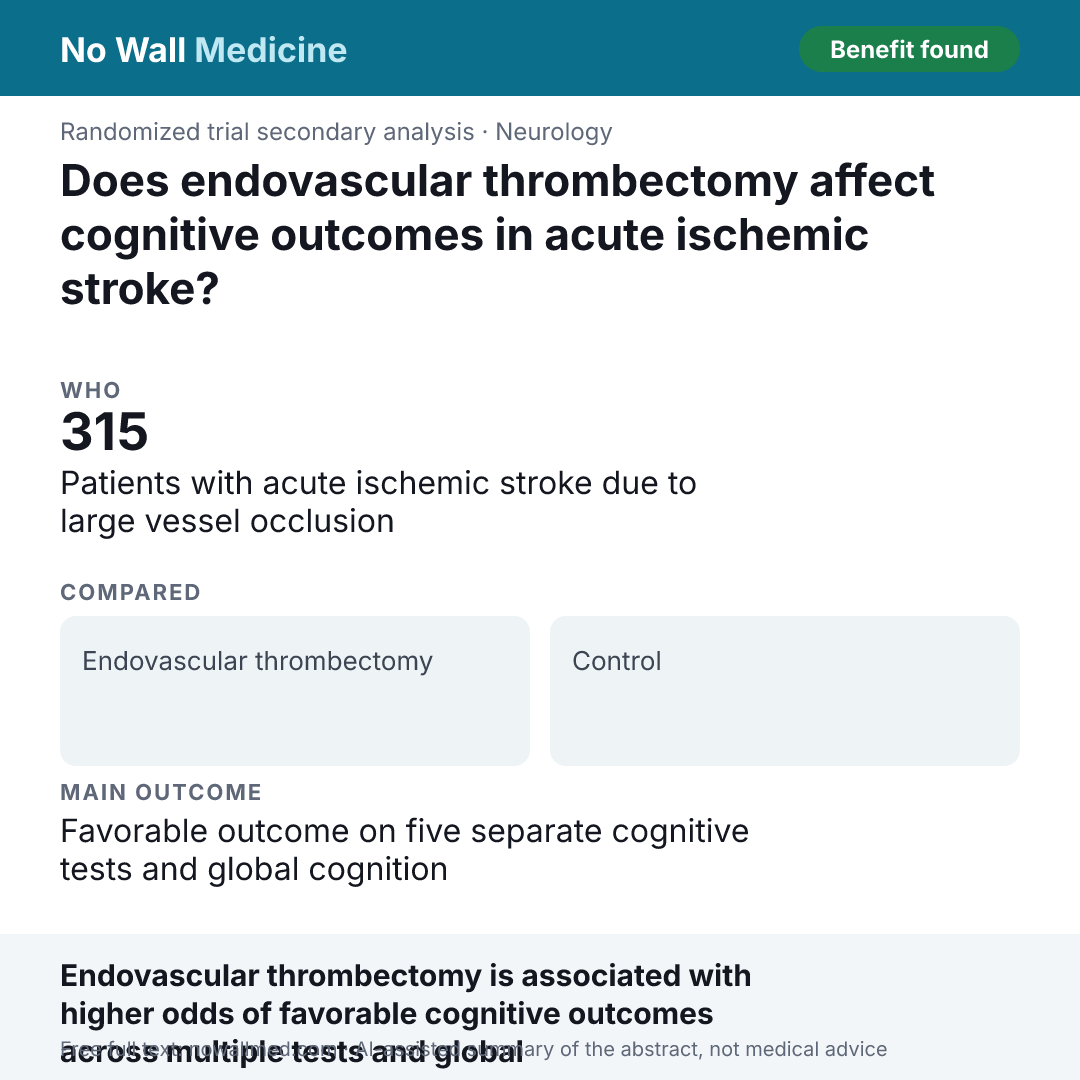
Randomized trial secondary analysisBenefit found
Does endovascular thrombectomy affect cognitive outcomes in acute ischemic stroke?
Who
315
Patients with acute ischemic stroke due to large vessel occlusion
Compared
Endovascular thrombectomy
Control
Main outcome
Favorable outcome on five separate cognitive tests and global cognition
Result: adjusted odds ratio 2.57 (95% CI 1.67 to 3.94) for global binary analysis
Bottom line: Endovascular thrombectomy is associated with higher odds of favorable cognitive outcomes across multiple tests and global assessments.
Neurology · 2024-05-13 · Save PNG
Key points
- Researchers analyzed 315 patients from the ESCAPE trial, comparing 165 receiving endovascular thrombectomy, a procedure to remove a clot from a blood vessel, to 150 in a control group.
- Endovascular thrombectomy was associated with higher odds of favorable outcomes on five cognitive tests, including a Montreal Cognitive Assessment adjusted odds ratio of 2.32.
- Global cognitive function analysis showed higher odds of favorable outcomes with endovascular thrombectomy, with an adjusted odds ratio of 2.83 in ordinal analyses.
Discussion prompts
- Would these patients look like yours? Who was left out?
- Is the main outcome one that matters to patients?
- Is the difference large enough to change what you do?
Cite: Joundi RA, Smith EE, Mandzia J, et al. Effect of Endovascular Thrombectomy for Acute Ischemic Stroke on Cognitive Outcomes: A Secondary Analysis of the ESCAPE Trial. Neurology. 2024;102(10):e209270. doi:10.1212/WNL.0000000000209270
Free full text: PubMed Central · Summary and visual abstract: nowallmed.com/a/effect-of-endovascular-thrombectomy-for-acute-ischemic-stroke-on-1hf7s3e/ (AI-assisted from the abstract; check the paper before relying on it).