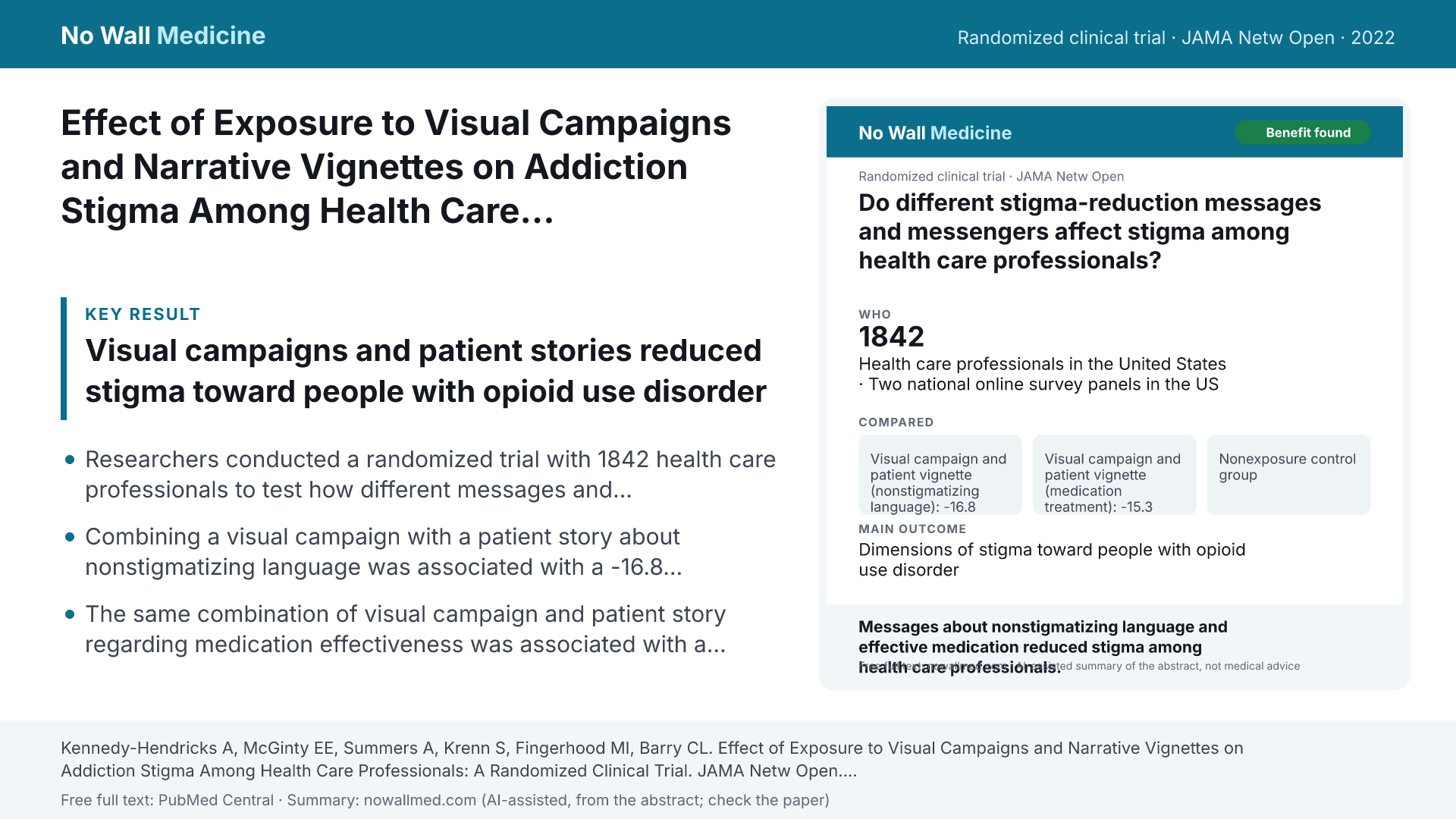
Visual campaigns and patient stories reduced stigma toward people with opioid use disorder
Effect of Exposure to Visual Campaigns and Narrative Vignettes on Addiction Stigma Among Health Care Professionals: A Randomized Clinical Trial
Randomized clinical trialBenefit found
Do different stigma-reduction messages and messengers affect stigma among health care professionals?
Who
1842
Health care professionals in the United States · Two national online survey panels in the US
Compared
Visual campaign and patient vignette (nonstigmatizing language): -16.8 percentage points (95% CI, -26.1 to -7.4)
Visual campaign and patient vignette (medication treatment): -15.3 percentage points (95% CI, -24.6 to -6.0)
Nonexposure control group
Main outcome
Dimensions of stigma toward people with opioid use disorder
Result: difference, -16.8 percentage points, 95% CI, -26.1 to -7.4
Bottom line: Messages about nonstigmatizing language and effective medication reduced stigma among health care professionals.
JAMA Netw Open · 2022-02-01 · Save PNG
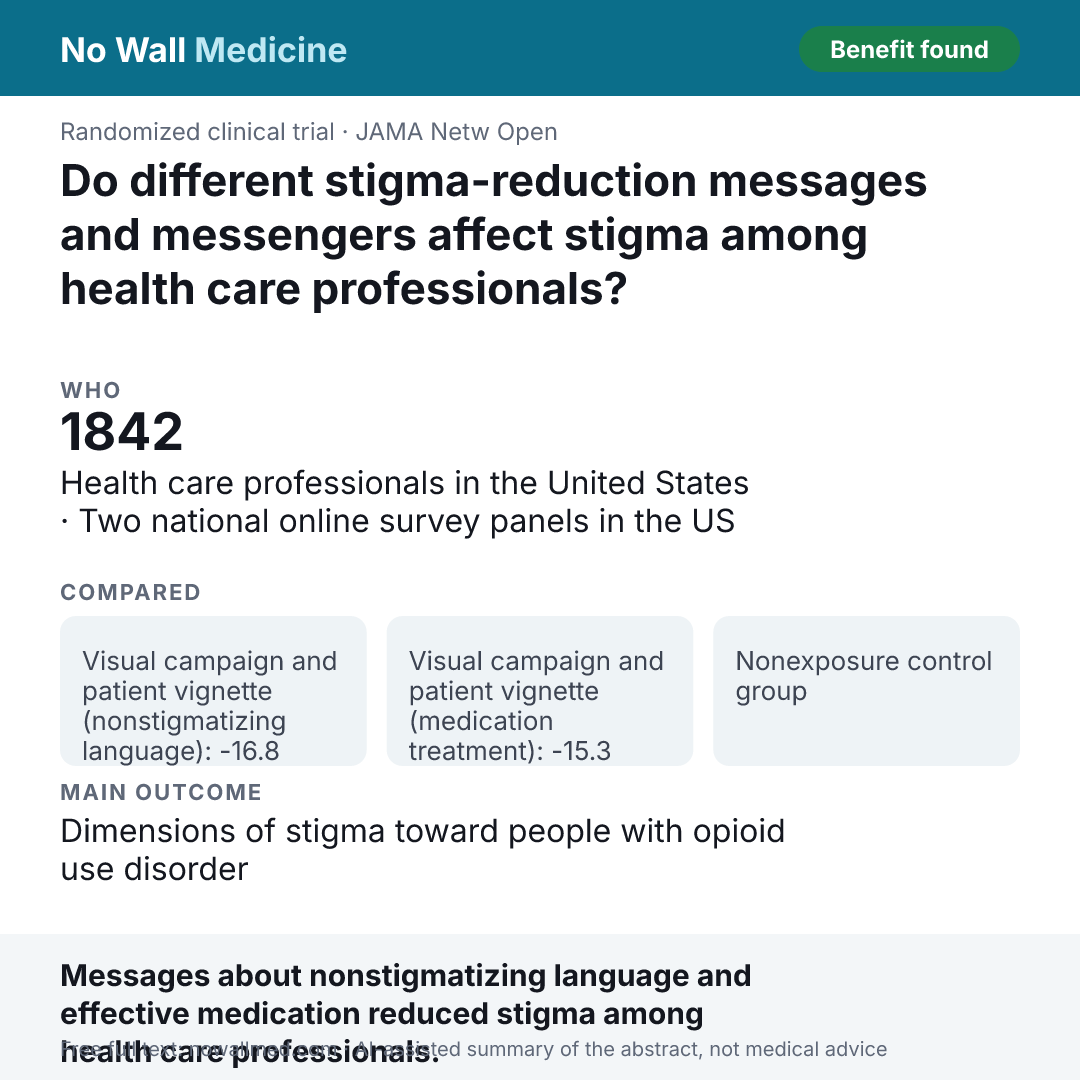
Clinical question: Do different stigma-reduction messages and messengers affect stigma among health care professionals?
Key points
- Researchers conducted a randomized trial with 1842 health care professionals to test how different messages and messengers affect attitudes toward people with opioid use disorder.
- Combining a visual campaign with a patient story about nonstigmatizing language was associated with a -16.8 percentage point difference in unwillingness to have a person with opioid use disorder marry into the family.
- The same combination of visual campaign and patient story regarding medication effectiveness was associated with a -15.3 percentage point difference in unwillingness to have a person with opioid use disorder as a neighbor.
Headline and key points written with AI from the paper’s abstract, with every number checked against it. Read the paper before relying on them.
Was this summary helpful?
Subject terms
Headline, design, result, key points, caveat and citation as plain text.
Cite this article
Kennedy-Hendricks A, McGinty EE, Summers A, Krenn S, Fingerhood MI, Barry CL. Effect of Exposure to Visual Campaigns and Narrative Vignettes on Addiction Stigma Among Health Care Professionals: A Randomized Clinical Trial. JAMA Netw Open. 2022. doi:10.1001/jamanetworkopen.2021.46971
Spotted a mistake? Suggest a correction