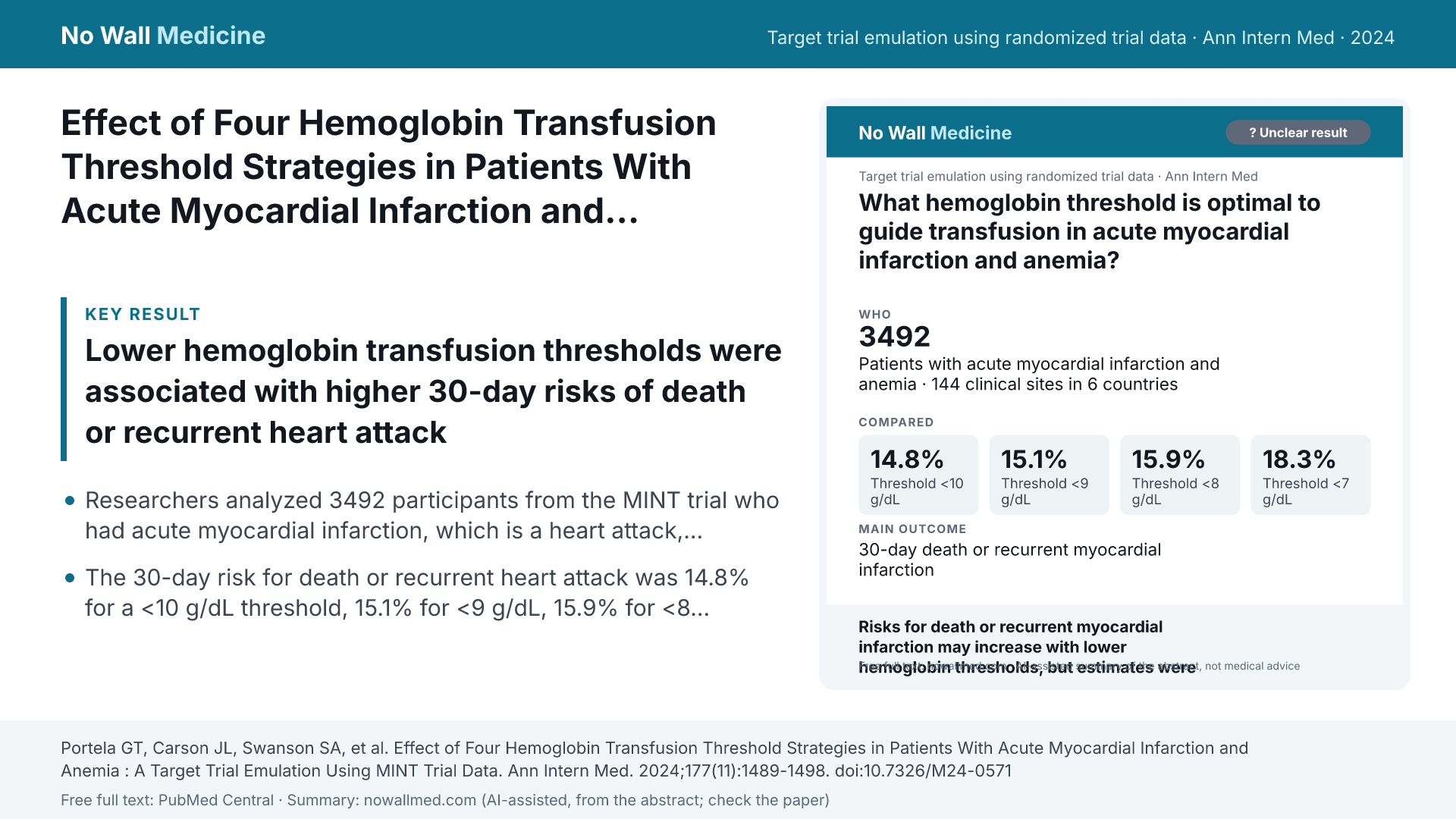
Lower hemoglobin transfusion thresholds were associated with higher 30-day risks of death or recurrent heart attack
Effect of Four Hemoglobin Transfusion Threshold Strategies in Patients With Acute Myocardial Infarction and Anemia : A Target Trial Emulation Using MINT Trial Data
Target trial emulation using randomized trial dataUnclear result
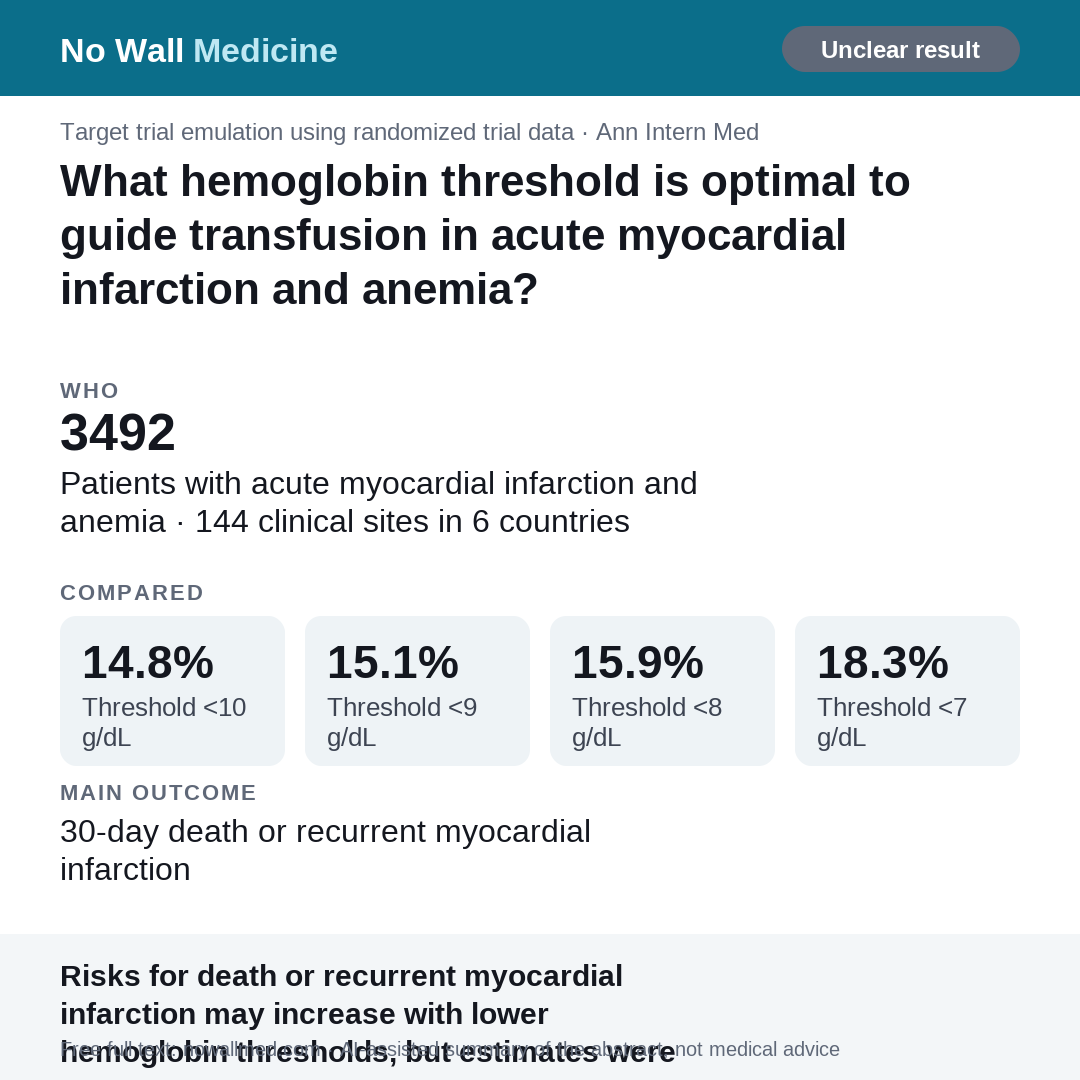
What hemoglobin threshold is optimal to guide transfusion in acute myocardial infarction and anemia?
Who
3492
Patients with acute myocardial infarction and anemia · 144 clinical sites in 6 countries
Compared
14.8%Threshold <10 g/dL (95% CI, 11.8% to 18.4%)
15.1%Threshold <9 g/dL (CI, 11.7% to 18.2%)
15.9%Threshold <8 g/dL (CI, 12.4% to 19.0%)
18.3%Threshold <7 g/dL (CI, 14.6% to 22.0%)
Main outcome
30-day death or recurrent myocardial infarction
Bottom line: Risks for death or recurrent myocardial infarction may increase with lower hemoglobin thresholds, but estimates were imprecise.
Limitation: Unmeasured confounding may have persisted despite adjustment.
Funded by: National Heart, Lung, and Blood Institute
Ann Intern Med · 2024-10-01Download image
Clinical question: What hemoglobin threshold is optimal to guide transfusion in acute myocardial infarction and anemia?
Why it matters: The optimal hemoglobin threshold to guide red blood cell transfusion for patients experiencing a heart attack and anemia is currently uncertain.
Key points
- Researchers analyzed 3492 participants from the MINT trial who had acute myocardial infarction, which is a heart attack, and anemia.
- The 30-day risk for death or recurrent heart attack was 14.8% for a <10 g/dL threshold, 15.1% for <9 g/dL, 15.9% for <8 g/dL, and 18.3% for <7 g/dL.
- Findings regarding the 30-day risk of death alone were similar across the different hemoglobin thresholds and were imprecise.
Limitation the authors note: Unmeasured confounding may have persisted despite adjustment.
Headline and key points written with AI from the paper’s abstract, with every number checked against it. Read the paper before relying on them.
Was this summary helpful?
Subject terms
Cite this article
Portela GT, Carson JL, Swanson SA, et al. Effect of Four Hemoglobin Transfusion Threshold Strategies in Patients With Acute Myocardial Infarction and Anemia : A Target Trial Emulation Using MINT Trial Data. Ann Intern Med. 2024. doi:10.7326/M24-0571
Spotted a mistake? Suggest a correction