Effect of Four Hemoglobin Transfusion Threshold Strategies in Patients With Acute Myocardial Infarction and Anemia : A Target Trial Emulation Using MINT Trial Data
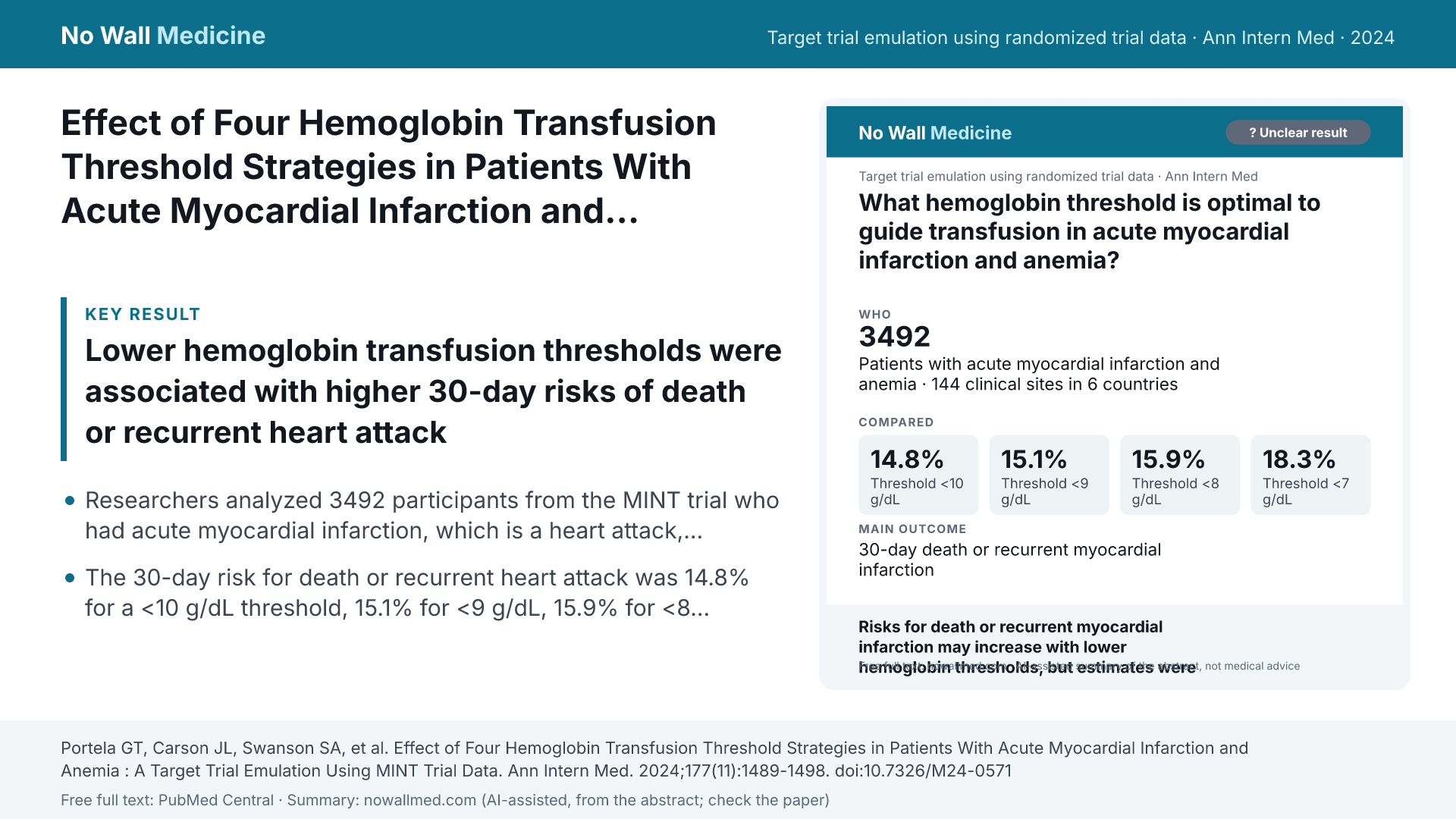
Key result: Lower hemoglobin transfusion thresholds were associated with higher 30-day risks of death or recurrent heart attack
Key points
- Researchers analyzed 3492 participants from the MINT trial who had acute myocardial infarction, which is a heart attack, and anemia.
- The 30-day risk for death or recurrent heart attack was 14.8% for a <10 g/dL threshold, 15.1% for <9 g/dL, 15.9% for <8 g/dL, and 18.3% for <7 g/dL.
- Findings regarding the 30-day risk of death alone were similar across the different hemoglobin thresholds and were imprecise.
Why it matters: The optimal hemoglobin threshold to guide red blood cell transfusion for patients experiencing a heart attack and anemia is currently uncertain.
Limitation the authors note: Unmeasured confounding may have persisted despite adjustment.
Discussion prompts
- Would these patients look like yours? Who was left out?
- Is the main outcome one that matters to patients?
- Is the difference large enough to change what you do?
Cite: Portela GT, Carson JL, Swanson SA, et al. Effect of Four Hemoglobin Transfusion Threshold Strategies in Patients With Acute Myocardial Infarction and Anemia : A Target Trial Emulation Using MINT Trial Data. Ann Intern Med. 2024;177(11):1489-1498. doi:10.7326/M24-0571
Free full text: PubMed Central · Summary and visual abstract: nowallmed.com/a/effect-of-four-hemoglobin-transfusion-threshold-strategies-in-1fqwrk2/ (AI-assisted from the abstract; check the paper before relying on it).