Gamification and financial incentives increased daily steps in patients at high cardiovascular risk
Effect of Gamification, Financial Incentives, or Both to Increase Physical Activity Among Patients at High Risk of Cardiovascular Events: The BE ACTIVE Randomized Controlled Trial
Pragmatic randomized clinical trialBenefit found
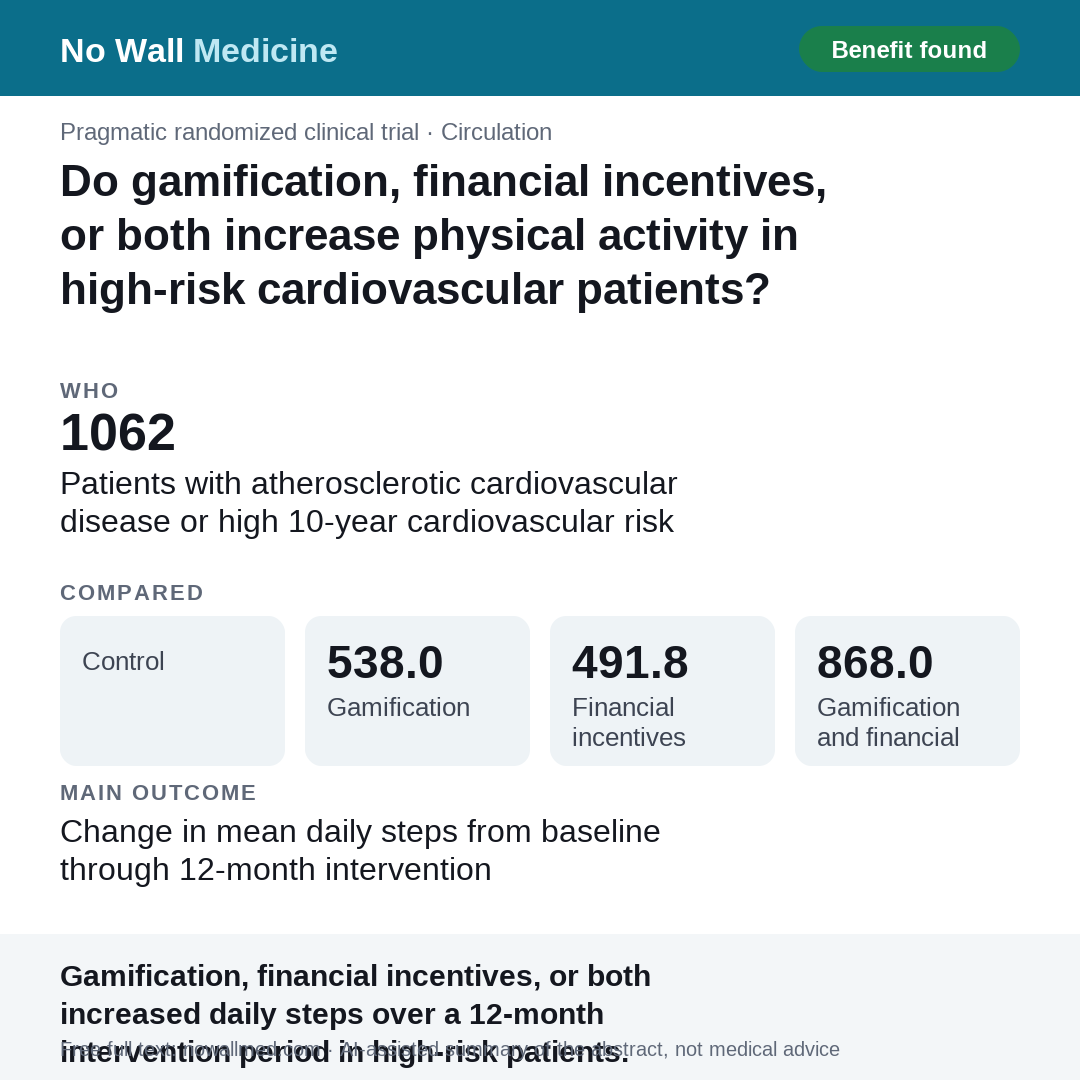
Do gamification, financial incentives, or both increase physical activity in high-risk cardiovascular patients?
Who
1062
Patients with atherosclerotic cardiovascular disease or high 10-year cardiovascular risk
Compared
Control
538.0Gamification (95% CI, 186.2-889.9)
491.8Financial incentives (95% CI, 139.6-844.1)
868.0Gamification and financial incentives (95% CI, 516.3-1219.7)
Main outcome
Change in mean daily steps from baseline through 12-month intervention
Result: adjusted difference, 868.0 (95% CI, 516.3-1219.7)
Bottom line: Gamification, financial incentives, or both increased daily steps over a 12-month intervention period in high-risk patients.
Circulation · 2024-04-07Download image
Clinical question: Do gamification, financial incentives, or both increase physical activity in high-risk cardiovascular patients?
Why it matters: The longer-term effectiveness of behavioral economics strategies, such as gamification and financial incentives, to increase physical activity is uncertain.
Key points
- The study enrolled 1062 patients with atherosclerotic cardiovascular disease or high risk of heart attack, stroke, or cardiovascular death and compared four different intervention groups.
- During the 12-month intervention, gamification, financial incentives, and the combination of both increased mean daily steps compared to the control group.
- At the 6-month follow-up, only the combination of gamification and financial incentives showed significantly greater daily steps than the control group.
Headline and key points written with AI from the paper’s abstract, with every number checked against it. Read the paper before relying on them.
Was this summary helpful?
Subject terms
Cite this article
Fanaroff AC, Patel MS, Chokshi N, Coratti S, Farraday D, Norton L. Effect of Gamification, Financial Incentives, or Both to Increase Physical Activity Among Patients at High Risk of Cardiovascular Events: The BE ACTIVE Randomized Controlled Trial. Circulation. 2024. doi:10.1161/CIRCULATIONAHA.124.069531
Spotted a mistake? Suggest a correction
Top studies every Monday
The week’s key trials and guidelines in your specialties, plus any topics you follow. By email, free.
Get the weekly digest