Half-dose arthritis medication was associated with more disease flares than stable doses in remission
Effect of Half-Dose vs Stable-Dose Conventional Synthetic Disease-Modifying Antirheumatic Drugs on Disease Flares in Patients With Rheumatoid Arthritis in Remission: The ARCTIC REWIND Randomized Clinical Trial
Randomized, parallel, open-label noninferiority studyHarm found
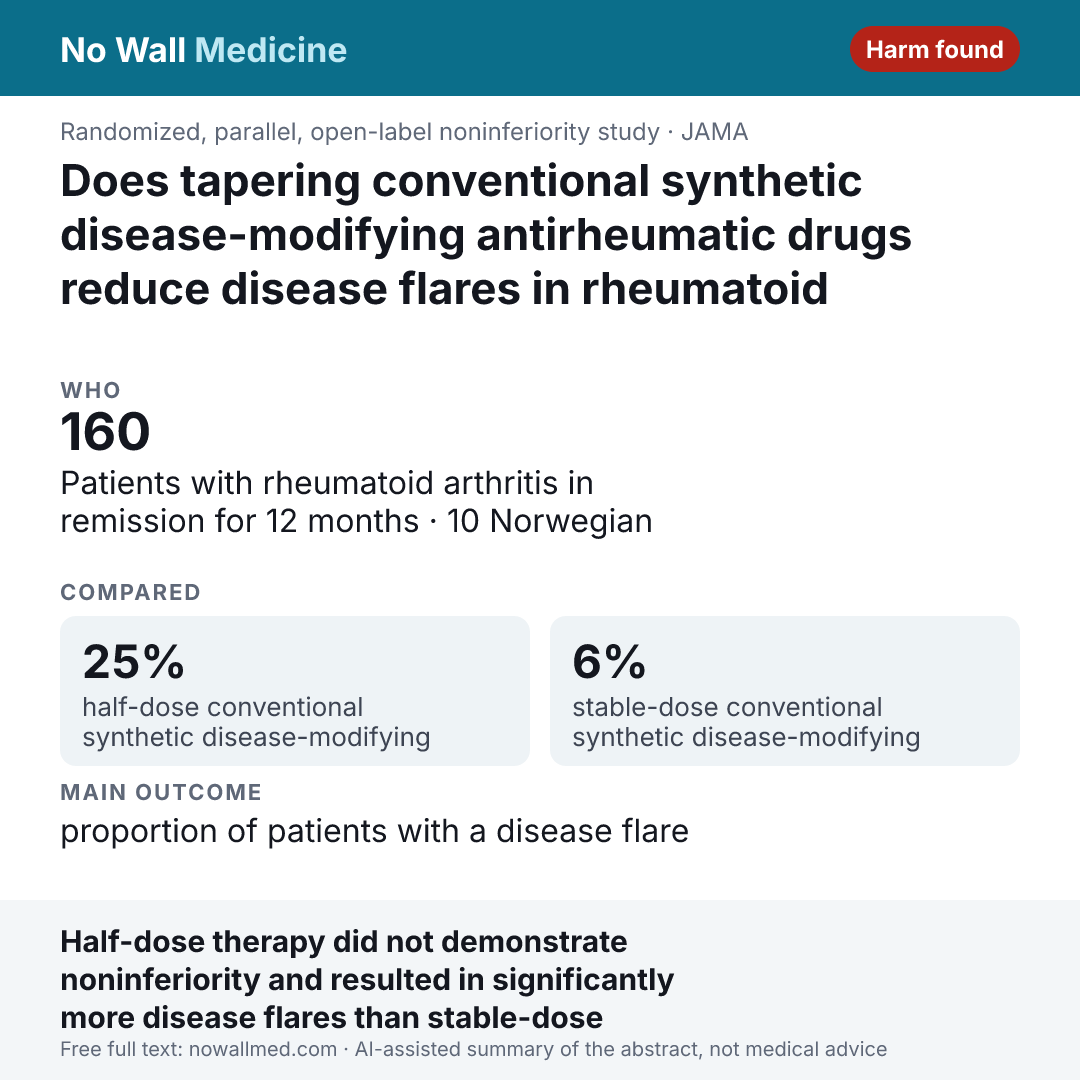
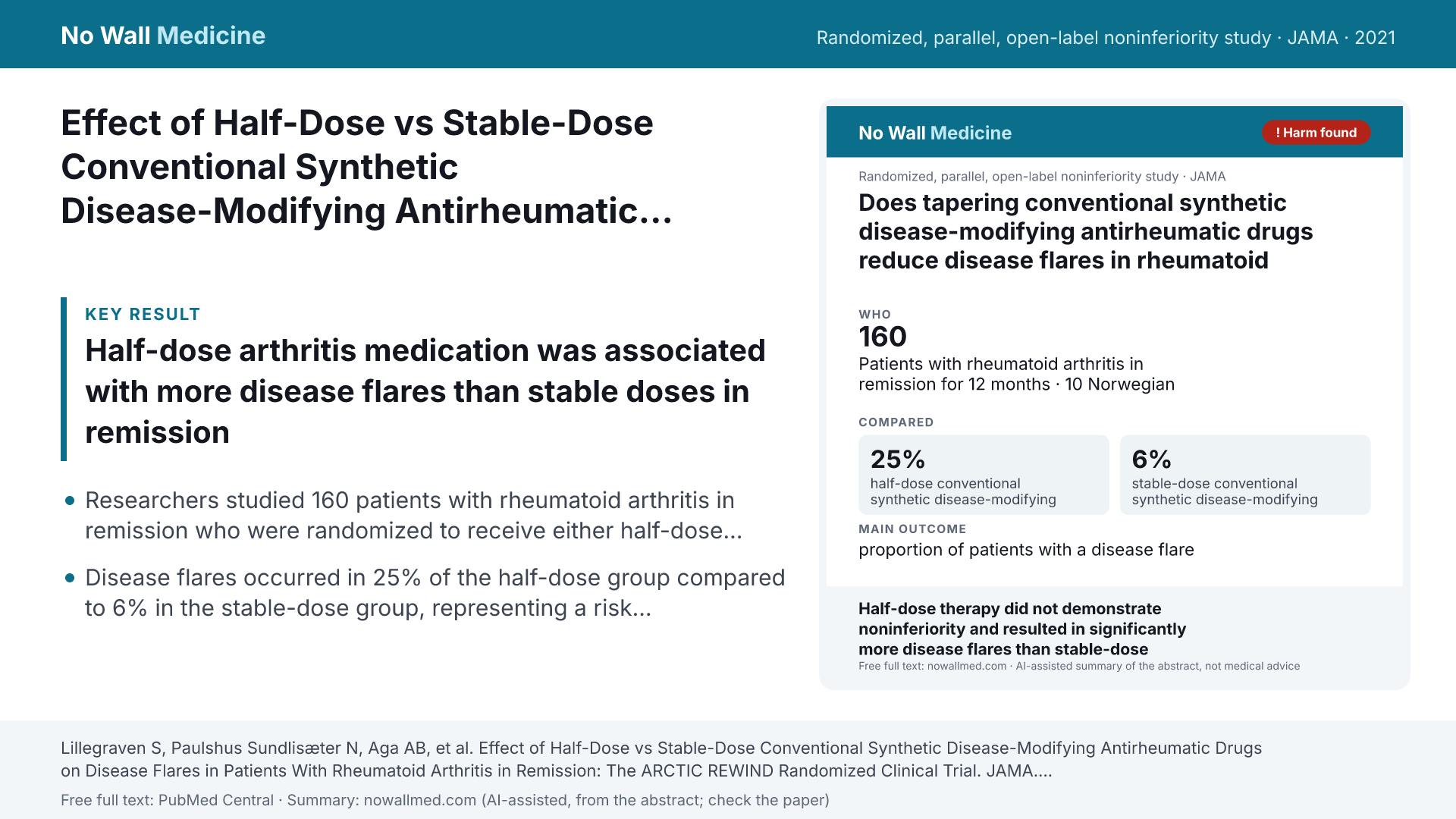
Does tapering conventional synthetic disease-modifying antirheumatic drugs reduce disease flares in rheumatoid arthritis patients in remission?
Who
160
Patients with rheumatoid arthritis in remission for 12 months · 10 Norwegian hospital-based rheumatology practices
Compared
25%half-dose conventional synthetic disease-modifying antirheumatic drugs
6%stable-dose conventional synthetic disease-modifying antirheumatic drugs
Main outcome
proportion of patients with a disease flare
Result: risk difference, 18% (95% CI, 7%-29%)
Bottom line: Half-dose therapy did not demonstrate noninferiority and resulted in significantly more disease flares than stable-dose therapy.
JAMA · 2021-05-04 · Save PNG
Same trial (NCT01881308)
Papers we list that report this registered trial, oldest first. Read a secondary analysis alongside the main results.
- Main results Harm found
This paper JAMA 2021-05 - Related analysis Harm found
Tapering tumour necrosis factor inhibitors increased flare rate in rheumatoid arthritis patients Ann Rheum Dis 2023-08 - Secondary analysis Key finding
RAID questionnaire score was more accurate than C reactive protein at identifying rheumatoid arthritis flares RMD Open 2024-01
Clinical question: Does tapering conventional synthetic disease-modifying antirheumatic drugs reduce disease flares in rheumatoid arthritis patients in remission?
Key points
- Researchers studied 160 patients with rheumatoid arthritis in remission who were randomized to receive either half-dose or stable-dose conventional synthetic disease-modifying antirheumatic drugs.
- Disease flares occurred in 25% of the half-dose group compared to 6% in the stable-dose group, representing a risk difference of 18%.
- Adverse events were reported in 44% of the half-dose group and 54% of the stable-dose group, with no deaths recorded.
Headline and key points written with AI from the paper’s abstract, with every number checked against it. Read the paper before relying on them.
Was this summary helpful?
Subject terms
Headline, design, result, key points, caveat and citation as plain text.
Cite this article
Lillegraven S, Paulshus Sundlisæter N, Aga AB, et al. Effect of Half-Dose vs Stable-Dose Conventional Synthetic Disease-Modifying Antirheumatic Drugs on Disease Flares in Patients With Rheumatoid Arthritis in Remission: The ARCTIC REWIND Randomized Clinical Trial. JAMA. 2021. doi:10.1001/jama.2021.4542
Spotted a mistake? Suggest a correction