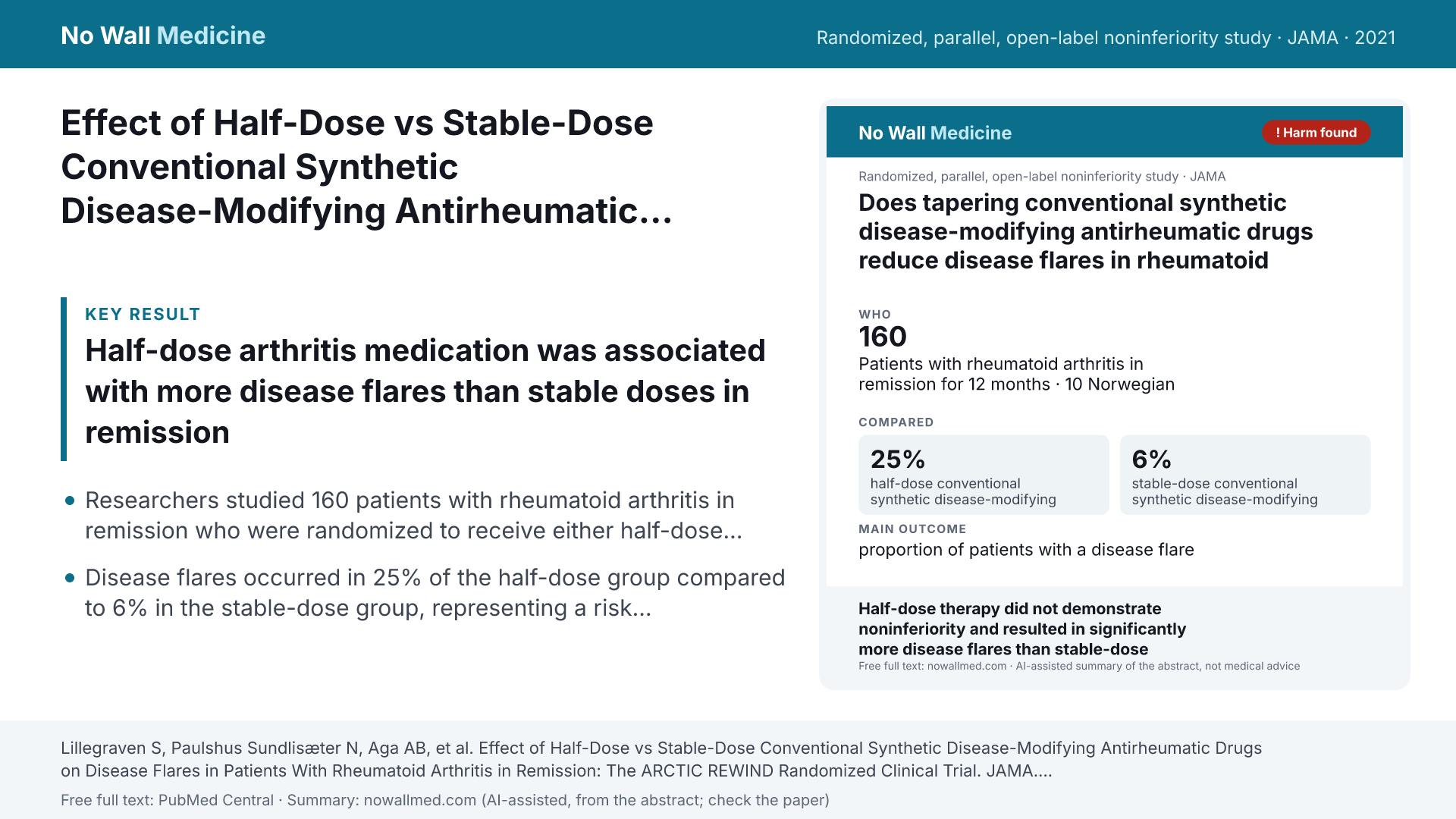
Effect of Half-Dose vs Stable-Dose Conventional Synthetic Disease-Modifying Antirheumatic Drugs on Disease Flares in Patients With Rheumatoid Arthritis in Remission: The ARCTIC REWIND Randomized Clinical Trial
Key result: Half-dose arthritis medication was associated with more disease flares than stable doses in remission
Randomized, parallel, open-label noninferiority studyHarm found
Does tapering conventional synthetic disease-modifying antirheumatic drugs reduce disease flares in rheumatoid arthritis patients in remission?
Who
160
Patients with rheumatoid arthritis in remission for 12 months · 10 Norwegian hospital-based rheumatology practices
Compared
25%half-dose conventional synthetic disease-modifying antirheumatic drugs
6%stable-dose conventional synthetic disease-modifying antirheumatic drugs
Main outcome
proportion of patients with a disease flare
Result: risk difference, 18% (95% CI, 7%-29%)
Bottom line: Half-dose therapy did not demonstrate noninferiority and resulted in significantly more disease flares than stable-dose therapy.
JAMA · 2021-05-04
Key points
- Researchers studied 160 patients with rheumatoid arthritis in remission who were randomized to receive either half-dose or stable-dose conventional synthetic disease-modifying antirheumatic drugs.
- Disease flares occurred in 25% of the half-dose group compared to 6% in the stable-dose group, representing a risk difference of 18%.
- Adverse events were reported in 44% of the half-dose group and 54% of the stable-dose group, with no deaths recorded.
Discussion prompts
- Would these patients look like yours? Who was left out?
- Is the main outcome one that matters to patients?
- Is the difference large enough to change what you do?
Cite: Lillegraven S, Paulshus Sundlisæter N, Aga AB, et al. Effect of Half-Dose vs Stable-Dose Conventional Synthetic Disease-Modifying Antirheumatic Drugs on Disease Flares in Patients With Rheumatoid Arthritis in Remission: The ARCTIC REWIND Randomized Clinical Trial. JAMA. 2021;325(17):1755-1764. doi:10.1001/jama.2021.4542
Free full text: PubMed Central · Summary and visual abstract: nowallmed.com/a/effect-of-half-dose-vs-stable-dose-conventional-synthetic-disease-zrac22/ (AI-assisted from the abstract; check the paper before relying on it).