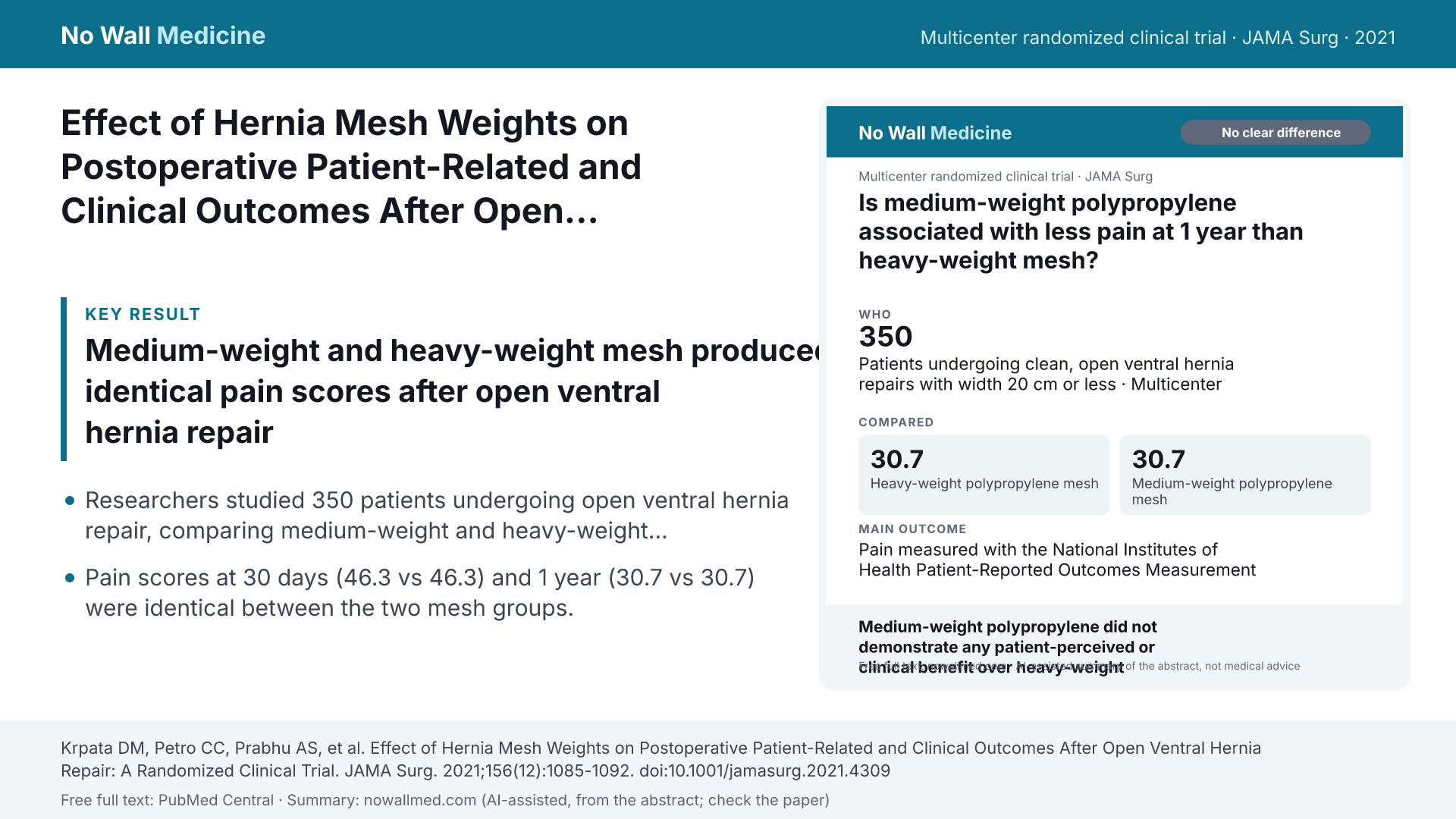
Medium-weight and heavy-weight mesh produced identical pain scores after open ventral hernia repair
Effect of Hernia Mesh Weights on Postoperative Patient-Related and Clinical Outcomes After Open Ventral Hernia Repair: A Randomized Clinical Trial
Multicenter randomized clinical trialNo clear difference
Is medium-weight polypropylene associated with less pain at 1 year than heavy-weight mesh?
Who
350
Patients undergoing clean, open ventral hernia repairs with width 20 cm or less · Multicenter
Compared
30.7Heavy-weight polypropylene mesh
30.7Medium-weight polypropylene mesh
Main outcome
Pain measured with the National Institutes of Health Patient-Reported Outcomes Measurement Information System
Bottom line: Medium-weight polypropylene did not demonstrate any patient-perceived or clinical benefit over heavy-weight polypropylene after open ventral hernia repair.
JAMA Surg · 2021-09-16Download image
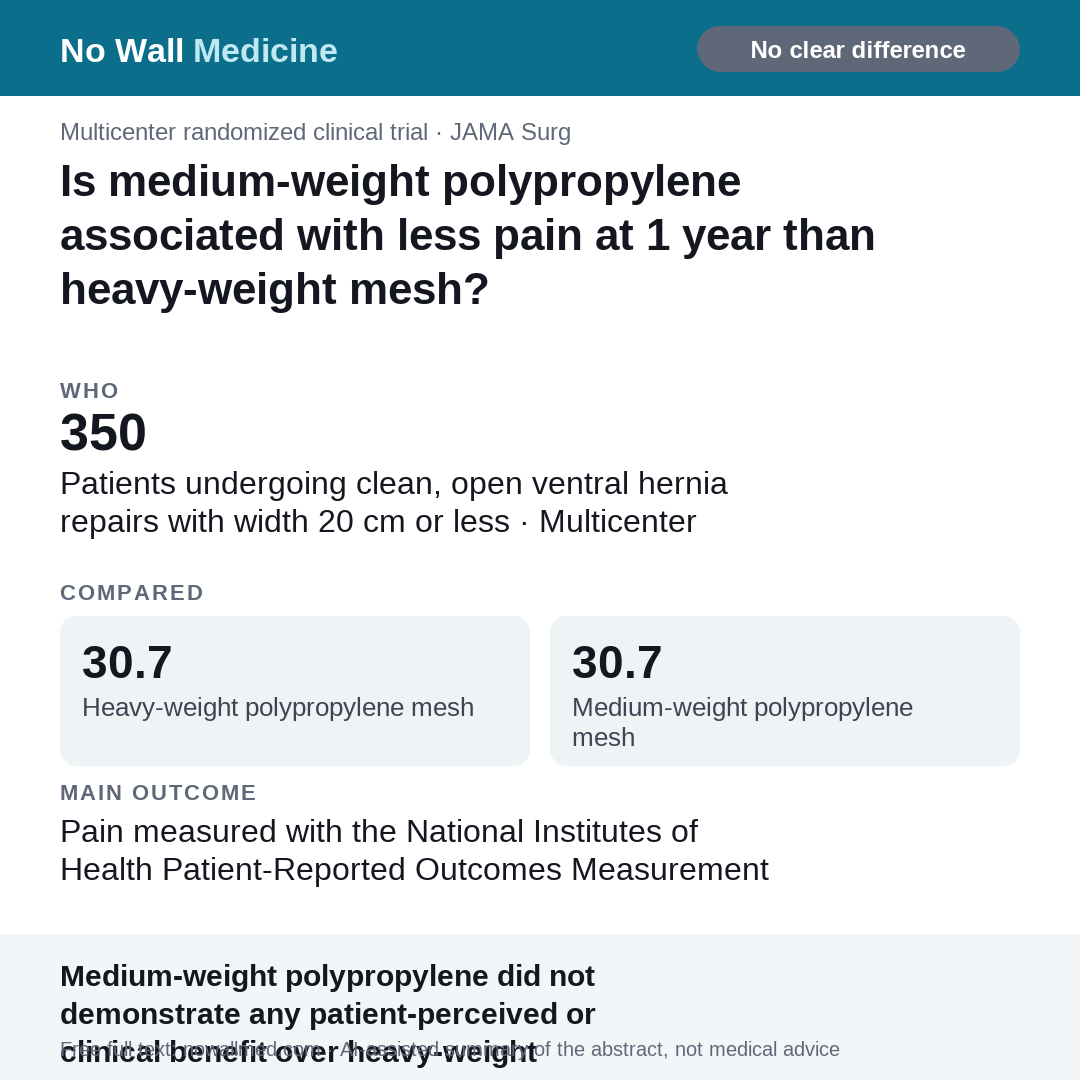
Clinical question: Is medium-weight polypropylene associated with less pain at 1 year than heavy-weight mesh?
Key points
- Researchers studied 350 patients undergoing open ventral hernia repair, comparing medium-weight and heavy-weight polypropylene mesh over 1 year.
- Pain scores at 30 days (46.3 vs 46.3) and 1 year (30.7 vs 30.7) were identical between the two mesh groups.
- No significant differences were found in quality of life or 1-year hernia recurrence rates, which were 8% for heavy-weight and 7% for medium-weight mesh.
Headline and key points written with AI from the paper’s abstract, with every number checked against it. Read the paper before relying on them.
Was this summary helpful?
Subject terms
Cite this article
Krpata DM, Petro CC, Prabhu AS, et al. Effect of Hernia Mesh Weights on Postoperative Patient-Related and Clinical Outcomes After Open Ventral Hernia Repair: A Randomized Clinical Trial. JAMA Surg. 2021. doi:10.1001/jamasurg.2021.4309
Spotted a mistake? Suggest a correction