Effect of Hernia Mesh Weights on Postoperative Patient-Related and Clinical Outcomes After Open Ventral Hernia Repair: A Randomized Clinical Trial
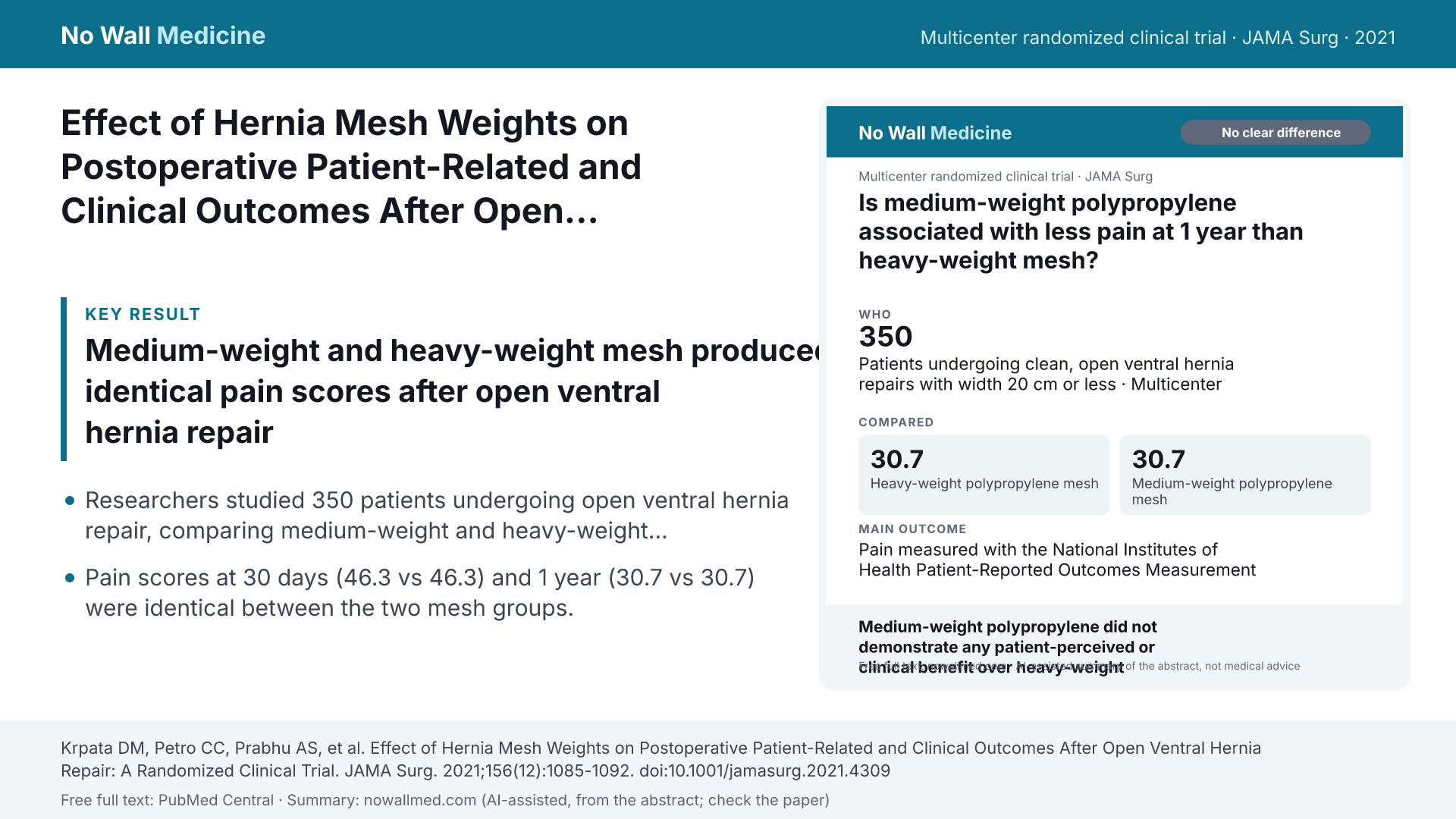
Key result: Medium-weight and heavy-weight mesh produced identical pain scores after open ventral hernia repair
Multicenter randomized clinical trialNo clear difference
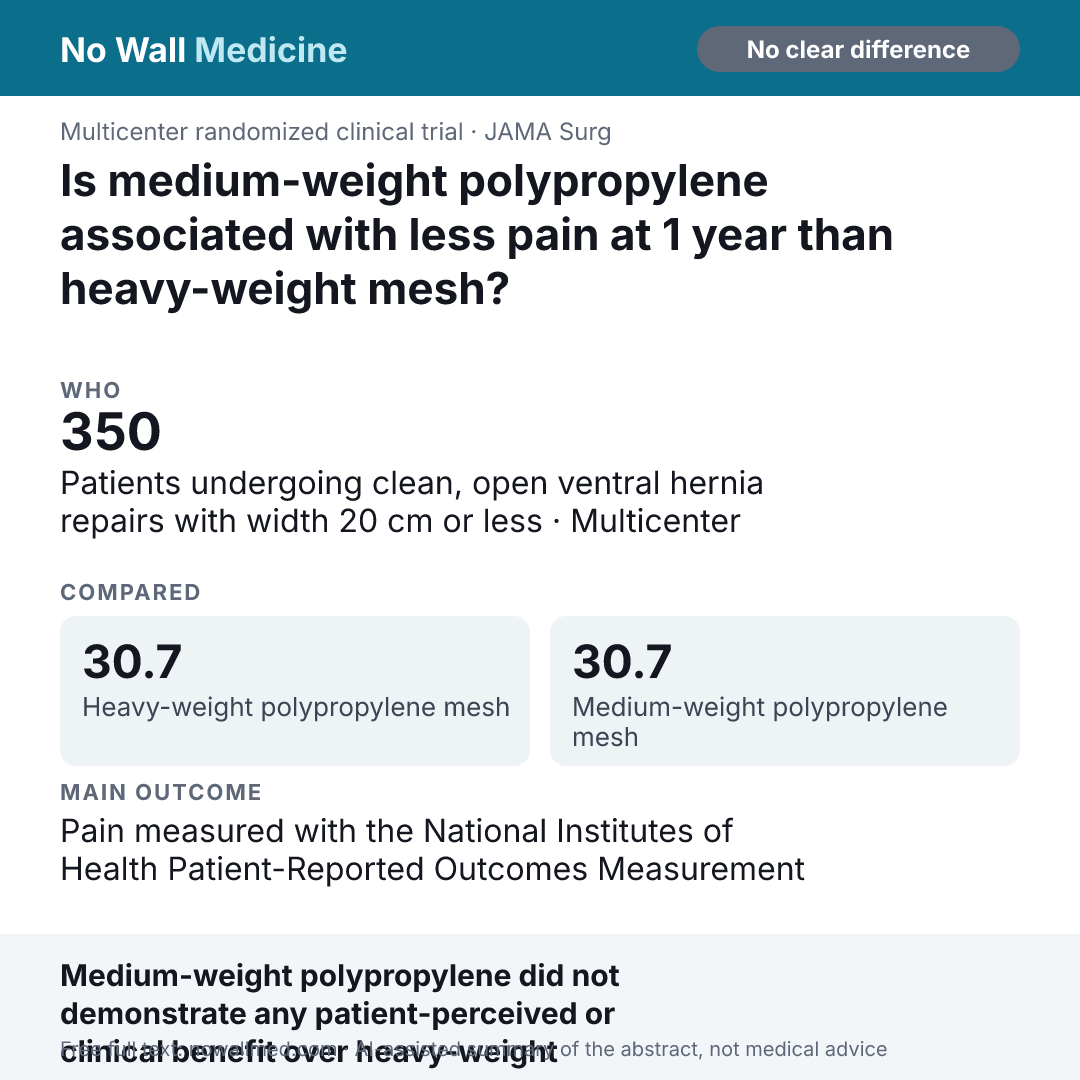
Is medium-weight polypropylene associated with less pain at 1 year than heavy-weight mesh?
Who
350
Patients undergoing clean, open ventral hernia repairs with width 20 cm or less · Multicenter
Compared
30.7Heavy-weight polypropylene mesh
30.7Medium-weight polypropylene mesh
Main outcome
Pain measured with the National Institutes of Health Patient-Reported Outcomes Measurement Information System
Bottom line: Medium-weight polypropylene did not demonstrate any patient-perceived or clinical benefit over heavy-weight polypropylene after open ventral hernia repair.
JAMA Surg · 2021-09-16 · Save PNG
Key points
- Researchers studied 350 patients undergoing open ventral hernia repair, comparing medium-weight and heavy-weight polypropylene mesh over 1 year.
- Pain scores at 30 days (46.3 vs 46.3) and 1 year (30.7 vs 30.7) were identical between the two mesh groups.
- No significant differences were found in quality of life or 1-year hernia recurrence rates, which were 8% for heavy-weight and 7% for medium-weight mesh.
Discussion prompts
- Would these patients look like yours? Who was left out?
- Is the main outcome one that matters to patients?
- Is the difference large enough to change what you do?
Cite: Krpata DM, Petro CC, Prabhu AS, et al. Effect of Hernia Mesh Weights on Postoperative Patient-Related and Clinical Outcomes After Open Ventral Hernia Repair: A Randomized Clinical Trial. JAMA Surg. 2021;156(12):1085-1092. doi:10.1001/jamasurg.2021.4309
Free full text: PubMed Central · Summary and visual abstract: nowallmed.com/a/effect-of-hernia-mesh-weights-on-postoperative-patient-related-and-vyswdu/ (AI-assisted from the abstract; check the paper before relying on it).