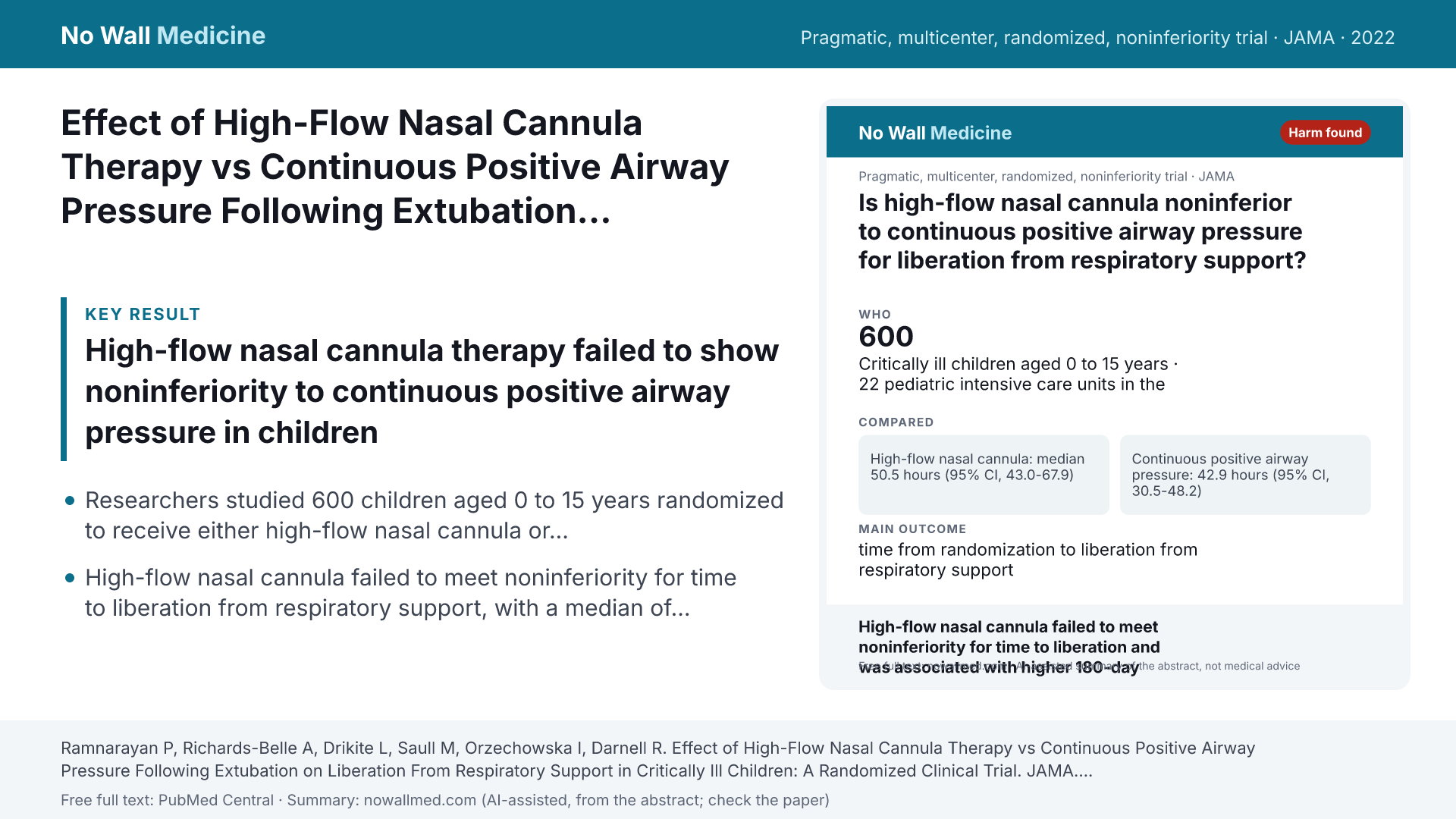
Effect of High-Flow Nasal Cannula Therapy vs Continuous Positive Airway Pressure Following Extubation on Liberation From Respiratory Support in Critically Ill Children: A Randomized Clinical Trial
Key result: High-flow nasal cannula therapy failed to show noninferiority to continuous positive airway pressure in children
Key points
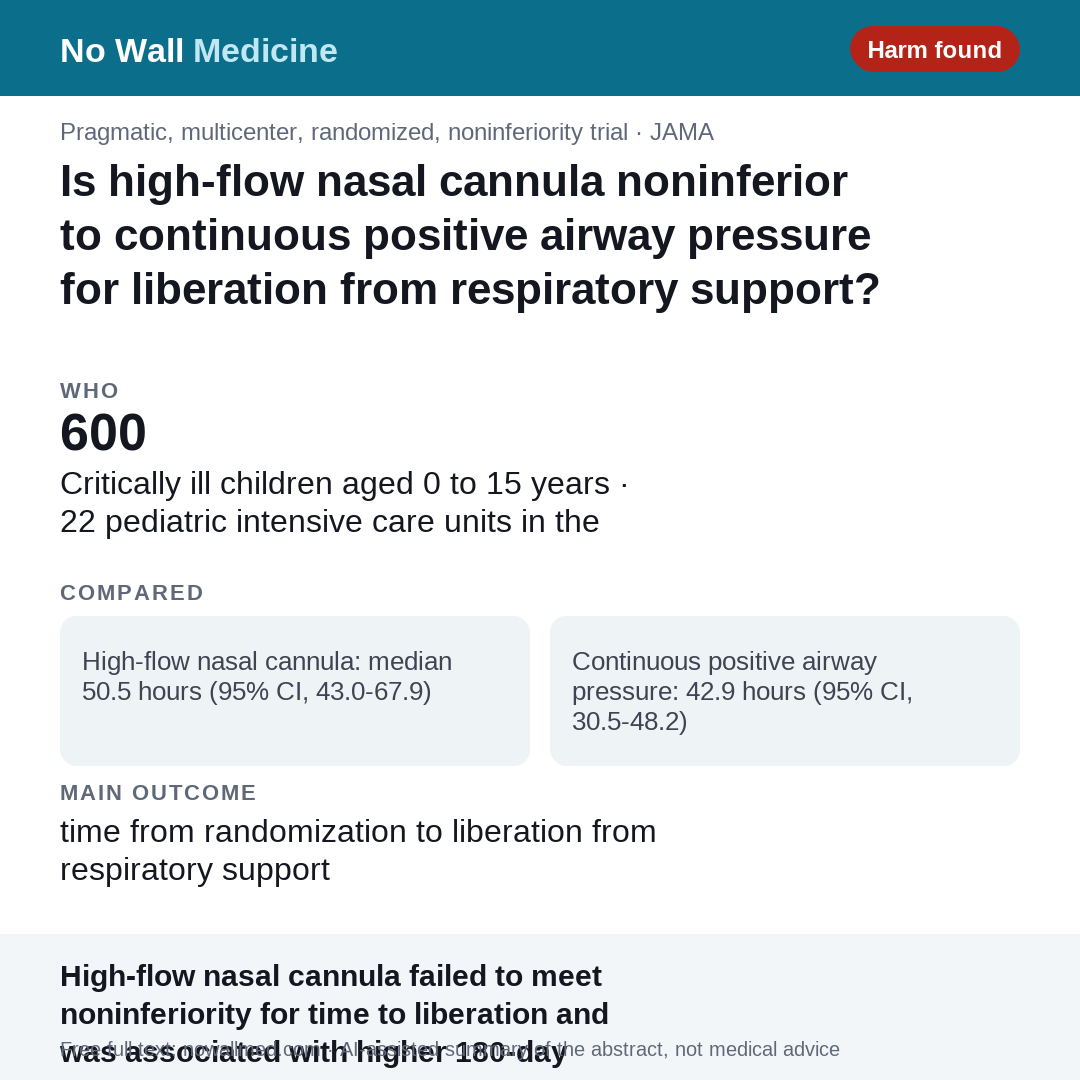
- Researchers studied 600 children aged 0 to 15 years randomized to receive either high-flow nasal cannula or continuous positive airway pressure after being taken off a breathing tube.
- High-flow nasal cannula failed to meet noninferiority for time to liberation from respiratory support, with a median of 50.5 hours compared to 42.9 hours for continuous positive airway pressure.
- Mortality at day 180 was significantly higher for the high-flow nasal cannula group at 5.6% compared to 2.4% for the continuous positive airway pressure group.
Why it matters: The optimal first-line mode of noninvasive respiratory support, such as high-flow nasal cannula or continuous positive airway pressure, following extubation in critically ill children is not known.
Discussion prompts
- Would these patients look like yours? Who was left out?
- Is the main outcome one that matters to patients?
- Is the difference large enough to change what you do?
Cite: Ramnarayan P, Richards-Belle A, Drikite L, Saull M, Orzechowska I, Darnell R. Effect of High-Flow Nasal Cannula Therapy vs Continuous Positive Airway Pressure Following Extubation on Liberation From Respiratory Support in Critically Ill Children: A Randomized Clinical Trial. JAMA. 2022. doi:10.1001/jama.2022.3367
Free full text: PubMed Central · Summary and visual abstract: nowallmed.com/a/effect-of-high-flow-nasal-cannula-therapy-vs-continuous-positive-cpf2cx/ (AI-assisted from the abstract; check the paper before relying on it).