Home cook interventions reduced salt intake and blood pressure in a Chinese community trial
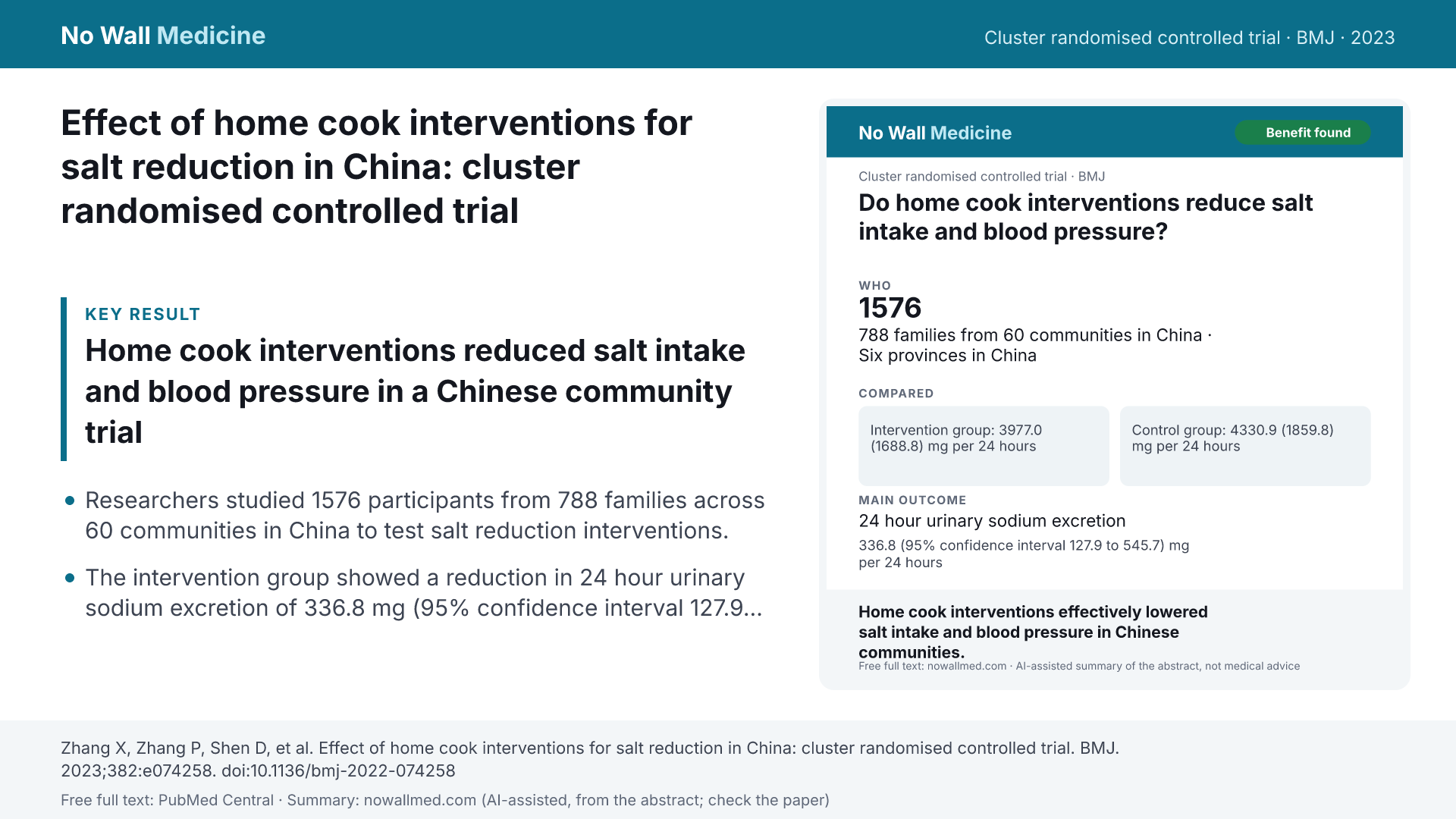
Effect of home cook interventions for salt reduction in China: cluster randomised controlled trial
Cluster randomised controlled trialBenefit found
Do home cook interventions reduce salt intake and blood pressure?
Who
1576
788 families from 60 communities in China · Six provinces in China
Compared
Intervention group: 3977.0 (1688.8) mg per 24 hours
Control group: 4330.9 (1859.8) mg per 24 hours
Main outcome
24 hour urinary sodium excretion
Result: 336.8 (95% confidence interval 127.9 to 545.7) mg per 24 hours
Bottom line: Home cook interventions effectively lowered salt intake and blood pressure in Chinese communities.
BMJ · 2023-08-24 · Save PNG
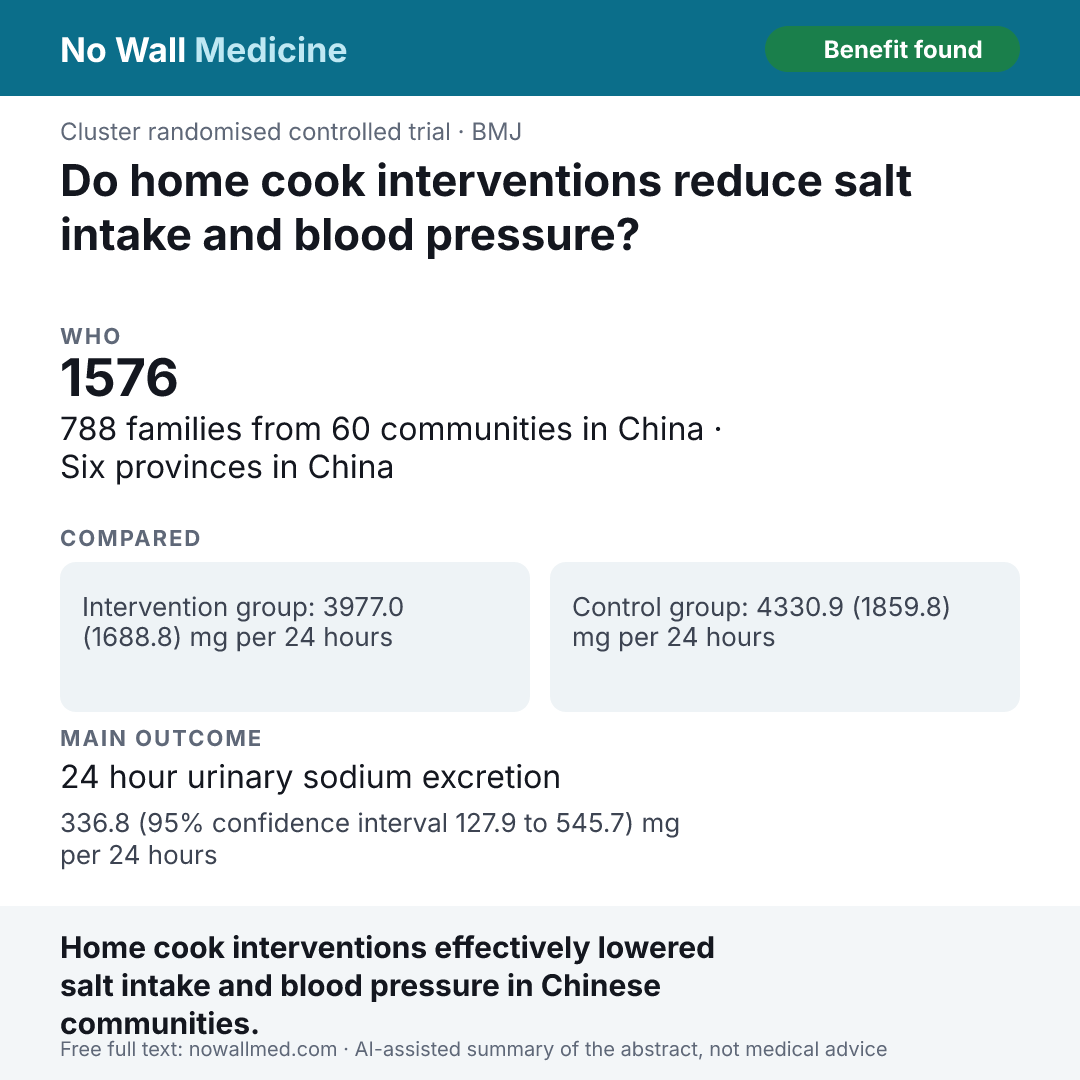
Clinical question: Do home cook interventions reduce salt intake and blood pressure?
Key points
- Researchers studied 1576 participants from 788 families across 60 communities in China to test salt reduction interventions.
- The intervention group showed a reduction in 24 hour urinary sodium excretion of 336.8 mg (95% confidence interval 127.9 to 545.7) compared to the control group.
- Systolic blood pressure and diastolic blood pressure were reduced by 2.0 (0.4 to 3.5) mm Hg and 1.1 (0.1 to 2.0) mm Hg, respectively.
Headline and key points written with AI from the paper’s abstract, with every number checked against it. Read the paper before relying on them.
Was this summary helpful?
Abstract
Objective
To determine the effects of salt reduction interventions designed for home cooks and family members. Design
Cluster randomised controlled trial. Setting
Six provinces in northern, central, and southern China from 15 October 2018 to 30 December 2019. Participants
60 communities from six provinces (10 communities from each province) were randomised; each community comprised 26 people (two people from each of 13 families). Interventions
Participants in the intervention group received 12 month interventions, including supportive environment building for salt reduction, six education sessions on salt reduction, and salt intake monitoring by seven day weighed record of salt and salty condiments. The control group did not receive any of the interventions. Main outcome measure
Difference between the two groups in change in salt intake measured by 24 hour urinary sodium during the 12 month follow-up. Results
1576 participants (775 (49.2%) men; mean age 55.8 (standard deviation 10.8) years) from 788 families (one home cook and one other adult in each family) completed the baseline assessment. After baseline assessment, 30 communities with 786 participants were allocated to the intervention group and 30 communities with 790 participants to the control group. During the trial, 157 (10%) participants were lost to follow-up, and the remaining 706 participants in the intervention group and 713 participants in the control group completed the follow-up assessment. During the 12 month follow-up, the urinary sodium excretion decreased from 4368.7 (standard deviation 1880.3) mg per 24 hours to 3977.0 (1688.8) mg per 24 hours in the intervention group and from 4418.7 (1973.7) mg per 24 hours to 4330.9 (1859.8) mg per 24 hours in the control group. Compared with the control group, adjusted mixed linear model analysis showed that the 24 hour urinary sodium excretion in the intervention group was reduced by 336.8 (95% confidence interval 127.9 to 545.7) mg per 24 hours (P=0.002); the systolic and diastolic blood pressures were reduced by 2.0 (0.4 to 3.5) (P=0.01) and 1.1 (0.1 to 2.0) mm Hg (P=0.03), respectively; and the knowledge, attitude, and behaviours in the intervention group improved significantly. Conclusions
The community based salt reduction package targeting home cooks and family members was effective in lowering salt intake and blood pressure. This intervention has the potential to be widely applied in China and other countries where home cooking remains a major source of salt intake. Trial registration
Chinese Clinical Trial Registry ChiCTR1800016804.
Abstract reproduced under the article’s CC BY licence.
Subject terms
Headline, design, result, key points, caveat and citation as plain text.
Cite this article
Zhang X, Zhang P, Shen D, et al. Effect of home cook interventions for salt reduction in China: cluster randomised controlled trial. BMJ. 2023;382:e074258. doi:10.1136/bmj-2022-074258
Spotted a mistake? Suggest a correction