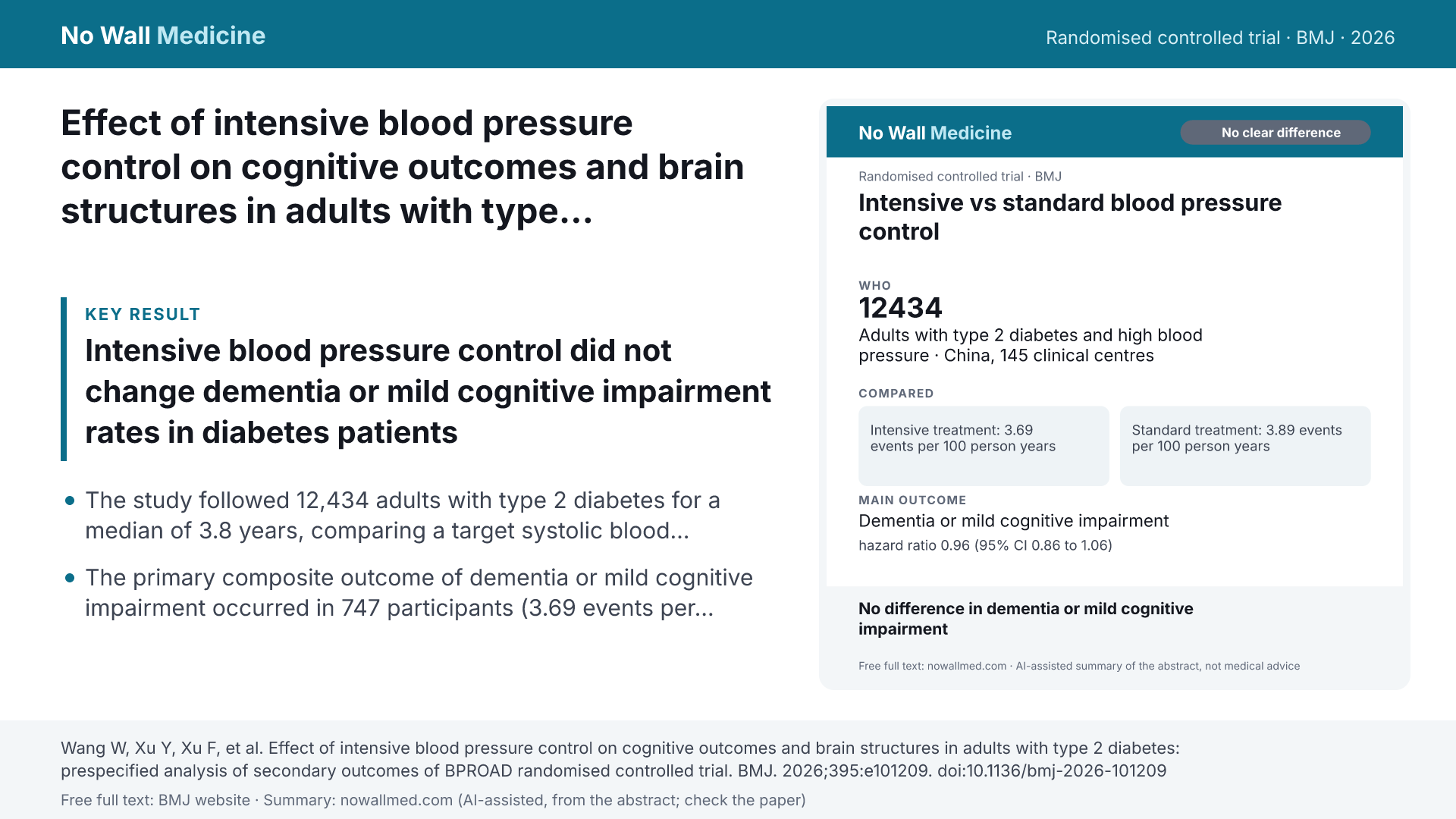
Intensive blood pressure control did not change dementia or mild cognitive impairment rates in diabetes patients
Effect of intensive blood pressure control on cognitive outcomes and brain structures in adults with type 2 diabetes: prespecified analysis of secondary outcomes of BPROAD randomised controlled trial
Randomised controlled trialNo clear difference
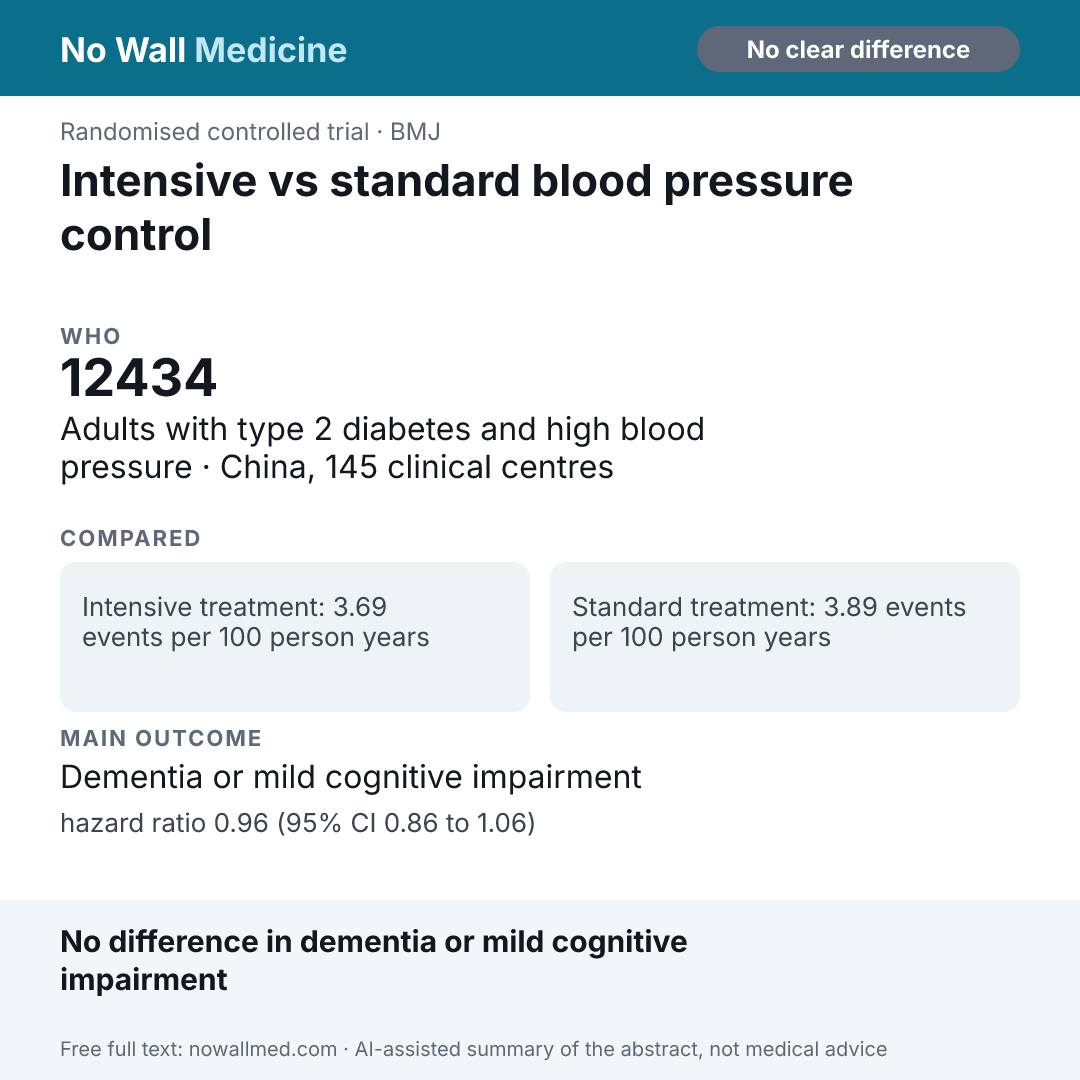
Intensive vs standard blood pressure control
Who
12434
Adults with type 2 diabetes and high blood pressure · China, 145 clinical centres
Compared
Intensive treatment: 3.69 events per 100 person years
Standard treatment: 3.89 events per 100 person years
Main outcome
Dementia or mild cognitive impairment
Result: hazard ratio 0.96 (95% CI 0.86 to 1.06)
Bottom line: No difference in dementia or mild cognitive impairment
BMJ · 2026-11-12 · Save PNG
Key points
- The study followed 12,434 adults with type 2 diabetes for a median of 3.8 years, comparing a target systolic blood pressure of <120 mm Hg to <140 mm Hg.
- The primary composite outcome of dementia or mild cognitive impairment occurred in 747 participants (3.69 events per 100 person years) in the intensive group and 783 in the standard group.
- In a brain magnetic resonance imaging subset, intensive treatment was associated with a smaller increase in white matter lesion volume compared to standard treatment.
Headline and key points written with AI from the paper’s abstract, with every number checked against it. Read the paper before relying on them.
Was this summary helpful?
Abstract
Objective
To evaluate the effect of intensive compared with standard treatment of systolic blood pressure (SBP) on cognitive outcomes and brain structures in adults with type 2 diabetes. Design
Multicentre, open label, outcome assessor masked, randomised controlled trial. Setting
145 clinical centres across seven geographical regions in China. Participants
12 821 adults aged ≥50 years with type 2 diabetes, raised SBP, and increased cardiovascular risk, of whom 12 434 without probable dementia at baseline were included in this cognitive ancillary study. Further assessments were performed annually and at the end of study. Interventions
Participants were randomly assigned to receive intensive treatment targeting SBP <120 mm Hg or standard treatment targeting SBP <140 mm Hg for up to five years. Main outcome measures
The primary cognitive outcome was a composite of all cause dementia or mild cognitive impairment. Secondary cognitive outcomes included all cause dementia, mild cognitive impairment, changes in cognitive functions, and changes in brain magnetic resonance imaging (MRI) characteristics. A subset of participants underwent brain MRI at baseline (n=862) and at the end of study (n=605) to assess changes in white matter lesion volume and total brain volume. Results
6219 participants were assigned to receive intensive treatment and 6215 to receive standard treatment. Baseline mean age was 63.7 years, and 5567 (44.8%) participants were women. After one year, mean SBP was 121.6 mm Hg in the intensive treatment group and 133.2 mm Hg in the standard treatment group. During a median follow-up of 3.8 years, the primary cognitive outcome of all cause dementia or mild cognitive impairment occurred in 747 participants (3.69 events per 100 person years) in the intensive treatment group and 783 participants (3.89 events per 100 person years) in the standard treatment group (hazard ratio 0.96, 95% confidence interval (CI) 0.86 to 1.06; P=0.38). In the MRI substudy (428 intensive treatment v 434 standard treatment), the intensive treatment group had a smaller increase in white matter lesion volume compared with the standard treatment group (between group difference -0.09 inverse hyperbolic sine (asinh) transformed cm3, 95% CI -0.15 to -0.02; P=0.01). Conclusions
Over a median of about four years, no statistically significant difference in incidence of a composite of all cause dementia or mild cognitive impairment was observed among adults with type 2 diabetes receiving standard treatment of SBP (target <140 mm Hg) and intensive treatment (target <120 mm Hg). Intensive treatment was, however, associated with a reduction in the accrual of cerebral white matter lesion volume. Trial registration
ClinicalTrials.gov NCT03808311.
Abstract reproduced under the article’s CC BY NC licence.
Subject terms
Headline, design, result, key points, caveat and citation as plain text.
Cite this article
Wang W, Xu Y, Xu F, et al. Effect of intensive blood pressure control on cognitive outcomes and brain structures in adults with type 2 diabetes: prespecified analysis of secondary outcomes of BPROAD randomised controlled trial. BMJ. 2026;395:e101209. doi:10.1136/bmj-2026-101209
Spotted a mistake? Suggest a correction