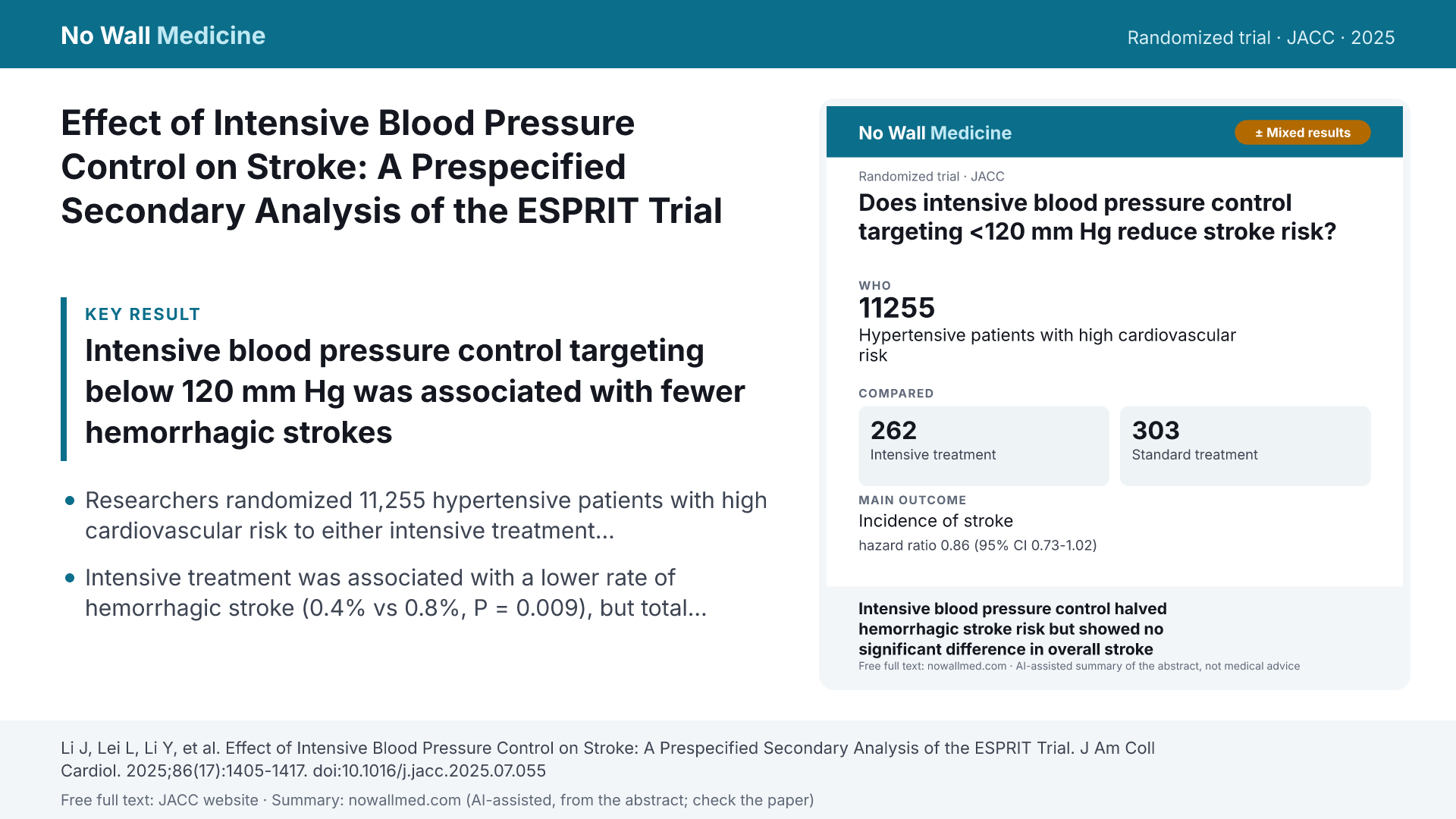
Intensive blood pressure control targeting below 120 mm Hg was associated with fewer hemorrhagic strokes
Effect of Intensive Blood Pressure Control on Stroke: A Prespecified Secondary Analysis of the ESPRIT Trial
Secondary analysis of a trialMixed results
Does intensive blood pressure control targeting <120 mm Hg reduce stroke risk?
Who
11255
Hypertensive patients with high cardiovascular risk
Compared
262Intensive treatment (4.7%)
303Standard treatment (5.4%)
Main outcome
Incidence of stroke
Result: hazard ratio 0.86 (95% CI 0.73-1.02)
Bottom line: Intensive blood pressure control halved hemorrhagic stroke risk but showed no significant difference in overall stroke incidence.
JACC · 2025-08-27 · Save PNG
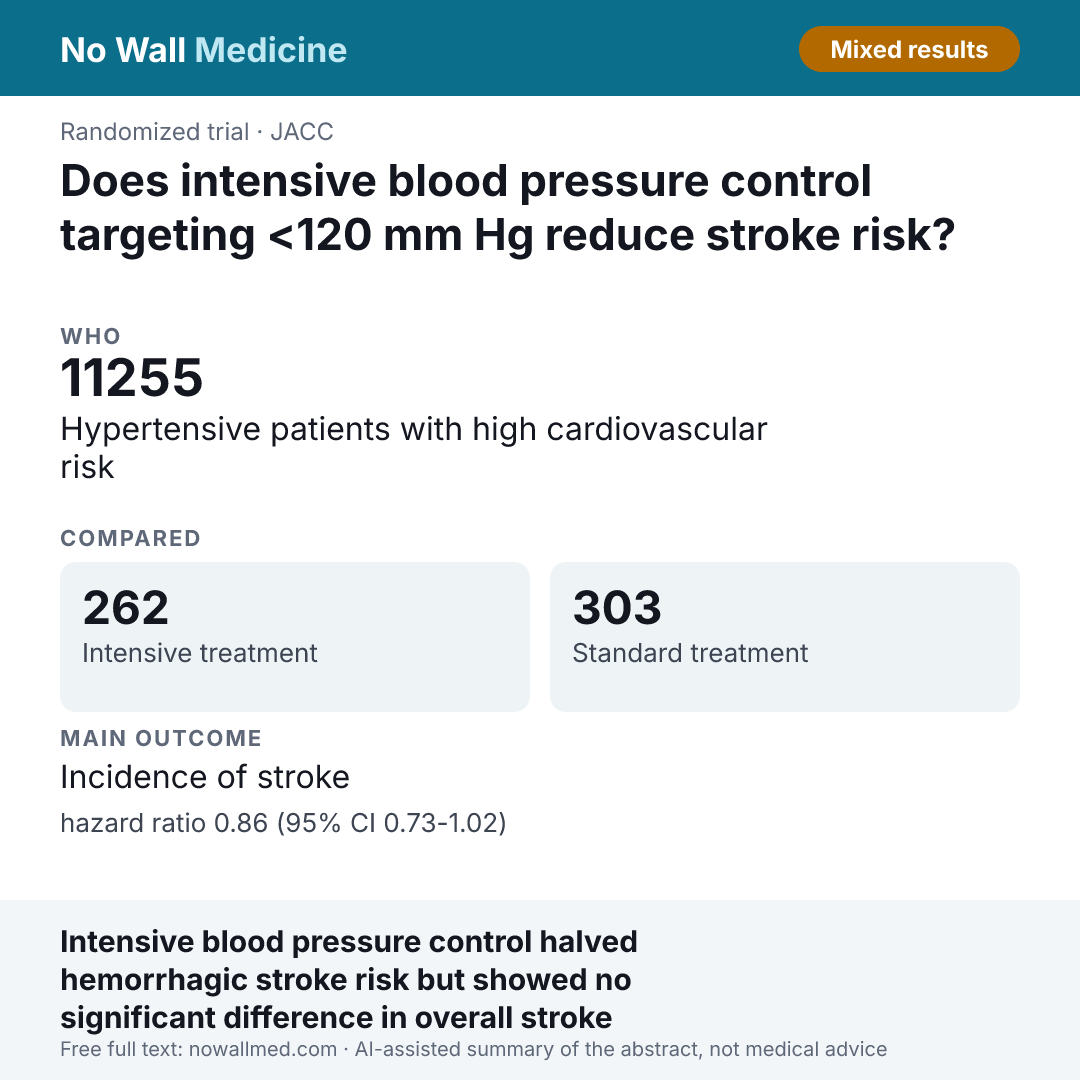
Clinical question: Does intensive blood pressure control targeting <120 mm Hg reduce stroke risk?
Key points
- Researchers randomized 11,255 hypertensive patients with high cardiovascular risk to either intensive treatment targeting systolic blood pressure below 120 mm Hg or standard treatment targeting below 140 mm Hg.
- Intensive treatment was associated with a lower rate of hemorrhagic stroke (0.4% vs 0.8%, P = 0.009), but total stroke incidence (4.7% vs 5.4%, P = 0.083) was not statistically significant.
- A landmark analysis showed the risk difference for stroke emerged after 1 year of intervention, with a hazard ratio of 0.75 for the period longer than 1 year.
Headline and key points written with AI from the paper’s abstract, with every number checked against it. Read the paper before relying on them.
Was this summary helpful?
Subject terms
Headline, design, result, key points, caveat and citation as plain text.
Cite this article
Li J, Lei L, Li Y, et al. Effect of Intensive Blood Pressure Control on Stroke: A Prespecified Secondary Analysis of the ESPRIT Trial. J Am Coll Cardiol. 2025;86(17):1405-1417. doi:10.1016/j.jacc.2025.07.055
Spotted a mistake? Suggest a correction