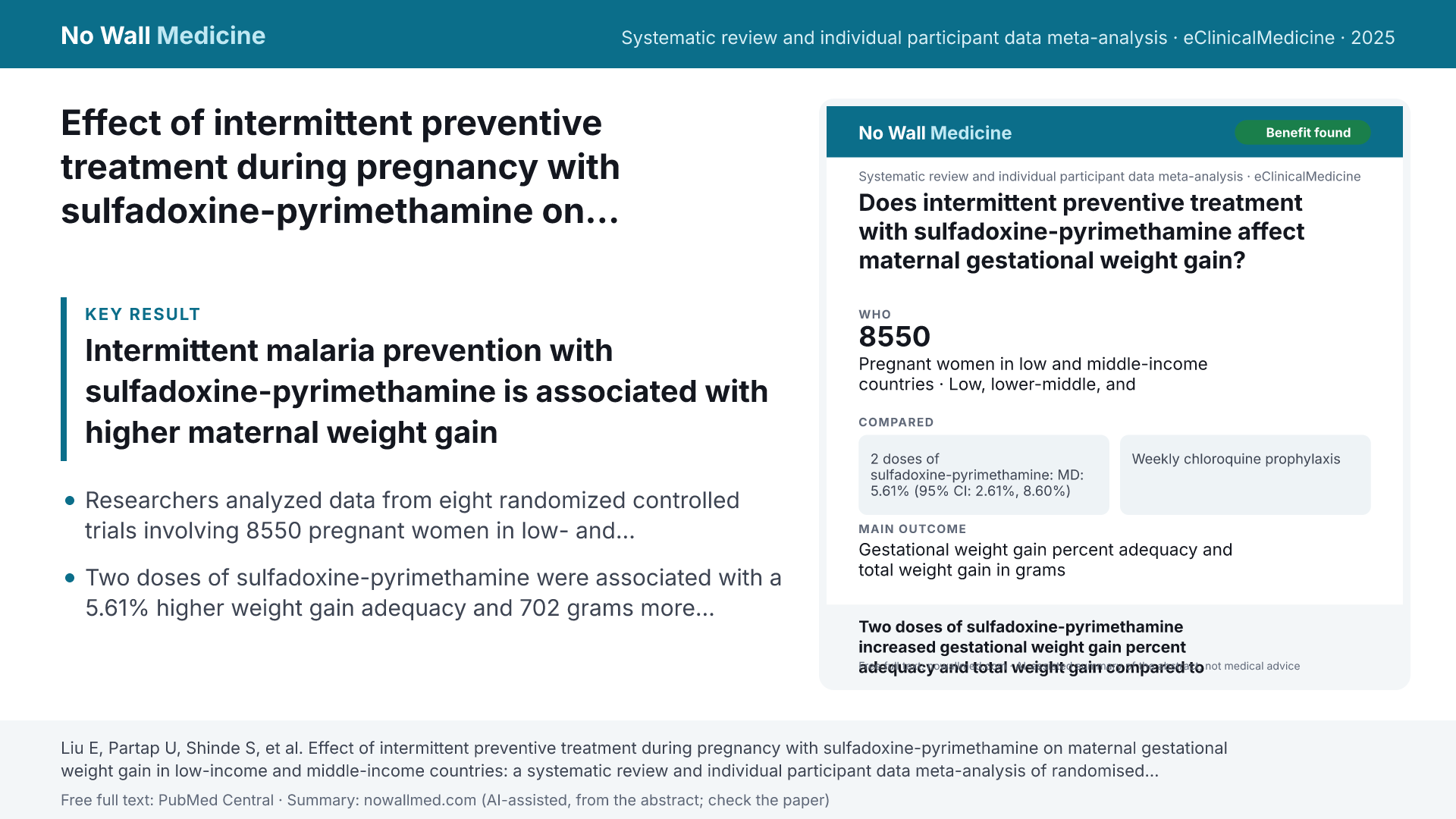
Effect of intermittent preventive treatment during pregnancy with sulfadoxine-pyrimethamine on maternal gestational weight gain in low-income and middle-income countries: a systematic review and individual participant data meta-analysis of randomised clinical trials
Key result: Intermittent malaria prevention with sulfadoxine-pyrimethamine is associated with higher maternal weight gain
Key points
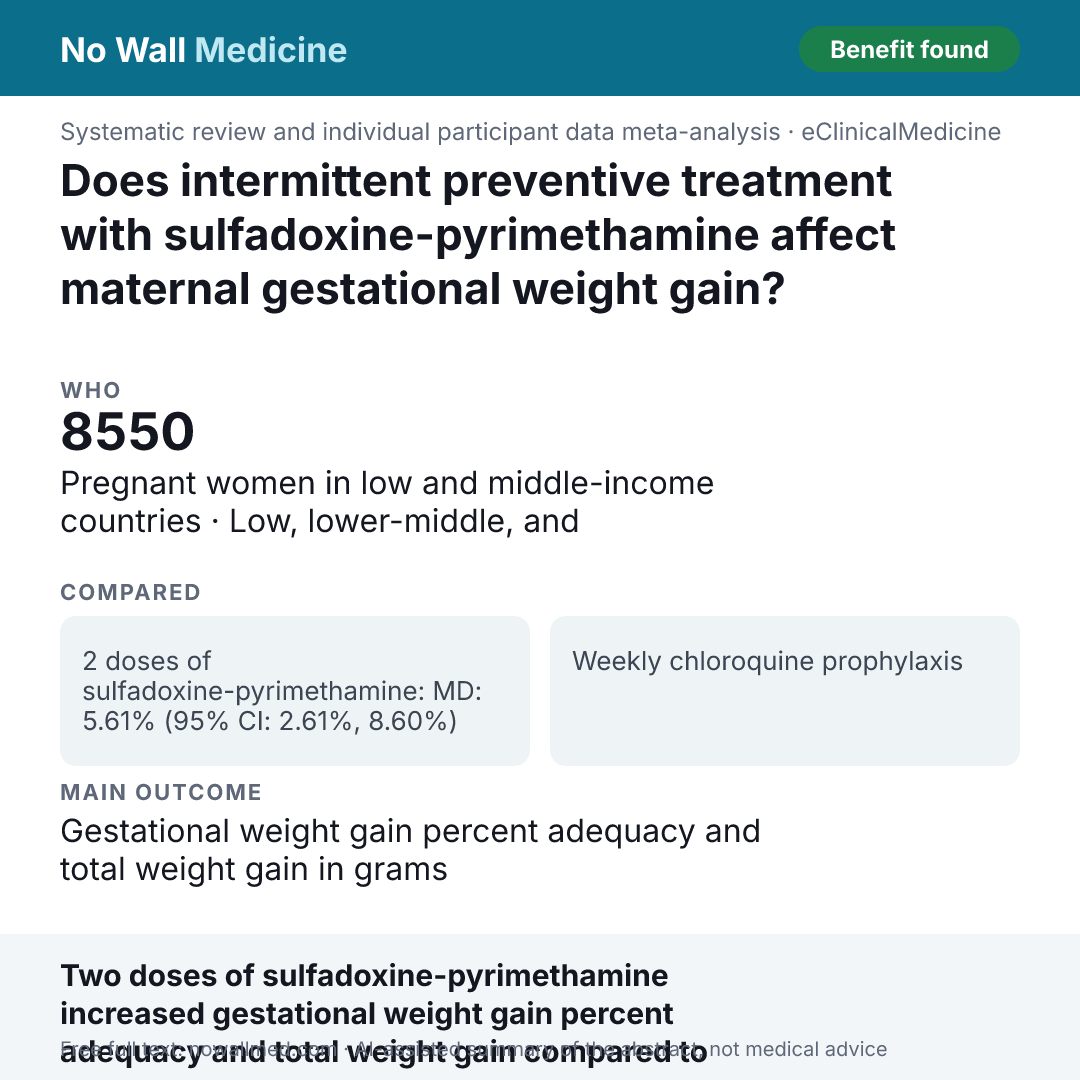
- Researchers analyzed data from eight randomized controlled trials involving 8550 pregnant women in low- and middle-income countries.
- Two doses of sulfadoxine-pyrimethamine were associated with a 5.61% higher weight gain adequacy and 702 grams more total weight gain compared to weekly chloroquine.
- Monthly sulfadoxine-pyrimethamine showed no significant difference in weight gain adequacy or total grams compared to the two-dose regimen.
Why it matters: Data regarding how intermittent preventive treatment for malaria affects maternal gestational weight gain is very limited.
Discussion prompts
- Would these patients look like yours? Who was left out?
- Is the main outcome one that matters to patients?
- Is the difference large enough to change what you do?
Cite: Liu E, Partap U, Shinde S, et al. Effect of intermittent preventive treatment during pregnancy with sulfadoxine-pyrimethamine on maternal gestational weight gain in low-income and middle-income countries: a systematic review and individual participant data meta-analysis of randomised clinical trials. EClinicalMedicine. 2025;84:103279. doi:10.1016/j.eclinm.2025.103279
Free full text: PubMed Central · Summary and visual abstract: nowallmed.com/a/effect-of-intermittent-preventive-treatment-during-pregnancy-with-mvz71a/ (AI-assisted from the abstract; check the paper before relying on it).