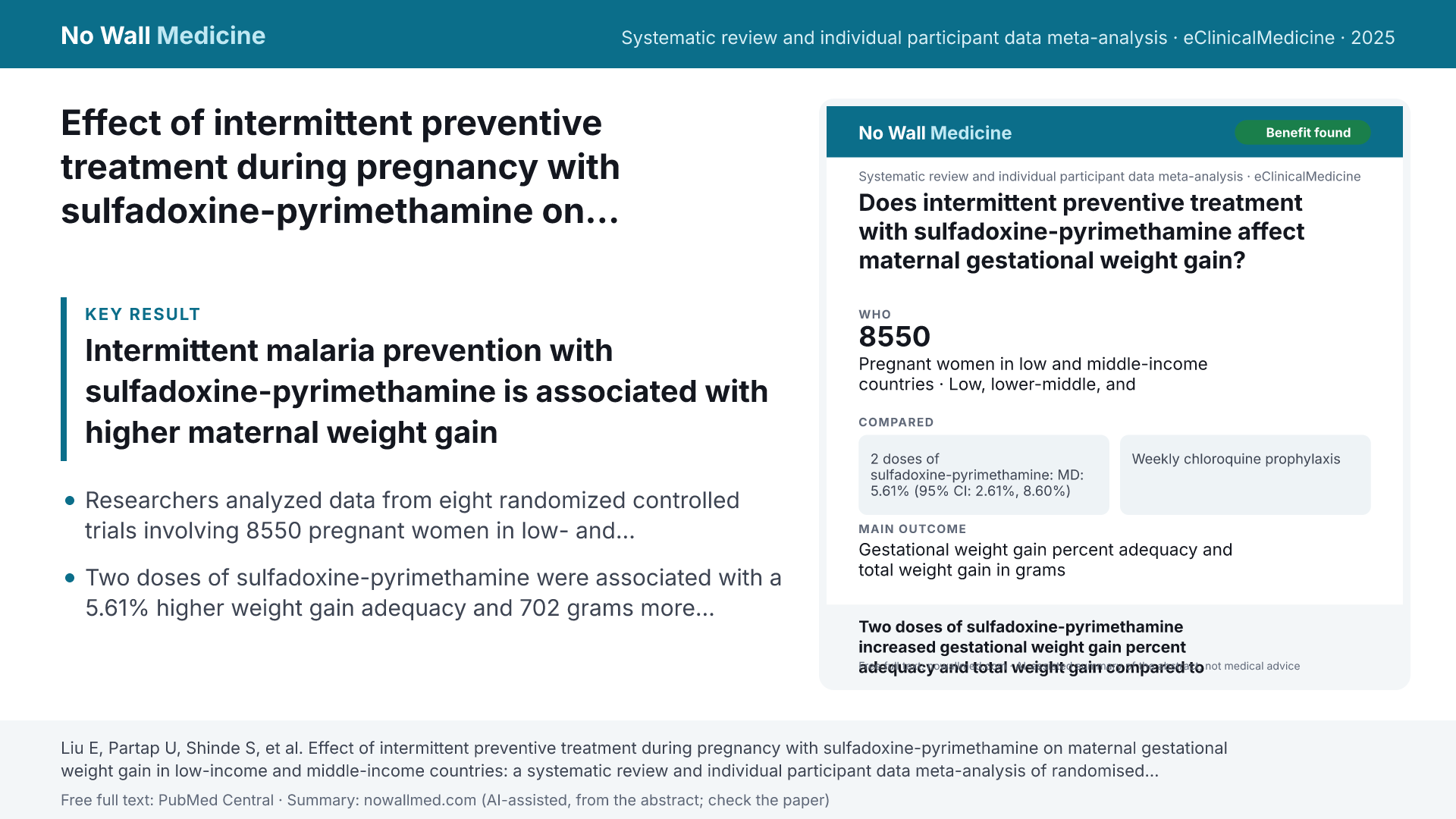
Intermittent malaria prevention with sulfadoxine-pyrimethamine is associated with higher maternal weight gain
Effect of intermittent preventive treatment during pregnancy with sulfadoxine-pyrimethamine on maternal gestational weight gain in low-income and middle-income countries: a systematic review and individual participant data meta-analysis of randomised clinical trials
Systematic review and individual participant data meta-analysisBenefit found
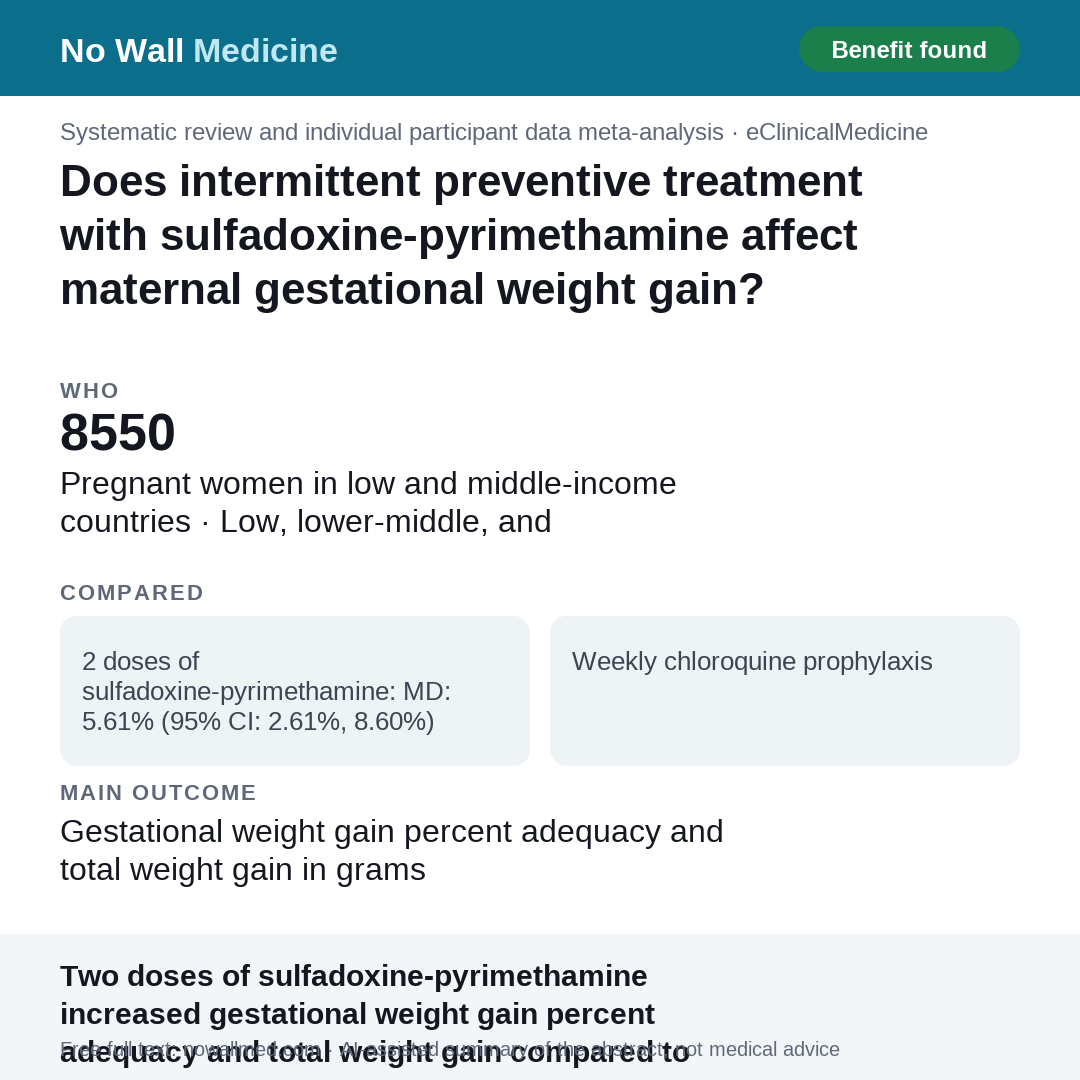
Does intermittent preventive treatment with sulfadoxine-pyrimethamine affect maternal gestational weight gain?
Who
8550
Pregnant women in low and middle-income countries · Low, lower-middle, and upper-middle-income countries
Compared
2 doses of sulfadoxine-pyrimethamine: MD: 5.61% (95% CI: 2.61%, 8.60%)
Weekly chloroquine prophylaxis
Main outcome
Gestational weight gain percent adequacy and total weight gain in grams
Result: MD: 5.61% (95% CI: 2.61%, 8.60%) for percent adequacy
Bottom line: Two doses of sulfadoxine-pyrimethamine increased gestational weight gain percent adequacy and total weight gain compared to weekly chloroquine.
eClinicalMedicine · 2025-06-02Download image
Clinical question: Does intermittent preventive treatment with sulfadoxine-pyrimethamine affect maternal gestational weight gain?
Why it matters: Data regarding how intermittent preventive treatment for malaria affects maternal gestational weight gain is very limited.
Key points
- Researchers analyzed data from eight randomized controlled trials involving 8550 pregnant women in low- and middle-income countries.
- Two doses of sulfadoxine-pyrimethamine were associated with a 5.61% higher weight gain adequacy and 702 grams more total weight gain compared to weekly chloroquine.
- Monthly sulfadoxine-pyrimethamine showed no significant difference in weight gain adequacy or total grams compared to the two-dose regimen.
Headline and key points written with AI from the paper’s abstract, with every number checked against it. Read the paper before relying on them.
Was this summary helpful?
Cite this article
Liu E, Partap U, Shinde S, et al. Effect of intermittent preventive treatment during pregnancy with sulfadoxine-pyrimethamine on maternal gestational weight gain in low-income and middle-income countries: a systematic review and individual participant data meta-analysis of randomised clinical trials. eClinicalMedicine. 2025. doi:10.1016/j.eclinm.2025.103279
Spotted a mistake? Suggest a correction