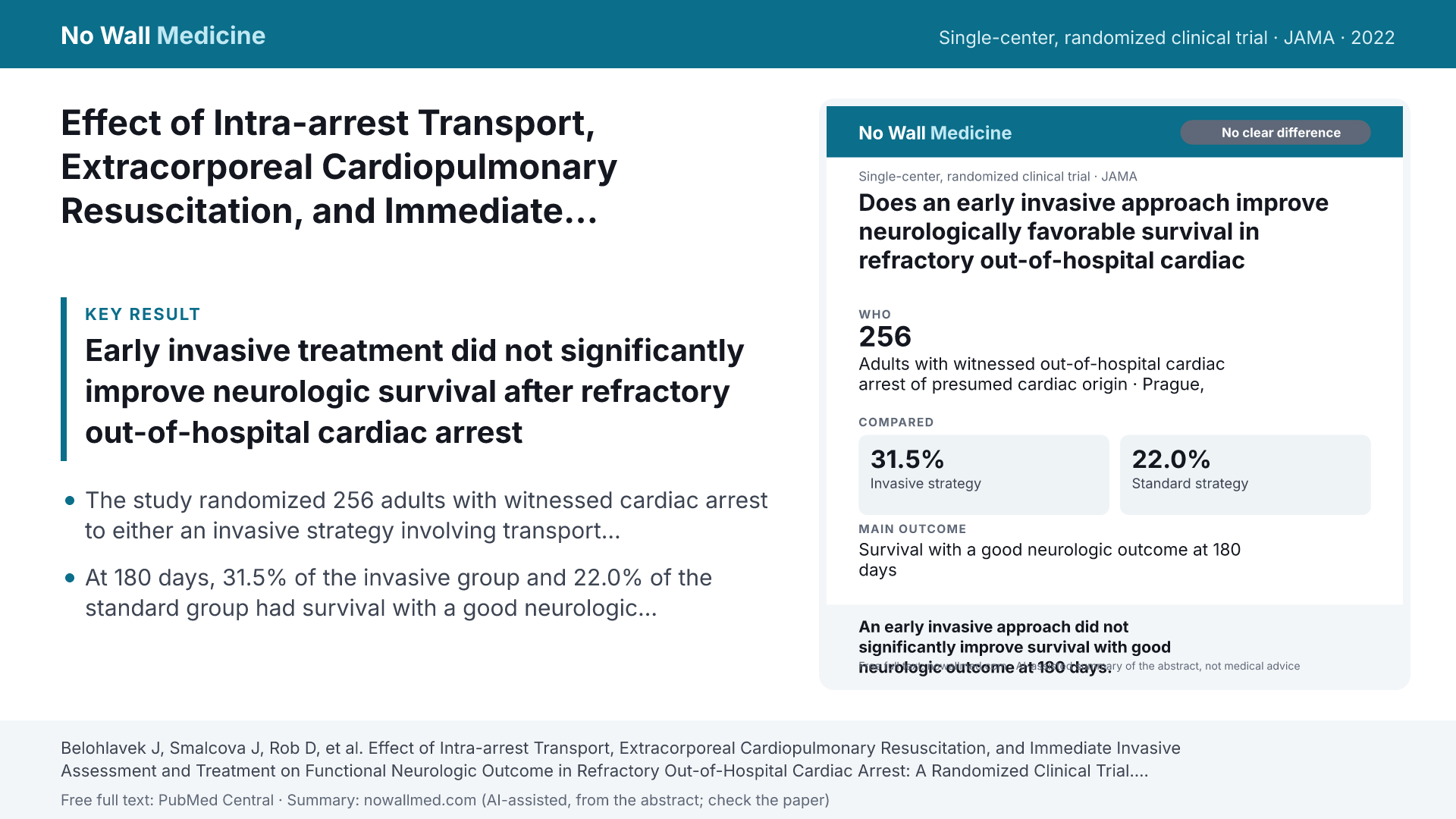
Early invasive treatment did not significantly improve neurologic survival after refractory out-of-hospital cardiac arrest
Effect of Intra-arrest Transport, Extracorporeal Cardiopulmonary Resuscitation, and Immediate Invasive Assessment and Treatment on Functional Neurologic Outcome in Refractory Out-of-Hospital Cardiac Arrest: A Randomized Clinical Trial
Single-center, randomized clinical trialNo clear difference
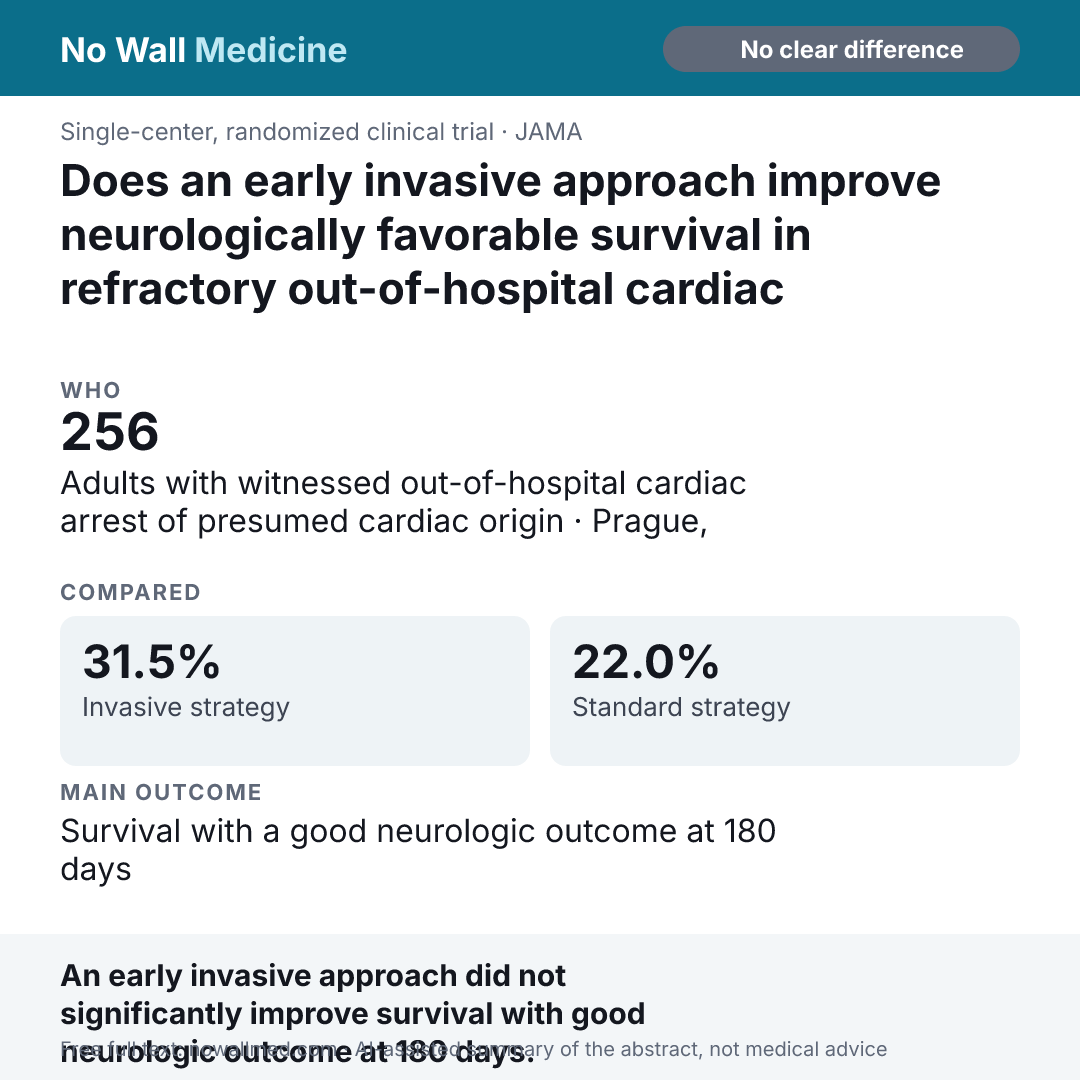
Does an early invasive approach improve neurologically favorable survival in refractory out-of-hospital cardiac arrest?
Who
256
Adults with witnessed out-of-hospital cardiac arrest of presumed cardiac origin · Prague, Czech Republic
Compared
31.5%Invasive strategy
22.0%Standard strategy
Main outcome
Survival with a good neurologic outcome at 180 days
Result: odds ratio 1.63 (95% CI 0.93 to 2.85)
Bottom line: An early invasive approach did not significantly improve survival with good neurologic outcome at 180 days.
Limitation: The trial was possibly underpowered to detect a clinically relevant difference.
JAMA · 2022-02-22 · Save PNG
Same trial (NCT01511666)
Papers we list that report this registered trial, oldest first. Read a secondary analysis alongside the main results.
- Main results No clear difference
This paper JAMA 2022-02 - Secondary analysis Benefit found
Extracorporeal cardiopulmonary resuscitation was associated with higher survival after refractory out-of-hospital cardiac arrest Crit Care 2022-10 - Secondary analysis Benefit found
ECPR approach increased organ donorship in refractory out-of-hospital cardiac arrest Resuscitation 2023-10 - Longer follow-up Benefit found
Extracorporeal cardiopulmonary resuscitation was associated with higher long-term survival in refractory out-of-hospital cardiac arrest Crit Care 2024-04
Clinical question: Does an early invasive approach improve neurologically favorable survival in refractory out-of-hospital cardiac arrest?
Key points
- The study randomized 256 adults with witnessed cardiac arrest to either an invasive strategy involving transport and extracorporeal cardiopulmonary resuscitation or a standard resuscitation strategy.
- At 180 days, 31.5% of the invasive group and 22.0% of the standard group had survival with a good neurologic outcome, which was not a statistically significant difference.
- Bleeding occurred more frequently in the invasive strategy group at 31% compared to 15% in the standard strategy group.
Limitation the authors note: The trial was stopped early because of futility criteria and was possibly underpowered to detect a clinically relevant difference.
Headline and key points written with AI from the paper’s abstract, with every number checked against it. Read the paper before relying on them.
Was this summary helpful?
Subject terms
Headline, design, result, key points, caveat and citation as plain text.
Cite this article
Belohlavek J, Smalcova J, Rob D, et al. Effect of Intra-arrest Transport, Extracorporeal Cardiopulmonary Resuscitation, and Immediate Invasive Assessment and Treatment on Functional Neurologic Outcome in Refractory Out-of-Hospital Cardiac Arrest: A Randomized Clinical Trial. JAMA. 2022;327(8):737-747. doi:10.1001/jama.2022.1025
Spotted a mistake? Suggest a correction