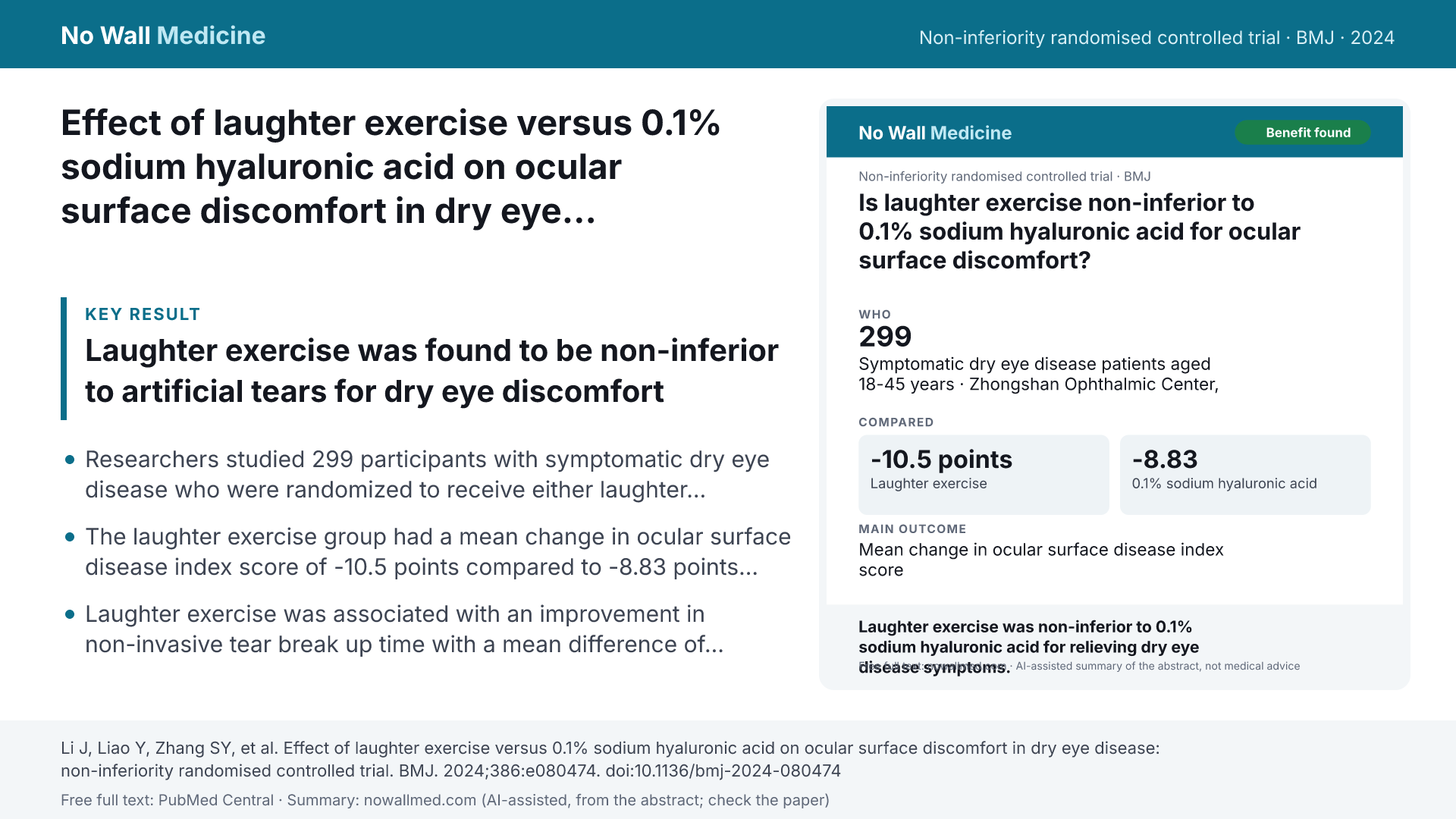
Laughter exercise was found to be non-inferior to artificial tears for dry eye discomfort
Effect of laughter exercise versus 0.1% sodium hyaluronic acid on ocular surface discomfort in dry eye disease: non-inferiority randomised controlled trial
Non-inferiority randomised controlled trialBenefit found
Is laughter exercise non-inferior to 0.1% sodium hyaluronic acid for ocular surface discomfort?
Who
299
Symptomatic dry eye disease patients aged 18-45 years · Zhongshan Ophthalmic Center, China
Compared
-10.5 pointsLaughter exercise (95% CI -13.1 to -7.82)
-8.830.1% sodium hyaluronic acid (-11.7 to -6.02)
Main outcome
Mean change in ocular surface disease index score
Result: mean difference -1.45 points (95% CI -5.08 to 2.19)
Bottom line: Laughter exercise was non-inferior to 0.1% sodium hyaluronic acid for relieving dry eye disease symptoms.
Limitation: Participants were unmasked to their group assignment for practical reasons.
BMJ · 2024-09-11 · Save PNG
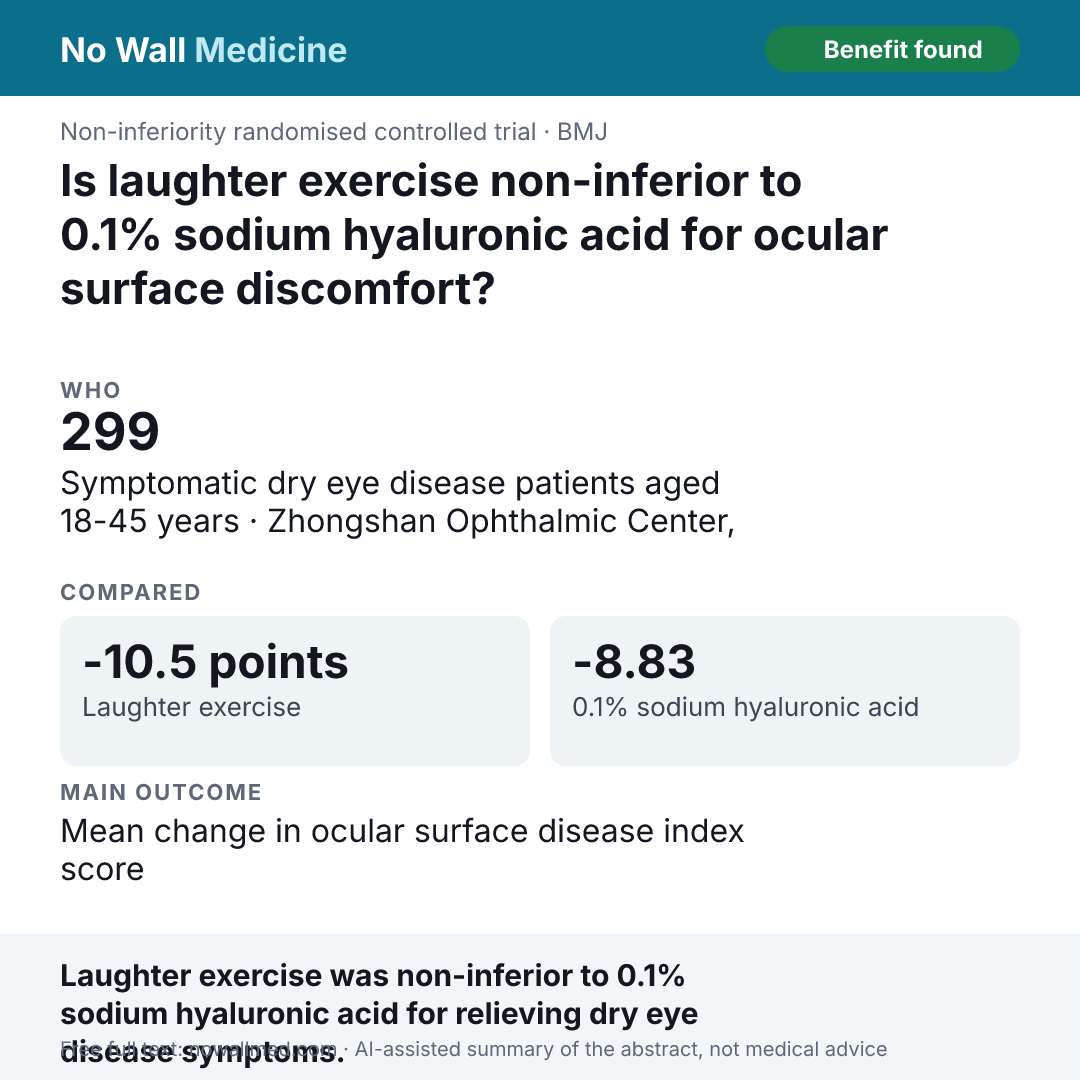
Clinical question: Is laughter exercise non-inferior to 0.1% sodium hyaluronic acid for ocular surface discomfort?
Key points
- Researchers studied 299 participants with symptomatic dry eye disease who were randomized to receive either laughter exercise or 0.1% sodium hyaluronic acid eye drops for eight weeks.
- The laughter exercise group had a mean change in ocular surface disease index score of -10.5 points compared to -8.83 points in the artificial tears group.
- Laughter exercise was associated with an improvement in non-invasive tear break up time with a mean difference of 2.30 seconds compared to the control group.
Limitation the authors note: Participants were unmasked to their group assignment for practical reasons.
Headline and key points written with AI from the paper’s abstract, with every number checked against it. Read the paper before relying on them.
Was this summary helpful?
Abstract
Objective
To assess efficacy and safety of laughter exercise in patients with symptomatic dry eye disease. Design
Non-inferiority randomised controlled trial. Setting
Recruitment was from clinics and community and the trial took place at Zhongshan Ophthalmic Center, Sun Yat-sen University, the largest ophthalmic centre in China, between 18 June 2020 to 8 January 2021. Participants
People with symptomatic dry eye disease aged 18-45 years with ocular surface disease index scores ranging from 18 to 80 and tear film break-up time of eight seconds or less. Interventions
Participants were randomised 1:1 to receive laughter exercise or artificial tears (0.1% sodium hyaluronic acid eyedrop, control group) four times daily for eight weeks. The laughter exercise group viewed an instructional video and participants were requested to vocalise the phrases "Hee hee hee, hah hah hah, cheese cheese cheese, cheek cheek cheek, hah hah hah hah hah hah" 30 times per five minute session. Investigators assessing study outcomes were masked to group assignment but participants were unmasked for practical reasons. Main outcome measures
The primary outcome was the mean change in the ocular surface disease index (0-100, higher scores indicating worse ocular surface discomfort) from baseline to eight weeks in the per protocol population. The non-inferiority margin was 6 points of this index score. Main secondary outcomes included the proportion of patients with a decrease from baseline in ocular surface disease index score of at least 10 points and changes in dry eye disease signs, for example, non-invasive tear break up time at eight weeks. Results
299 participants (mean age 28.9 years; 74% female) were randomly assigned to receive laughter exercise (n=149) or 0.1% sodium hyaluronic acid (n=150). 283 (95%) completed the trial. The mean change in ocular surface disease index score at eight weeks was -10.5 points (95% confidence interval (CI) -13.1 to -7.82) in the laughter exercise group and -8.83 (-11.7 to -6.02) in the control group. The upper boundary of the CI for difference in change between groups was lower than the non-inferiority margin (mean difference -1.45 points (95% CI -5.08 to 2.19); P=0.43), supporting non-inferiority. Among secondary outcomes, the laughter exercise was better in improving non-invasive tear break up time (mean difference 2.30 seconds (95% CI 1.30 to 3.30), P<0.001); other secondary outcomes showed no significant difference. No adverse events were noted in either study group. Conclusions
The laughter exercise was non-inferior to 0.1% sodium hyaluronic acid in relieving subjective symptoms in patients with dry eye disease with limited corneal staining over eight weeks intervention. Trial registration
ClinicalTrials.gov NCT04421300.
Abstract reproduced under the article’s CC BY NC licence.
Subject terms
Headline, design, result, key points, caveat and citation as plain text.
Cite this article
Li J, Liao Y, Zhang SY, et al. Effect of laughter exercise versus 0.1% sodium hyaluronic acid on ocular surface discomfort in dry eye disease: non-inferiority randomised controlled trial. BMJ. 2024;386:e080474. doi:10.1136/bmj-2024-080474
Spotted a mistake? Suggest a correction