Antiseptic eye drops with steroids may help resolve symptoms of epidemic keratoconjunctivitis
Topical Pharmacologic Interventions Versus Active Control, Placebo, or No Treatment for Epidemic Keratoconjunctivitis: Findings From a Cochrane Systematic Review
Systematic review of randomized controlled trialsBenefit found
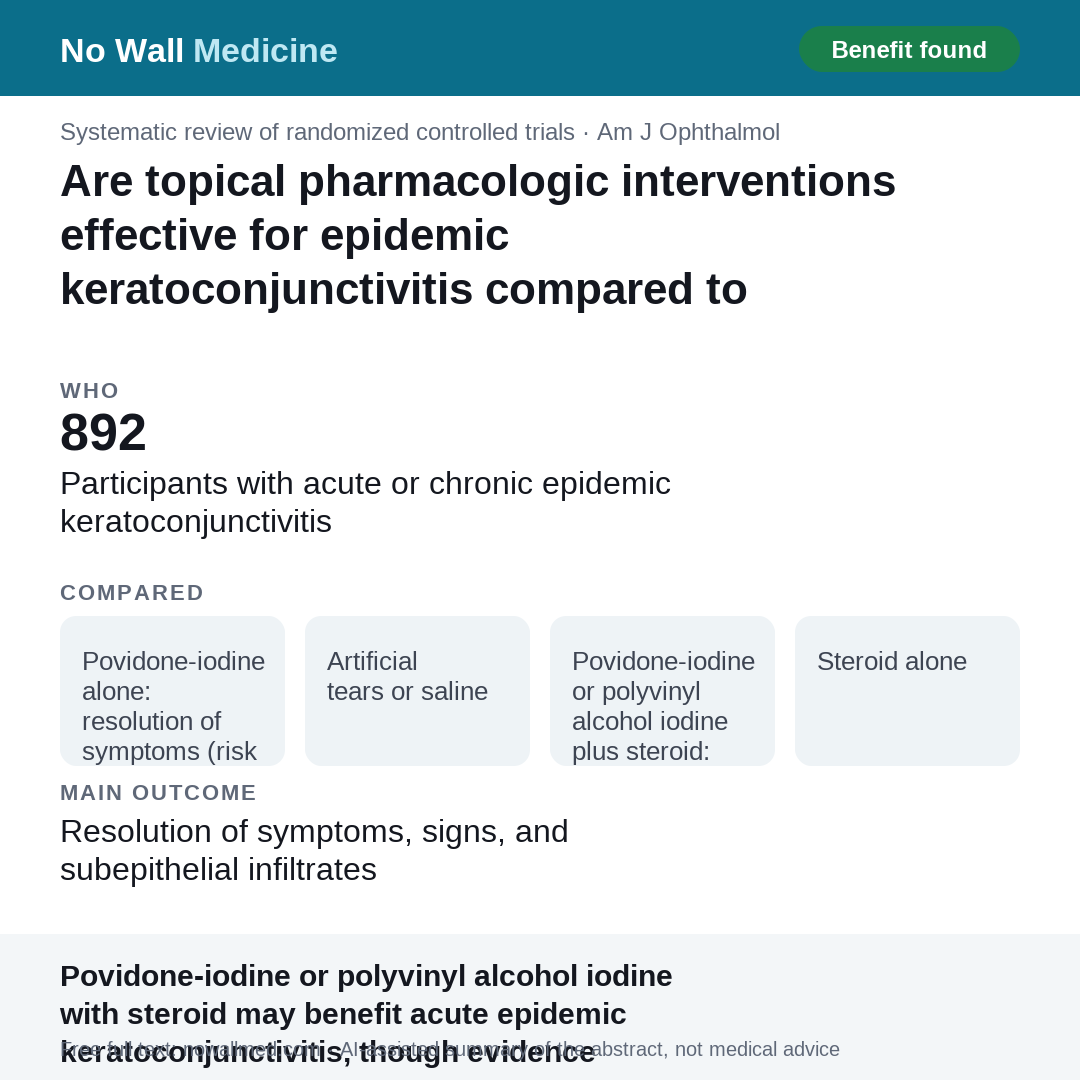
Are topical pharmacologic interventions effective for epidemic keratoconjunctivitis compared to controls?
Who
892
Participants with acute or chronic epidemic keratoconjunctivitis
Compared
Povidone-iodine alone: resolution of symptoms (risk ratio 1.15 [95% confidence interval 1.07-1.24])
Artificial tears or saline
Povidone-iodine or polyvinyl alcohol iodine plus steroid: fewer eyes developed subepithelial infiltrates (risk ratio 0.08 [95% confidence interval 0.01-0.55])
Steroid alone
Main outcome
Resolution of symptoms, signs, and subepithelial infiltrates
Result: risk ratio 1.15 (95% CI 1.07-1.24); risk ratio 0.08 (95% CI 0.01-0.55)
Bottom line: Povidone-iodine or polyvinyl alcohol iodine with steroid may benefit acute epidemic keratoconjunctivitis, though evidence certainty is low.
Limitation: Imprecision from small sample sizes, potential risk of bias, and variability in participant selection and reporting.
Am J Ophthalmol · 2022-03-22Download image
Clinical question: Are topical pharmacologic interventions effective for epidemic keratoconjunctivitis compared to controls?
Why it matters: It is unclear whether antiseptic agents, virus-fighting agents, or immune-modulating eye drops are more effective than placebo or standard treatments for epidemic keratoconjunctivitis.
Key points
- Researchers reviewed 10 randomized controlled trials involving 892 participants with acute or chronic epidemic keratoconjunctivitis, an eye infection.
- Compared to artificial tears, povidone-iodine alone was associated with more symptom resolution (risk ratio 1.15) and sign resolution (risk ratio 3.19) within 10 days.
- Using povidone-iodine or polyvinyl alcohol iodine with steroids was associated with fewer subepithelial infiltrates, which are small white spots on the cornea, within 21 days.
Limitation the authors note: The evidence is limited by low certainty, small sample sizes, potential risk of bias, and variability in how participants and outcomes were measured.
Headline and key points written with AI from the paper’s abstract, with every number checked against it. Read the paper before relying on them.
Was this summary helpful?
Subject terms
Cite this article
Liu SH, Hawkins BS, Ren M, Ng SM, Leslie L, Han G. Topical Pharmacologic Interventions Versus Active Control, Placebo, or No Treatment for Epidemic Keratoconjunctivitis: Findings From a Cochrane Systematic Review. Am J Ophthalmol. 2022. doi:10.1016/j.ajo.2022.03.018
Spotted a mistake? Suggest a correction
Top studies every Monday
The week’s key trials and guidelines in your specialties, plus any topics you follow. By email, free.
Get the weekly digest