Chlorhexidine Versus Povidone-Iodine for Intravitreal Injection Antisepsis: A Systematic Review and Meta-Analysis
Systematic review and meta-analysisNo clear difference
Is chlorhexidine or povidone-iodine more effective and safe for preventing postinjection endophthalmitis?
Who
Patients undergoing intravitreal injections
Compared
0.032%Chlorhexidine
0.026%Povidone-iodine
Main outcome
Incidence of presumed postinjection endophthalmitis
Result: odds ratio 2.03 (95% CI 0.74 to 5.58)
Bottom line: Chlorhexidine and povidone-iodine showed similar endophthalmitis rates, but chlorhexidine had a more favorable safety and pain profile.
Am J Ophthalmol · 2025-03-26Download image
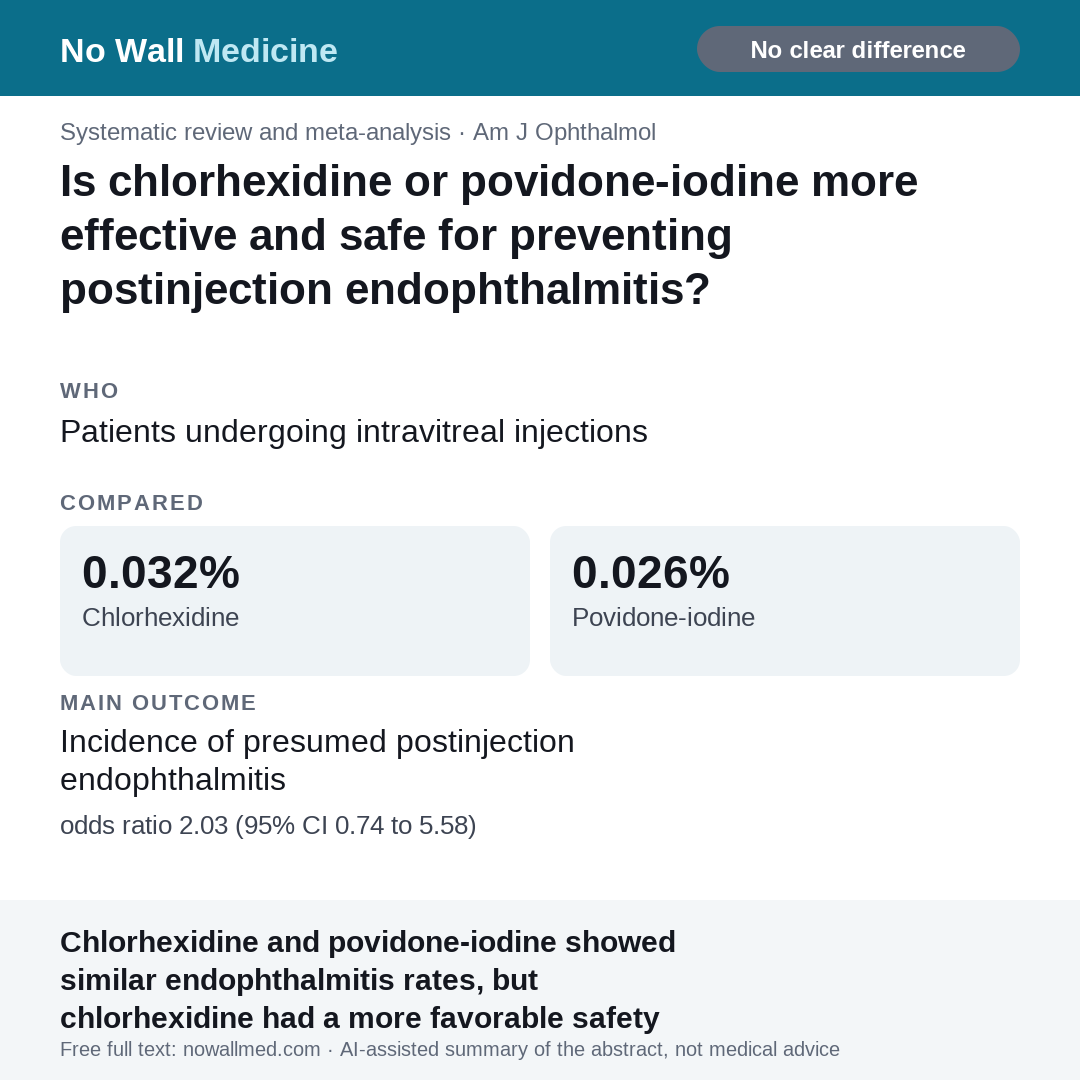
Clinical question: Is chlorhexidine or povidone-iodine more effective and safe for preventing postinjection endophthalmitis?
Abstract
Purpose
While povidone-iodine (PI) is a commonly used antiseptic solution for postinjection endophthalmitis (PIE) prophylaxis, chlorhexidine (CHX) may be better tolerated by patients. This systematic review and meta-analysis aims to comprehensively compare the efficacy and safety of CHX and PI for PIE prophylaxis. Design
Systematic Review and Meta-Analysis. Methods
MEDLINE, Embase, and the Cochrane Library were systematically searched for relevant literature from January 2000 to July 2024. Studies that compared CHX with PI for either PIE prophylaxis, functional outcomes, or safety outcomes were included. A random-effects meta-analysis was performed, using the Mantel-Haenszel method for dichotomous outcomes and inverse variance method for continuous outcomes. The primary outcomes were the comparative PIE incidence after CHX versus PI. Secondary outcomes pertained to best-corrected visual acuity (BCVA), patient intolerance, pain, safety endpoints, and specimens cultured. Results
A total of seven studies were included. The incidence of presumed PIE (nCHX = 60/185,849, 0.032% vs nPI = 69/269,491, 0.026%), culture-positive PIE (nCHX = 30/185,849 0.016% vs nPI = 24/269,491, 0.009%; odds ratio [OR] = 2.03, 95% confidence interval [CI] = [0.74, 5.58], P = .17) and culture-negative PIE (nCHX = 30/185,849, 0.016% vs nPI = 45/269,491, 0.017%; OR = 0.97, 95% CI = [0.45, 2.06], P = .93) were nonsignificantly different between PI and CHX groups. No significant risk differences were observed for these outcomes. Across three studies reporting on 54 eyes with culture-positive endophthalmitis, the odds of having positive Staphylococcus epidermidis cultures were significantly lower in the CHX group (nCHX = 9/30, 30.0% vs nPI = 18/24, 75.0%; OR = 0.15, 95% CI = [0.04, 0.54], P = .004); however, the odds were nonsignificantly different for Staphylococcus aureus (P = .64), Streptococcus viridans (P = .46), Streptococcus mitis (P = .83), and Enterococcus faecalis (P = .46). In cases of endophthalmitis, the mean BCVA was nonsignificantly different between CHX and PI groups at the last study observation (P = .67). The systematic review revealed minimal patient intolerance to CHX, more favorable reductions in pain with CHX than PI, greater corneal epitheliopathy with PI than CHX, and nonsignificantly different reductions in ocular surface microbial isolates between comparators. Conclusions
CHX and PI were associated with nonsignificantly different rates of presumed, culture-positive, and culture-negative PIE. Endophthalmitis cases associated with both antiseptic agents had a comparable prognosis with respect to BCVA. However, CHX exhibited a more favorable safety and pain profile compared to PI and was associated with a lower odds of positive S. epidermidis cultures in endophthalmitis cases.
Subject terms
Cite this article
Mihalache A, Tao BK, Huang RS, Dhivagaran T, Popovic MM, Kertes PJ. Chlorhexidine Versus Povidone-Iodine for Intravitreal Injection Antisepsis: A Systematic Review and Meta-Analysis. Am J Ophthalmol. 2025. doi:10.1016/j.ajo.2025.03.031
Spotted a mistake? Suggest a correction
Top studies every Monday
The week’s key trials and guidelines in your specialties, plus any topics you follow. By email, free.
Get the weekly digest