PBO insecticidal nets reduced malaria parasite prevalence more than conventional nets
Effect of long-lasting insecticidal nets with and without piperonyl butoxide on malaria indicators in Uganda (LLINEUP): final results of a cluster-randomised trial embedded in a national distribution campaign
Cluster-randomised trialBenefit found
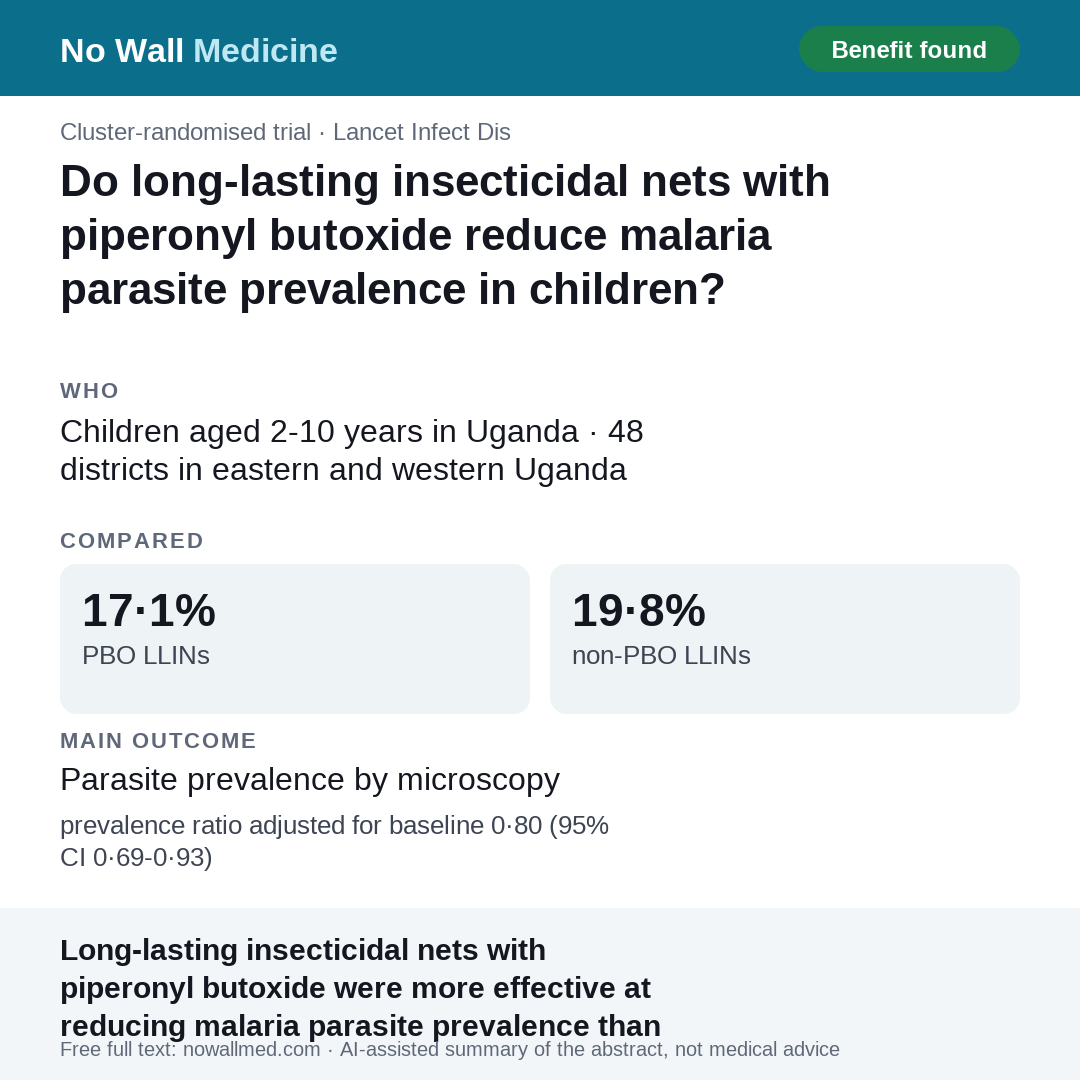
Do long-lasting insecticidal nets with piperonyl butoxide reduce malaria parasite prevalence in children?
Who
Children aged 2-10 years in Uganda · 48 districts in eastern and western Uganda
Compared
17·1%PBO LLINs (506 of 2958)
19·8%non-PBO LLINs (701 of 3534)
Main outcome
Parasite prevalence by microscopy
Result: prevalence ratio adjusted for baseline 0·80 (95% CI 0·69-0·93)
Bottom line: Long-lasting insecticidal nets with piperonyl butoxide were more effective at reducing malaria parasite prevalence than conventional nets.
Lancet Infect Dis · 2022-09-26Download image
Clinical question: Do long-lasting insecticidal nets with piperonyl butoxide reduce malaria parasite prevalence in children?
Why it matters: Effectiveness of long-lasting insecticidal nets with piperonyl butoxide was unknown against malaria with pyrethroid resistance
Key points
- 104 health subdistricts in Uganda were randomly assigned to PBO or conventional long-lasting insecticidal nets.
- Parasite prevalence was 17·1% with PBO nets and 19·8% with conventional nets at 25 months.
- PBO nets had a lower parasite prevalence ratio of 0·80 compared to conventional nets.
Limitation the authors note: Due to COVID-19 restrictions, only 90 of the 104 clusters were surveyed at 25 months
Headline and key points written with AI from the paper’s abstract, with every number checked against it. Read the paper before relying on them.
Was this summary helpful?
Abstract
Background
Long-lasting insecticidal nets (LLINs) are the foundation of malaria control but resistance of mosquito vectors to pyrethroids threatens their effectiveness. We embedded a cluster-randomised trial into Uganda's 2017-18 campaign to distribute LLINs. LLINs with piperonyl butoxide (PBO) reduced parasite prevalence more effectively than conventional LLINs (without PBO) for 18 months. Here, we report the final 25-month survey results. Methods
LLINEUP was a cluster-randomised trial conducted in 48 districts in eastern and western Uganda. 104 health subdistricts (clusters) without ongoing or planned indoor residual spraying with pirimiphos-methyl (Actellic, Basel, Switzerland) were eligible for inclusion in the trial. Clusters were randomly assigned to PBO LLINs (PermaNet 3.0 or Olyset Plus) and conventional LLINs (PermaNet 2.0 or Olyset Net) with proportionate randomisation using STATA version 14.2. LLINs were delivered from March 25, 2017, to March 18, 2018. Between April 23, 2019, and Sept 13, 2019, community surveys were conducted in 50 randomly selected households per cluster; ten households per cluster were randomly selected for entomology surveys. Mosquitoes were collected in the morning from indoor surfaces of households using Prokopack aspirators. Due to COVID-19 restrictions, only 90 of the 104 clusters were surveyed at 25 months. The primary outcome was parasite prevalence by microscopy in children aged 2-10 years, assessed in the as-treated population, determined using the results from the 6-month household survey on the type of LLINs received in each cluster. This trial is registered with ISRCTN, ISRCTN17516395, and is now completed. Findings
In the as-treated analysis, two clusters were excluded (no predominant LLIN received) and four were reassigned; 40 PBO LLIN clusters (30 PermaNet 3.0, ten Olyset Plus) and 48 non-PBO LLIN (36 PermaNet 2.0, 12 Olyset Net) were included. Parasite prevalence was 17·1% (506 of 2958 participants) in the PBO group and 19·8% (701 of 3534) in the non-PBO group (prevalence ratio adjusted for baseline 0·80 [95% CI 0·69-0·93], p=0·0048). Comparing within-treatment group parasite prevalence to baseline, parasite prevalence ratios were lower in the PBO groups at all timepoints, but the difference was greatest at 6 months (PBO LLINs parasite prevalence at baseline 28·8% [1001 of 3472, 95% CI 27·3-30·4] vs at 6 months 12·0% [361 of 3009, 10·9-13·2], prevalence ratio [PR] 0·43 [95% CI 0·36-0·52], p<0·0001; non-PBO LLINs parasite prevalence at baseline 25·4% [1015 of 4004, 24·0-26·7] vs 6 months 14·8% [526 of 3551, 13·7-16·0], PR 0·60 [0·54-0·68], p<0·0001) and 25 months (PBO LLINs parasite prevalence at 25 months 17·1% [506 of 2958, 15·8-18·5], PR 0·63 [95% CI 0·57-0·71], p<0·0001; non-PBO LLINs parasite prevalence at 25 months 19·8% [701 of 3534, 18·5-21·2], PR 0·79 [0·73-0·86], p<0·0001). Interpretation
In Uganda, PBO LLINs outperformed pyrethroid-only LLINs for 25 months. WHO concluded that PBO LLINs are more effective against malaria than non-PBO LLINs when resistance to pyrethroids is high and issued a conditional recommendation suggesting PBO LLINs should be deployed in areas of pyrethroid resistance. Funding
The Against Malaria Foundation, UK Department for International Development, Innovative Vector Control Consortium, and Bill and Melinda Gates Foundation.
Abstract reproduced under the article’s CC BY licence.
Subject terms
Cite this article
Maiteki-Sebuguzi C, Gonahasa S, Kamya MR, Katureebe A, Bagala I, Lynd A. Effect of long-lasting insecticidal nets with and without piperonyl butoxide on malaria indicators in Uganda (LLINEUP): final results of a cluster-randomised trial embedded in a national distribution campaign. Lancet Infect Dis. 2022. doi:10.1016/S1473-3099(22)00469-8
Spotted a mistake? Suggest a correction
Top studies every Monday
The week’s key trials and guidelines in your specialties, plus any topics you follow. By email, free.
Get the weekly digest