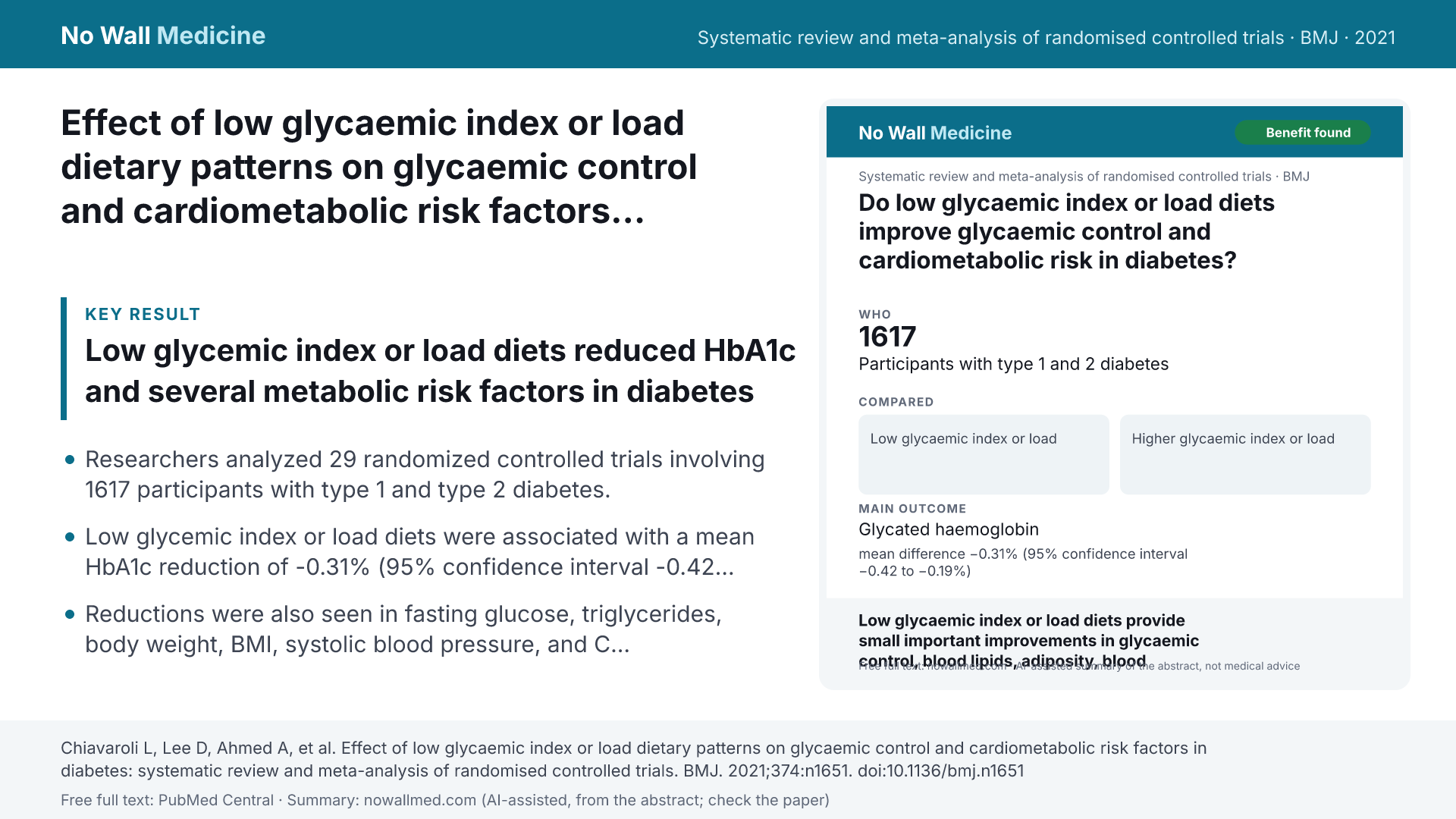
Low glycemic index or load diets reduced HbA1c and several metabolic risk factors in diabetes
Effect of low glycaemic index or load dietary patterns on glycaemic control and cardiometabolic risk factors in diabetes: systematic review and meta-analysis of randomised controlled trials
Systematic review and meta-analysis of randomised controlled trialsBenefit found
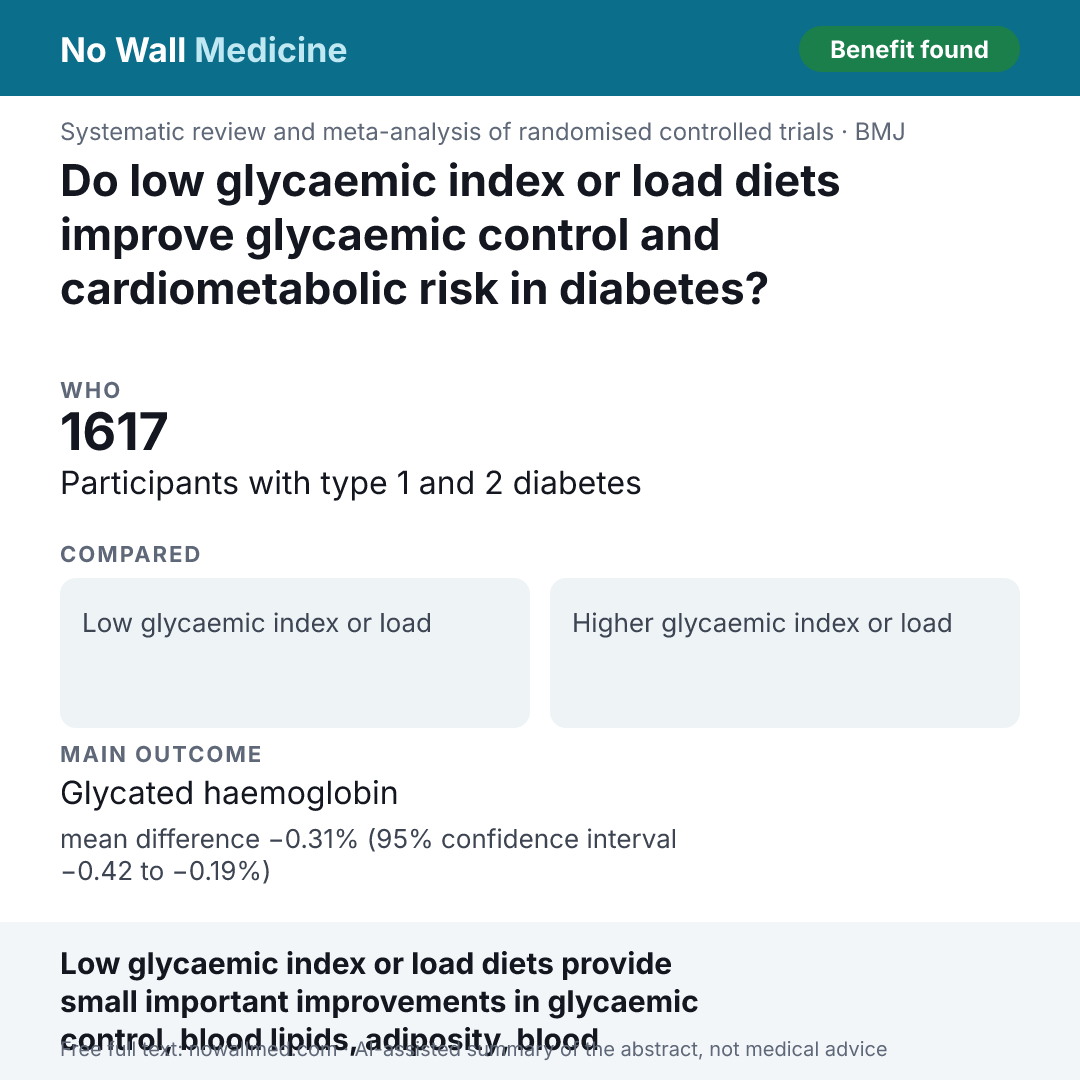
Do low glycaemic index or load diets improve glycaemic control and cardiometabolic risk in diabetes?
Who
1617
Participants with type 1 and 2 diabetes
Compared
Low glycaemic index or load
Higher glycaemic index or load
Main outcome
Glycated haemoglobin
Result: mean difference −0.31% (95% confidence interval −0.42 to −0.19%)
Bottom line: Low glycaemic index or load diets provide small important improvements in glycaemic control, blood lipids, adiposity, blood pressure, and inflammation.
Limitation: Certainty of evidence was downgraded mainly due to imprecision.
BMJ · 2021-08-04 · Save PNG
Clinical question: Do low glycaemic index or load diets improve glycaemic control and cardiometabolic risk in diabetes?
Why it matters: Clinical practice guidelines for nutrition therapy in diabetes require updated evidence regarding the effects of low glycemic index or load dietary patterns.
Key points
- Researchers analyzed 29 randomized controlled trials involving 1617 participants with type 1 and type 2 diabetes.
- Low glycemic index or load diets were associated with a mean HbA1c reduction of -0.31% (95% confidence interval -0.42 to -0.19%, P<0.001).
- Reductions were also seen in fasting glucose, triglycerides, body weight, BMI, systolic blood pressure, and C reactive protein, but not in insulin, HDL-C, waist circumference, or diastolic blood pressure.
Limitation the authors note: The certainty of evidence for most secondary outcomes was moderate, with downgrades occurring mainly due to imprecision.
Headline and key points written with AI from the paper’s abstract, with every number checked against it. Read the paper before relying on them.
Was this summary helpful?
Abstract
Objective
To inform the update of the European Association for the Study of Diabetes clinical practice guidelines for nutrition therapy. Design
Systematic review and meta-analysis of randomised controlled trials. Data sources
Medline, Embase, and the Cochrane Library searched up to 13 May 2021. Eligibility criteria for selecting studies
Randomised controlled trials of three or more weeks investigating the effect of diets with low glycaemic index (GI)/glycaemic load (GL) in diabetes. Outcome and measures
The primary outcome was glycated haemoglobin (HbA1c). Secondary outcomes included other markers of glycaemic control (fasting glucose, fasting insulin); blood lipids (low density lipoprotein cholesterol (LDL-C), high density lipoprotein cholesterol (HDL-C), non-HDL-C, apo B, triglycerides); adiposity (body weight, BMI (body mass index), waist circumference), blood pressure (systolic blood pressure (SBP) and diastolic blood pressure (DBP)), and inflammation (C reactive protein (CRP)). Data extraction and synthesis
Two independent reviewers extracted data and assessed risk of bias. Data were pooled by random effects models. GRADE (grading of recommendations assessment, development, and evaluation) was used to assess the certainty of evidence. Results
29 trial comparisons were identified in 1617 participants with type 1 and 2 diabetes who were predominantly middle aged, overweight, or obese with moderately controlled type 2 diabetes treated by hyperglycaemia drugs or insulin. Low GI/GL dietary patterns reduced HbA1c in comparison with higher GI/GL control diets (mean difference −0.31% (95% confidence interval −0.42 to −0.19%), P<0.001; substantial heterogeneity, I2=75%, P<0.001). Reductions occurred also in fasting glucose, LDL-C, non-HDL-C, apo B, triglycerides, body weight, BMI, systolic blood pressure (dose-response), and CRP (P<0.05), but not blood insulin, HDL-C, waist circumference, or diastolic blood pressure. A positive dose-response gradient was seen for the difference in GL and HbA1c and for absolute dietary GI and SBP (P<0.05). The certainty of evidence was high for the reduction in HbA1c and moderate for most secondary outcomes, with downgrades due mainly to imprecision. Conclusions
This synthesis suggests that low GI/GL dietary patterns result in small important improvements in established targets of glycaemic control, blood lipids, adiposity, blood pressure, and inflammation beyond concurrent treatment with hyperglycaemia drugs or insulin, predominantly in adults with moderately controlled type 1 and type 2 diabetes. The available evidence provides a good indication of the likely benefit in this population. Study registration
ClinicalTrials.gov NCT04045938.
Abstract reproduced under the article’s CC BY NC licence.
Subject terms
Headline, design, result, key points, caveat and citation as plain text.
Cite this article
Chiavaroli L, Lee D, Ahmed A, et al. Effect of low glycaemic index or load dietary patterns on glycaemic control and cardiometabolic risk factors in diabetes: systematic review and meta-analysis of randomised controlled trials. BMJ. 2021;374:n1651. doi:10.1136/bmj.n1651
Spotted a mistake? Suggest a correction