Lower limb mirror visual feedback increased brain activity in sensory and motor regions of healthy subjects
Effect of lower limb mirror visual feedback on cortical activation in healthy subjects: a self-controlled randomized trail
Self-controlled randomized trialBenefit found
Does lower limb mirror visual feedback affect cortical activation in healthy subjects?
Who
23
Healthy subjects
Compared
Lower limb mirror visual feedback: Significantly higher mean oxyhemoglobin changes
Sham lower limb mirror visual feedback
Main outcome
Cortical activation measured by functional near-infrared spectroscopy
Bottom line: Lower limb mirror visual feedback increases neural activity in sensory and motor related brain areas.
J Neuroeng Rehabil · 2025-10-15Download image
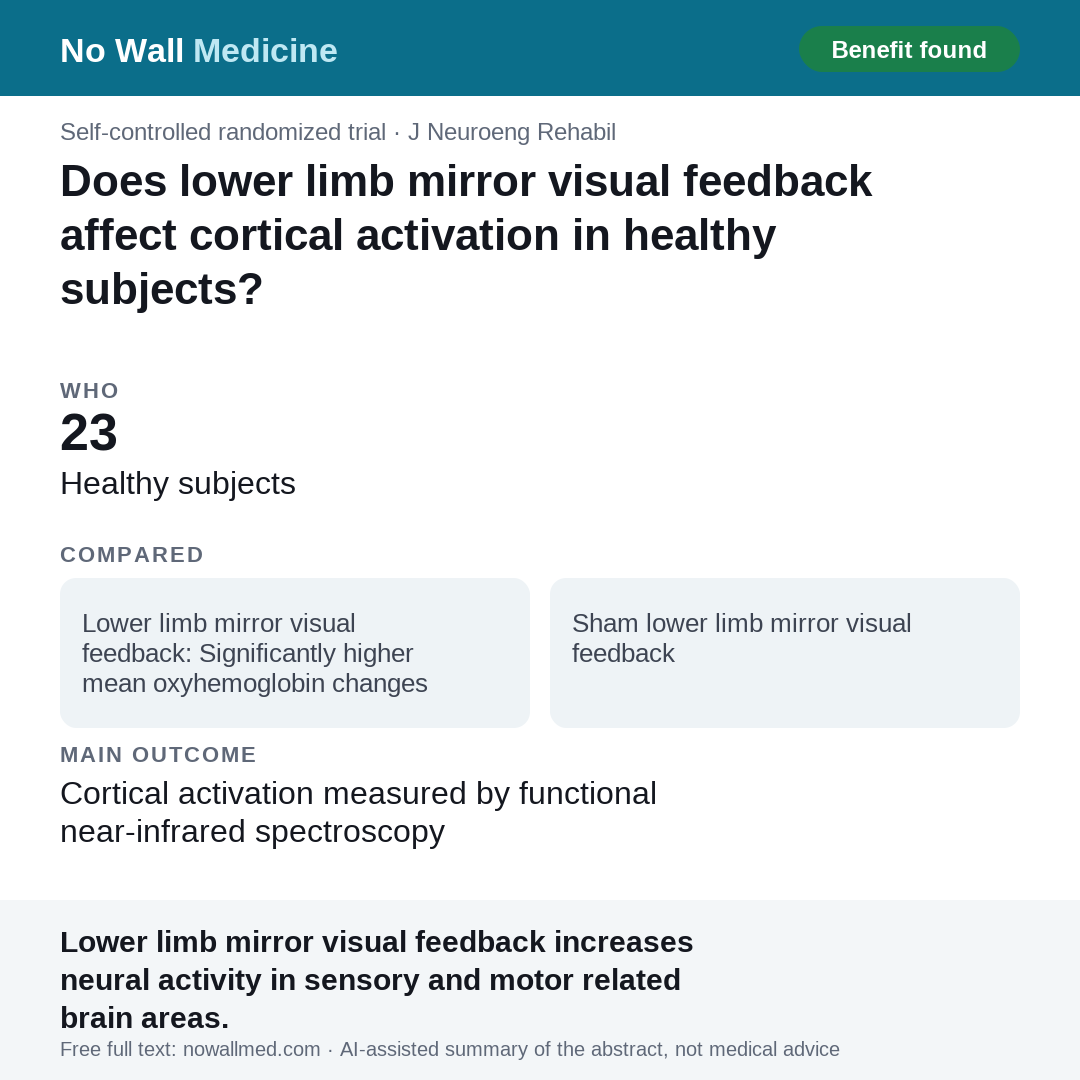
Clinical question: Does lower limb mirror visual feedback affect cortical activation in healthy subjects?
Why it matters: The neural mechanisms of how mirror visual feedback affects the lower limbs are not yet clear.
Key points
- Researchers conducted a self-controlled randomized trial with 23 healthy subjects to compare real lower limb mirror visual feedback with a sham version.
- Mirror visual feedback was associated with significantly higher mean oxyhemoglobin changes in the bilateral premotor and supplementary motor cortex, bilateral dorsolateral prefrontal cortex, left primary somatosensory cortex, and right frontal pole.
- The study used functional near-infrared spectroscopy, a non-invasive way to monitor brain activity, to measure changes in blood oxygenation.
Headline and key points written with AI from the paper’s abstract, with every number checked against it. Read the paper before relying on them.
Was this summary helpful?
Subject terms
Cite this article
Cui W, Tian Y, Yu Q, Huang L, Yang Y, Liu H. Effect of lower limb mirror visual feedback on cortical activation in healthy subjects: a self-controlled randomized trail. J Neuroeng Rehabil. 2025. doi:10.1186/s12984-025-01725-6
Spotted a mistake? Suggest a correction
Top studies every Monday
The week’s key trials and guidelines in your specialties, plus any topics you follow. By email, free.
Get the weekly digest