Single session of brain stimulation failed to improve motor learning or change brain activity
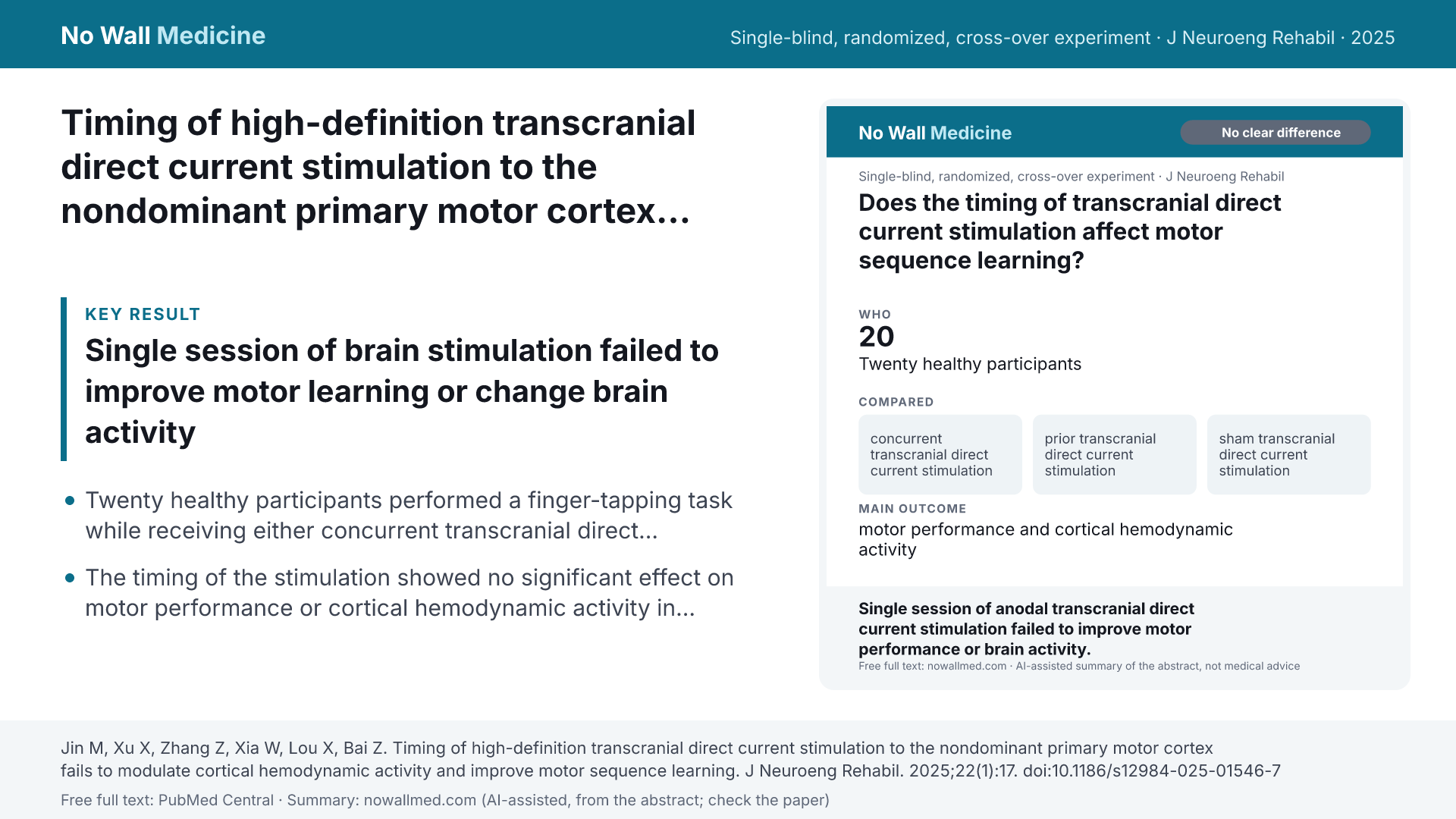
Timing of high-definition transcranial direct current stimulation to the nondominant primary motor cortex fails to modulate cortical hemodynamic activity and improve motor sequence learning
Single-blind, randomized, cross-over experimentNo clear difference
Does the timing of transcranial direct current stimulation affect motor sequence learning?
Who
20
Twenty healthy participants
Compared
concurrent transcranial direct current stimulation
prior transcranial direct current stimulation
sham transcranial direct current stimulation
Main outcome
motor performance and cortical hemodynamic activity
Bottom line: Single session of anodal transcranial direct current stimulation failed to improve motor performance or brain activity.
J Neuroeng Rehabil · 2025-01-31Download image
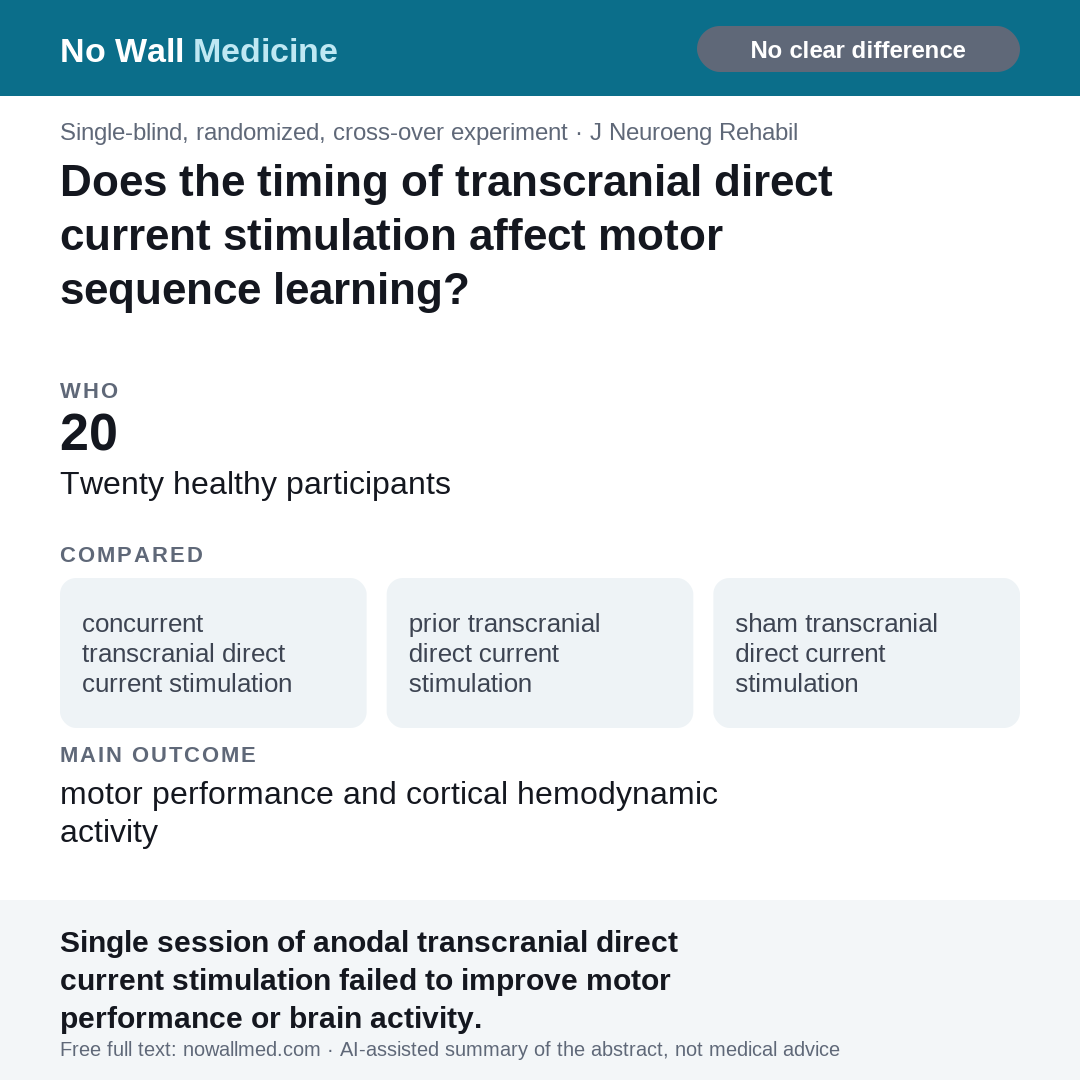
Clinical question: Does the timing of transcranial direct current stimulation affect motor sequence learning?
Why it matters: It is unknown whether the timing of a single session of electrical brain stimulation relative to motor practice affects brain activity or motor learning.
Key points
- Twenty healthy participants performed a finger-tapping task while receiving either concurrent transcranial direct current stimulation (a type of electrical brain stimulation), prior stimulation, or a sham treatment.
- The timing of the stimulation showed no significant effect on motor performance or cortical hemodynamic activity in the prefrontal cortex, supplementary motor area, or primary motor cortex.
- No significant correlation was found between changes in brain activity and motor performance during the study.
Headline and key points written with AI from the paper’s abstract, with every number checked against it. Read the paper before relying on them.
Was this summary helpful?
Subject terms
Cite this article
Jin M, Xu X, Zhang Z, Xia W, Lou X, Bai Z. Timing of high-definition transcranial direct current stimulation to the nondominant primary motor cortex fails to modulate cortical hemodynamic activity and improve motor sequence learning. J Neuroeng Rehabil. 2025. doi:10.1186/s12984-025-01546-7
Spotted a mistake? Suggest a correction
Top studies every Monday
The week’s key trials and guidelines in your specialties, plus any topics you follow. By email, free.
Get the weekly digest