Lower oxygen saturation targets did not significantly improve survival after out-of-hospital cardiac arrest
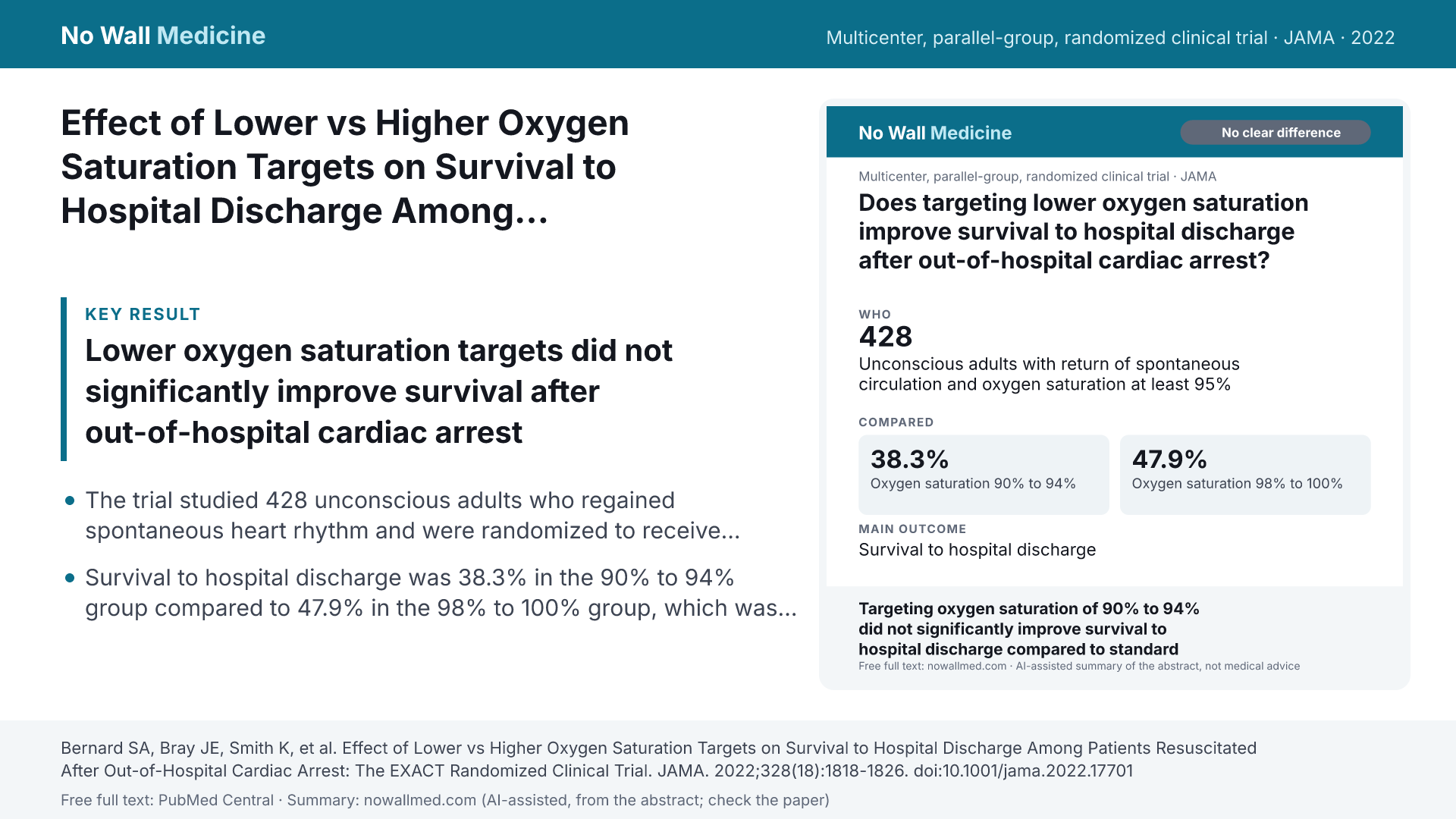
Effect of Lower vs Higher Oxygen Saturation Targets on Survival to Hospital Discharge Among Patients Resuscitated After Out-of-Hospital Cardiac Arrest: The EXACT Randomized Clinical Trial
Multicenter, parallel-group, randomized clinical trialNo clear difference
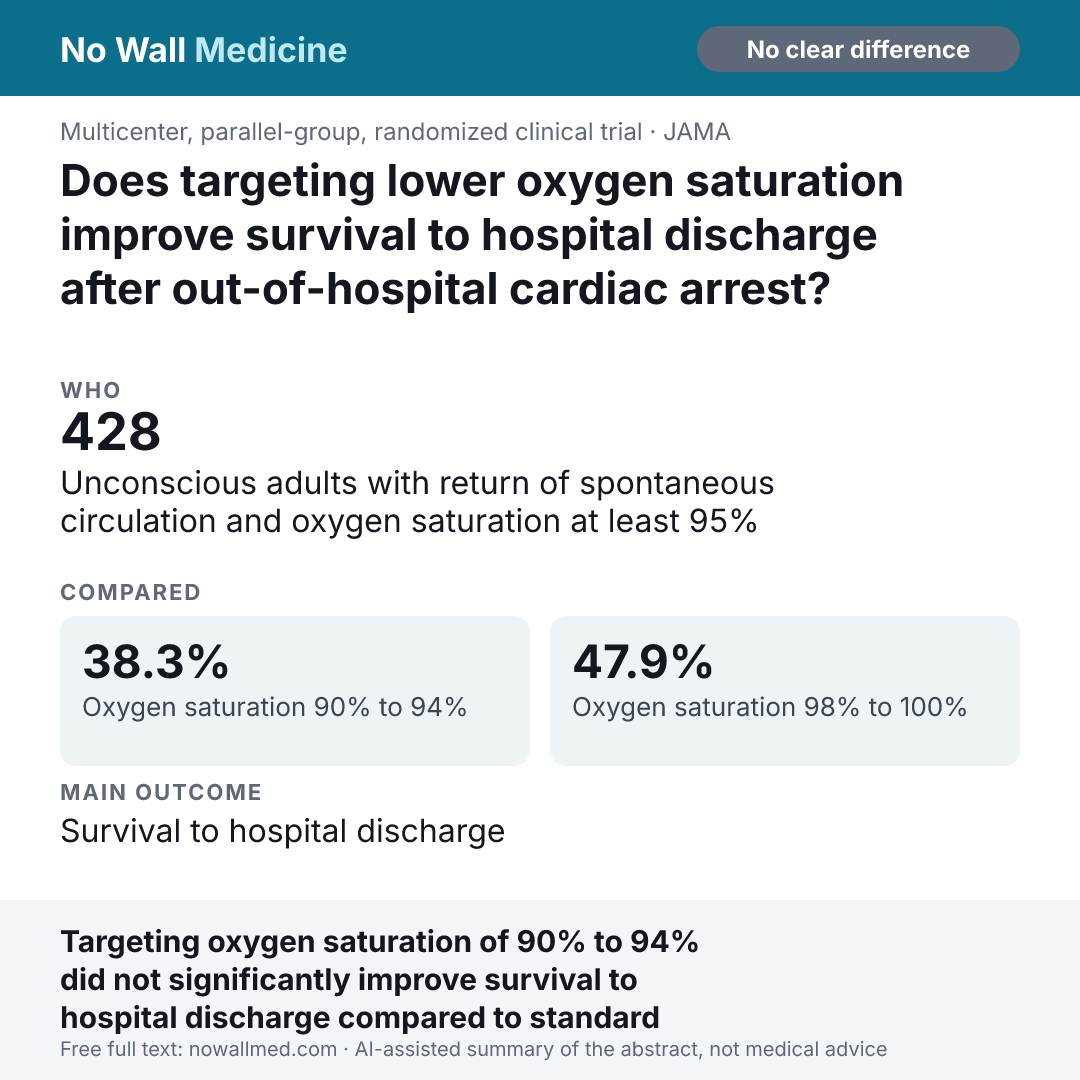
Does targeting lower oxygen saturation improve survival to hospital discharge after out-of-hospital cardiac arrest?
Who
428
Unconscious adults with return of spontaneous circulation and oxygen saturation at least 95% · 2 emergency medical services and 15 hospitals in Australia
Compared
38.3%Oxygen saturation 90% to 94% (82/214)
47.9%Oxygen saturation 98% to 100% (101/211)
Main outcome
Survival to hospital discharge
Result: unadjusted odds ratio 0.68 (95% CI 0.46-1.00)
Bottom line: Targeting oxygen saturation of 90% to 94% did not significantly improve survival to hospital discharge compared to standard care.
Limitation: The trial was stopped early due to the COVID-19 pandemic.
JAMA · 2022-10-27 · Save PNG
Clinical question: Does targeting lower oxygen saturation improve survival to hospital discharge after out-of-hospital cardiac arrest?
Key points
- The trial studied 428 unconscious adults who regained spontaneous heart rhythm and were randomized to receive oxygen titration to 90% to 94% or 98% to 100%.
- Survival to hospital discharge was 38.3% in the 90% to 94% group compared to 47.9% in the 98% to 100% group, which was not a statistically significant difference.
- Hypoxic episodes, where blood oxygen levels fall below 90%, were observed in 31.3% of the lower target group compared to 16.1% in the standard care group.
Limitation the authors note: The trial was stopped early due to the COVID-19 pandemic.
Headline and key points written with AI from the paper’s abstract, with every number checked against it. Read the paper before relying on them.
Was this summary helpful?
Subject terms
Headline, design, result, key points, caveat and citation as plain text.
Cite this article
Bernard SA, Bray JE, Smith K, et al. Effect of Lower vs Higher Oxygen Saturation Targets on Survival to Hospital Discharge Among Patients Resuscitated After Out-of-Hospital Cardiac Arrest: The EXACT Randomized Clinical Trial. JAMA. 2022;328(18):1818-1826. doi:10.1001/jama.2022.17701
Spotted a mistake? Suggest a correction