Restrictive and high-dose oxygenation strategies showed no difference in survival after cardiac arrest
Restrictive versus high-dose oxygenation strategy in post-arrest management following adult non-traumatic cardiac arrest: a meta-analysis
Meta-analysis of 8 randomized controlled trialsNo clear difference
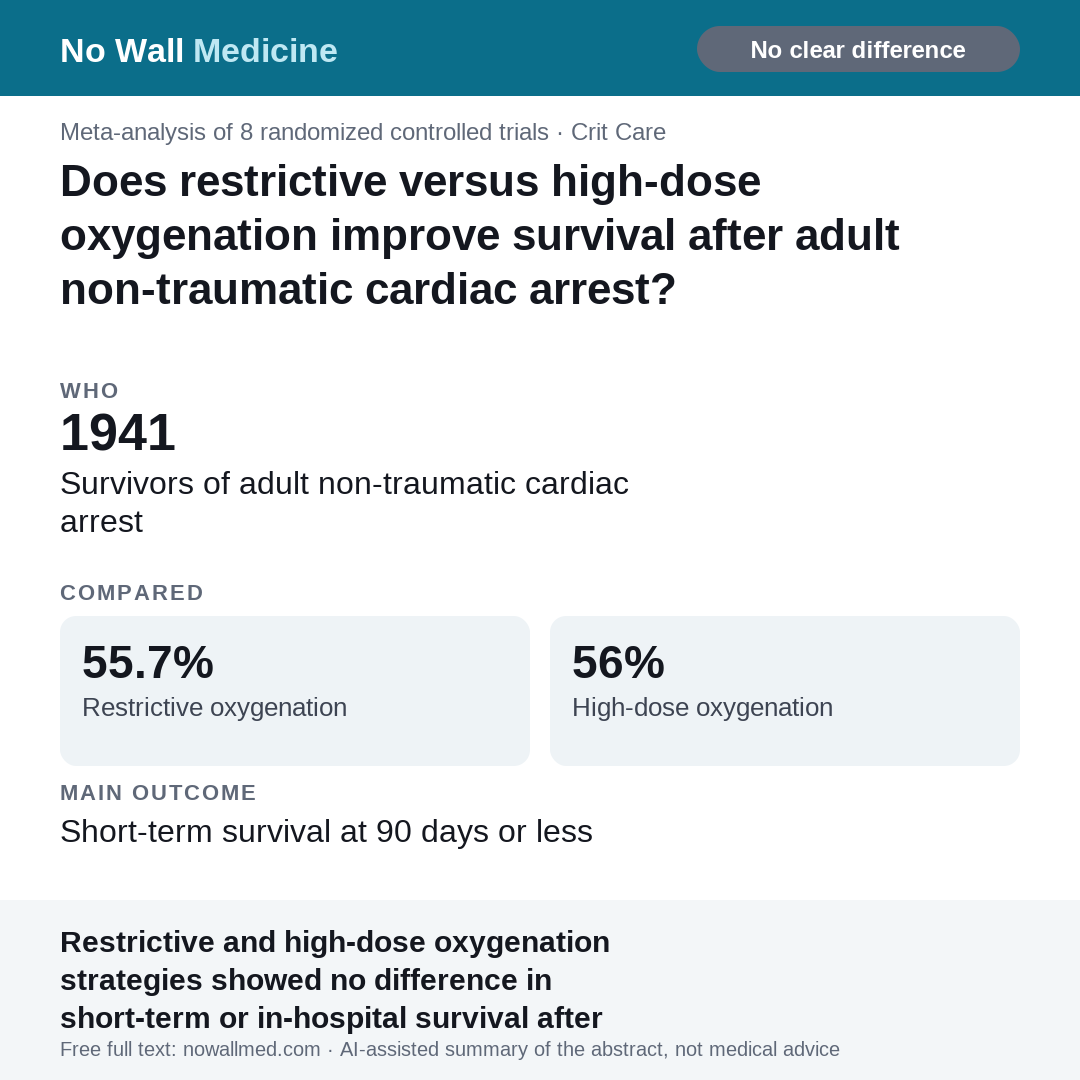
Does restrictive versus high-dose oxygenation improve survival after adult non-traumatic cardiac arrest?
Who
1941
Survivors of adult non-traumatic cardiac arrest
Compared
55.7%Restrictive oxygenation
56%High-dose oxygenation
Main outcome
Short-term survival at 90 days or less
Result: relative risk 0.99 (95% CI 0.90 to 1.10)
Bottom line: Restrictive and high-dose oxygenation strategies showed no difference in short-term or in-hospital survival after cardiac arrest.
Crit Care · 2023-10-05Download image
Clinical question: Does restrictive versus high-dose oxygenation improve survival after adult non-traumatic cardiac arrest?
Why it matters: Current guidelines lack specific oxygen targets for patients after they experience return of spontaneous circulation following a cardiac arrest.
Key points
- Researchers analyzed eight randomized controlled trials involving 1941 patients to compare restrictive versus high-dose oxygenation after return of spontaneous circulation.
- Short-term survival at 90 days or less was 55.7% for restrictive oxygenation and 56% for high-dose oxygenation, showing no significant difference.
- The restrictive oxygenation group was associated with more frequent episodes of hypoxemia, which is low blood oxygen levels, compared to the high-dose group.
Headline and key points written with AI from the paper’s abstract, with every number checked against it. Read the paper before relying on them.
Was this summary helpful?
Subject terms
Cite this article
Macherey-Meyer S, Heyne S, Meertens MM, Braumann S, Hueser C, Mauri V. Restrictive versus high-dose oxygenation strategy in post-arrest management following adult non-traumatic cardiac arrest: a meta-analysis. Crit Care. 2023. doi:10.1186/s13054-023-04669-2
Spotted a mistake? Suggest a correction
Top studies every Monday
The week’s key trials and guidelines in your specialties, plus any topics you follow. By email, free.
Get the weekly digest