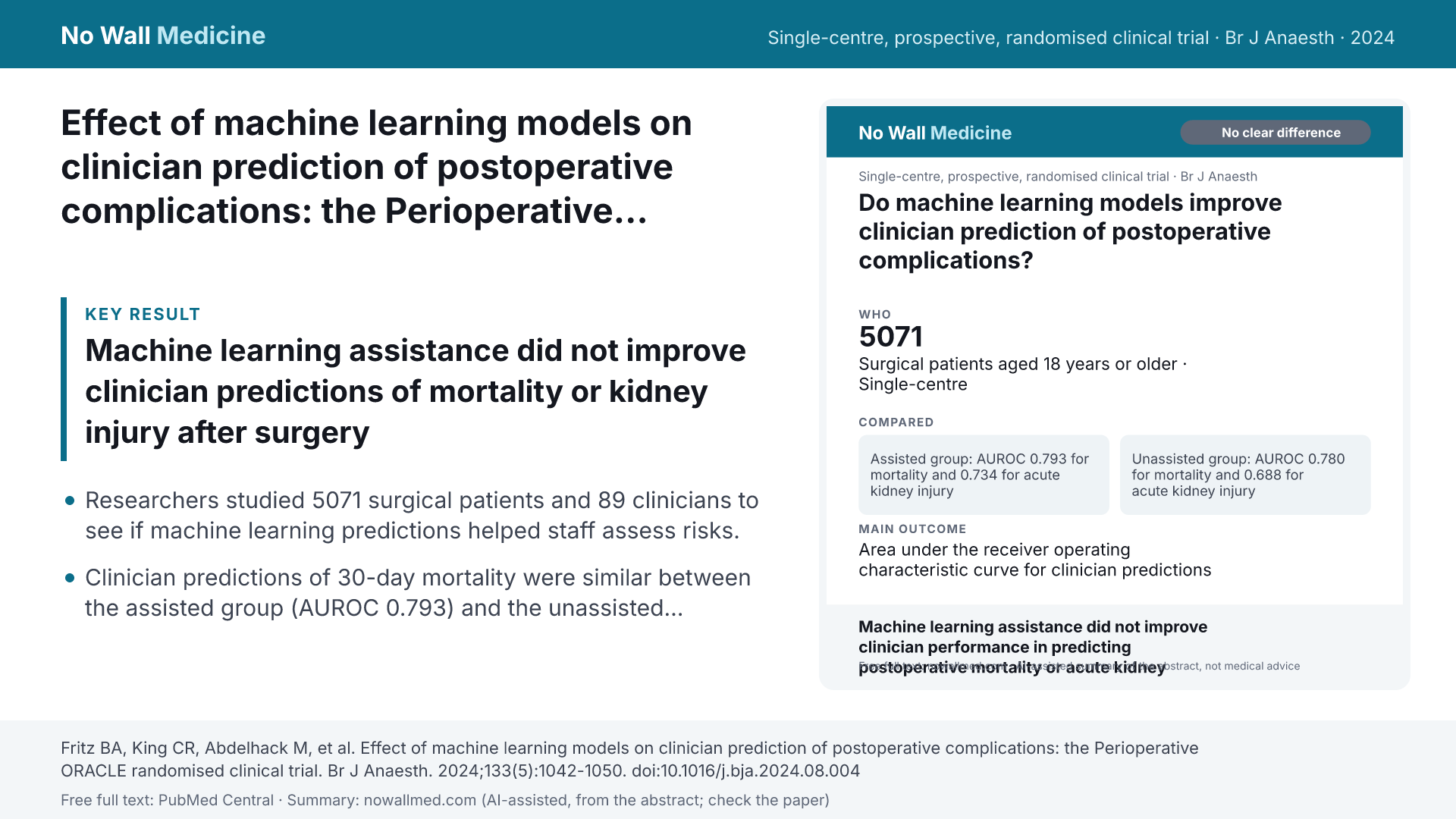
Machine learning assistance did not improve clinician predictions of mortality or kidney injury after surgery
Effect of machine learning models on clinician prediction of postoperative complications: the Perioperative ORACLE randomised clinical trial
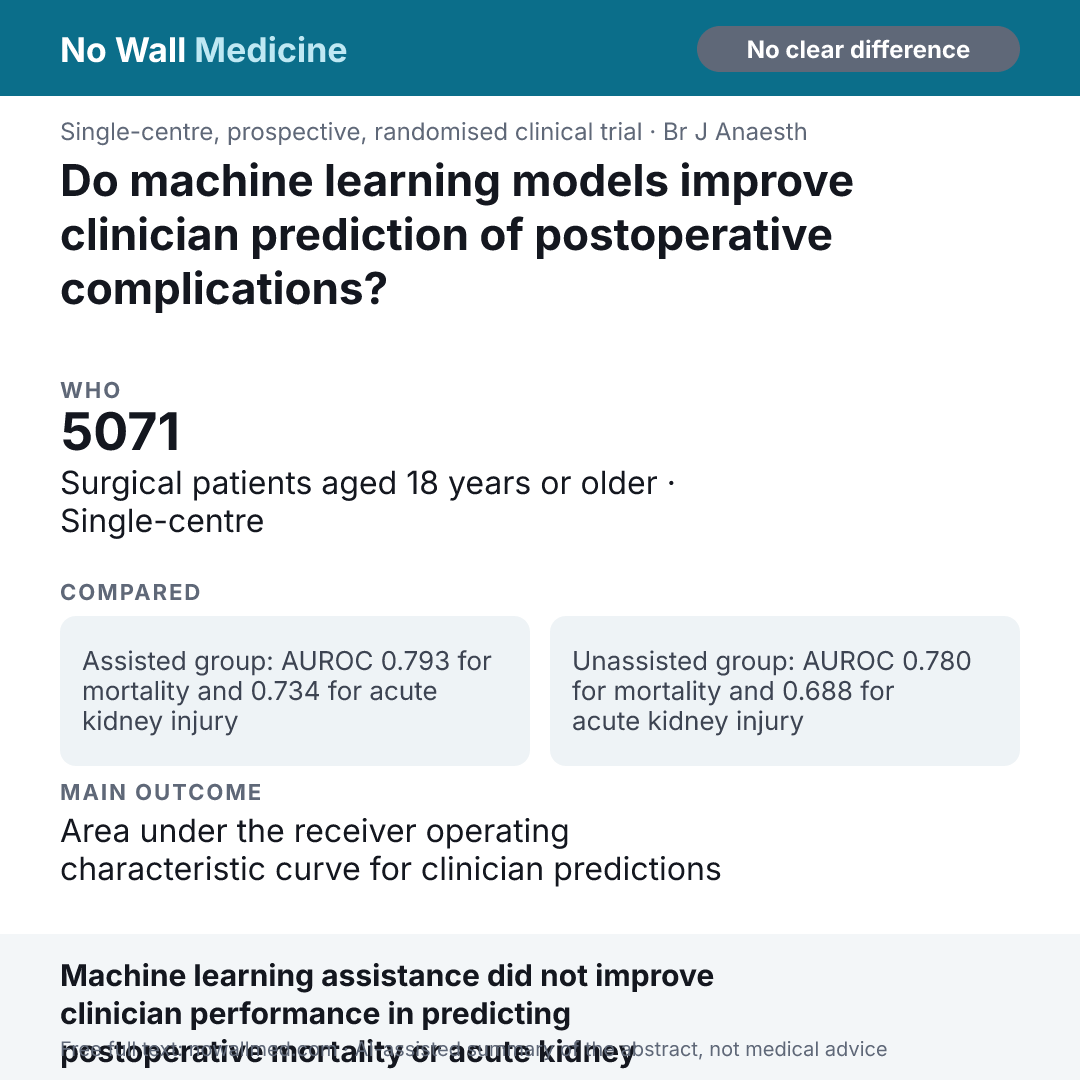
Single-centre, prospective, randomised clinical trialNo clear difference
Do machine learning models improve clinician prediction of postoperative complications?
Who
5071
Surgical patients aged 18 years or older · Single-centre
Compared
Assisted group: AUROC 0.793 for mortality and 0.734 for acute kidney injury
Unassisted group: AUROC 0.780 for mortality and 0.688 for acute kidney injury
Main outcome
Area under the receiver operating characteristic curve for clinician predictions
Result: mean difference 0.013 (95% CI -0.070 to 0.097) for mortality
Bottom line: Machine learning assistance did not improve clinician performance in predicting postoperative mortality or acute kidney injury.
Br J Anaesth · 2024-09-10 · Save PNG
Clinical question: Do machine learning models improve clinician prediction of postoperative complications?
Key points
- Researchers studied 5071 surgical patients and 89 clinicians to see if machine learning predictions helped staff assess risks.
- Clinician predictions of 30-day mortality were similar between the assisted group (AUROC 0.793) and the unassisted group (AUROC 0.780).
- Predictions of acute kidney injury, a sudden loss of kidney function, showed an AUROC of 0.734 with assistance versus 0.688 without assistance.
Limitation the authors note: This was a single-centre trial.
Headline and key points written with AI from the paper’s abstract, with every number checked against it. Read the paper before relying on them.
Was this summary helpful?
Subject terms
Headline, design, result, key points, caveat and citation as plain text.
Cite this article
Fritz BA, King CR, Abdelhack M, et al. Effect of machine learning models on clinician prediction of postoperative complications: the Perioperative ORACLE randomised clinical trial. Br J Anaesth. 2024;133(5):1042-1050. doi:10.1016/j.bja.2024.08.004
Spotted a mistake? Suggest a correction