Effect of machine learning models on clinician prediction of postoperative complications: the Perioperative ORACLE randomised clinical trial
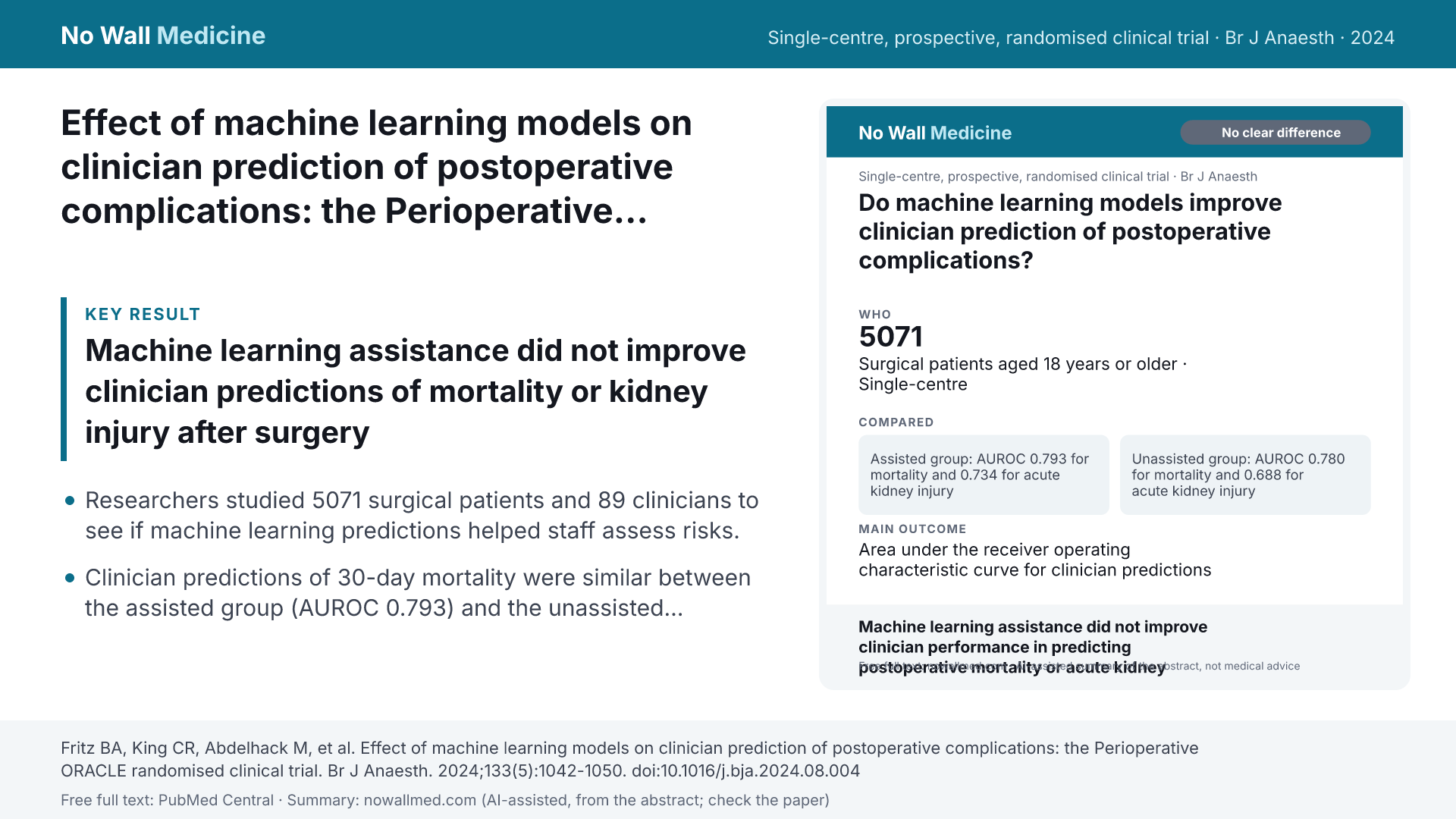
Key result: Machine learning assistance did not improve clinician predictions of mortality or kidney injury after surgery
Single-centre, prospective, randomised clinical trialNo clear difference
Do machine learning models improve clinician prediction of postoperative complications?
Who
5071
Surgical patients aged 18 years or older · Single-centre
Compared
Assisted group: AUROC 0.793 for mortality and 0.734 for acute kidney injury
Unassisted group: AUROC 0.780 for mortality and 0.688 for acute kidney injury
Main outcome
Area under the receiver operating characteristic curve for clinician predictions
Result: mean difference 0.013 (95% CI -0.070 to 0.097) for mortality
Bottom line: Machine learning assistance did not improve clinician performance in predicting postoperative mortality or acute kidney injury.
Br J Anaesth · 2024-09-10
Key points
- Researchers studied 5071 surgical patients and 89 clinicians to see if machine learning predictions helped staff assess risks.
- Clinician predictions of 30-day mortality were similar between the assisted group (AUROC 0.793) and the unassisted group (AUROC 0.780).
- Predictions of acute kidney injury, a sudden loss of kidney function, showed an AUROC of 0.734 with assistance versus 0.688 without assistance.
Limitation the authors note: This was a single-centre trial.
Discussion prompts
- Would these patients look like yours? Who was left out?
- Is the main outcome one that matters to patients?
- Is the difference large enough to change what you do?
Cite: Fritz BA, King CR, Abdelhack M, et al. Effect of machine learning models on clinician prediction of postoperative complications: the Perioperative ORACLE randomised clinical trial. Br J Anaesth. 2024;133(5):1042-1050. doi:10.1016/j.bja.2024.08.004
Free full text: PubMed Central · Summary and visual abstract: nowallmed.com/a/effect-of-machine-learning-models-on-clinician-prediction-of-1l0vsni/ (AI-assisted from the abstract; check the paper before relying on it).