Mechanical thrombectomy alone showed no significant difference in outcomes compared to combined stroke treatments
Effect of Mechanical Thrombectomy Without vs With Intravenous Thrombolysis on Functional Outcome Among Patients With Acute Ischemic Stroke: The SKIP Randomized Clinical Trial
Randomized, open-label, noninferiority clinical trialUnclear result
Is mechanical thrombectomy alone noninferior to combined intravenous thrombolysis and mechanical thrombectomy?
Who
204
Patients with acute ischemic stroke due to large vessel occlusion · 23 hospital networks in Japan
Compared
59.4%Mechanical thrombectomy alone
57.3%Combined intravenous thrombolysis plus mechanical thrombectomy
Main outcome
Favorable outcome defined as modified Rankin Scale score 0 to 2
Result: odds ratio 1.09 (1-sided 97.5% CI 0.63 to ∞)
Bottom line: Mechanical thrombectomy alone failed to demonstrate noninferiority, but wide confidence intervals prevented a conclusion of inferiority.
Limitation: Wide confidence intervals around the effect estimate did not allow a conclusion of inferiority.
JAMA · 2021-01-19Download image
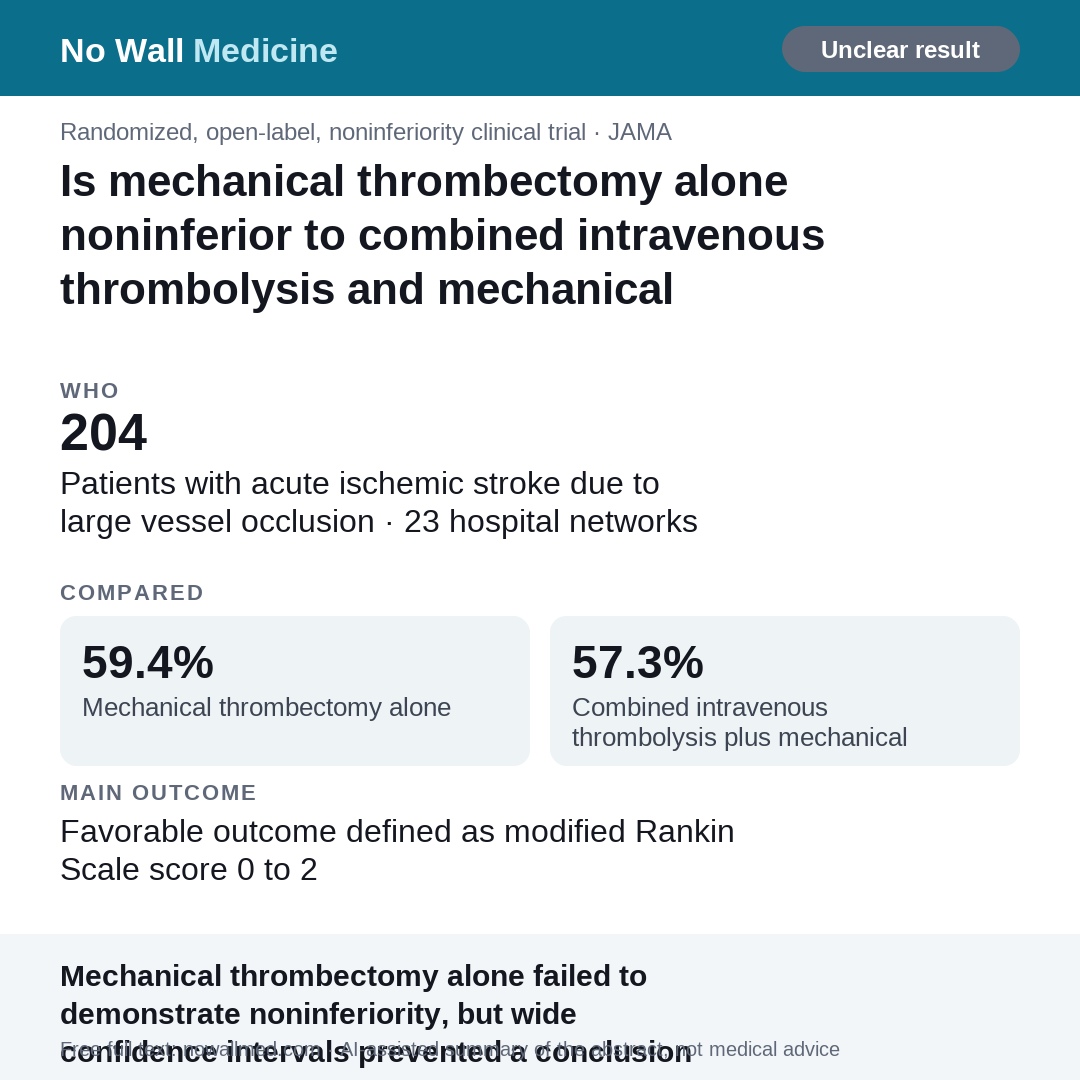
Clinical question: Is mechanical thrombectomy alone noninferior to combined intravenous thrombolysis and mechanical thrombectomy?
Why it matters: It is unclear whether intravenous clot-dissolving medication is necessary when performing mechanical thrombectomy for patients with acute large vessel occlusion stroke.
Key points
- Researchers studied 204 patients with acute ischemic stroke caused by large vessel occlusion, comparing mechanical thrombectomy alone to combined intravenous clot-dissolving medication and mechanical thrombectomy.
- Favorable outcomes at 90 days occurred in 59.4% of the mechanical thrombectomy alone group and 57.3% of the combined group, showing no significant difference between the two.
- Any intracerebral hemorrhage, or bleeding within the brain, was observed in 33.7% of the mechanical thrombectomy alone group compared to 50.5% in the combined group.
Headline and key points written with AI from the paper’s abstract, with every number checked against it. Read the paper before relying on them.
Was this summary helpful?
Subject terms
Cite this article
Suzuki K, Matsumaru Y, Takeuchi M, Morimoto M, Kanazawa R, Takayama Y. Effect of Mechanical Thrombectomy Without vs With Intravenous Thrombolysis on Functional Outcome Among Patients With Acute Ischemic Stroke: The SKIP Randomized Clinical Trial. JAMA. 2021. doi:10.1001/jama.2020.23522
Spotted a mistake? Suggest a correction
Top studies every Monday
The week’s key trials and guidelines in your specialties, plus any topics you follow. By email, free.
Get the weekly digest