Antithrombotic agents showed varying effects on brain bleeding and stroke damage in animal models
Antithrombotic Agents for tPA-Induced Cerebral Hemorrhage: A Systematic Review and Meta-Analysis of Preclinical Studies
Systematic review and meta-analysis of preclinical studiesBenefit found
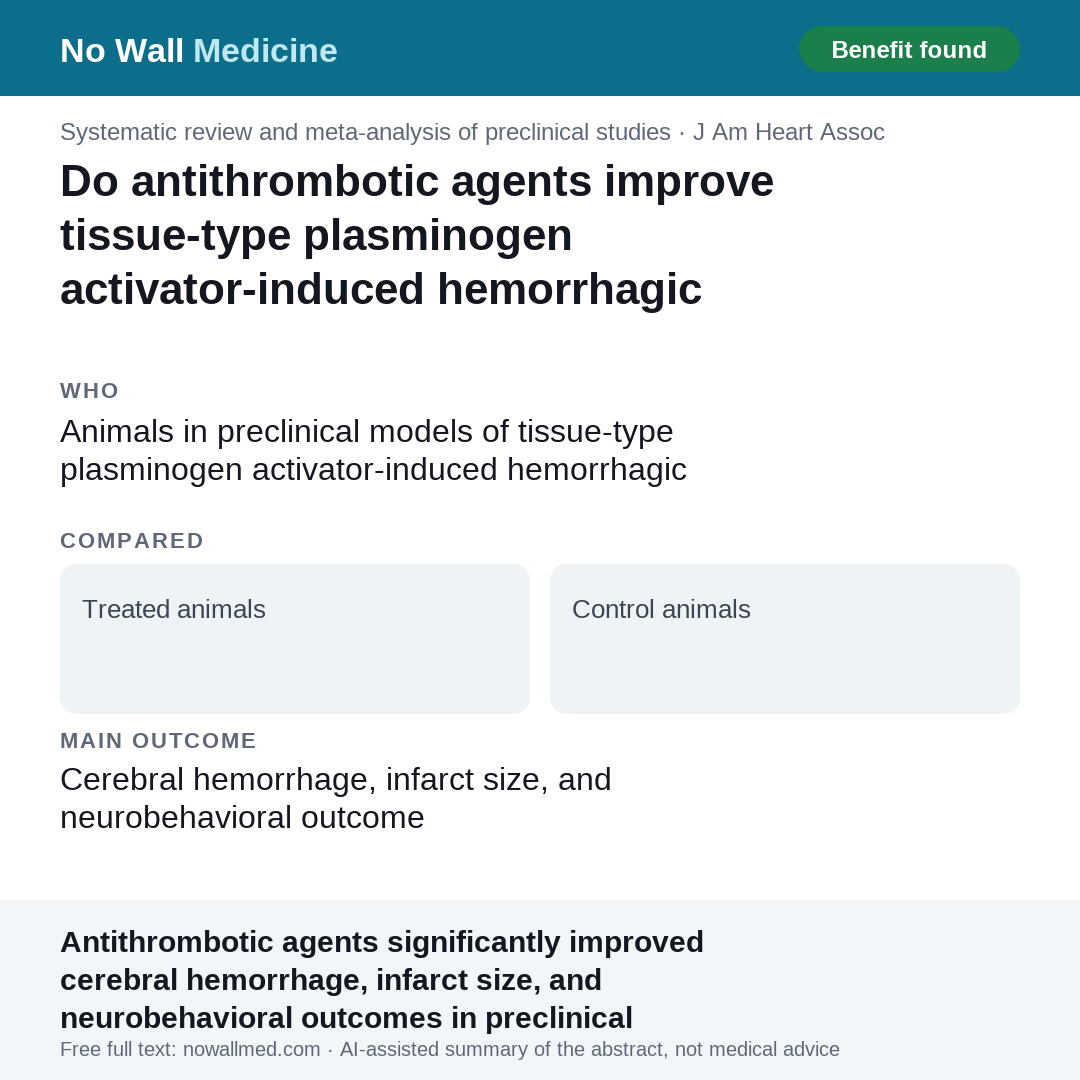
Do antithrombotic agents improve tissue-type plasminogen activator-induced hemorrhagic transformation in animal models?
Who
Animals in preclinical models of tissue-type plasminogen activator-induced hemorrhagic transformation · Preclinical animal models
Compared
Treated animals
Control animals
Main outcome
Cerebral hemorrhage, infarct size, and neurobehavioral outcome
Result: standardized mean difference 0.45 (95% CI 0.11-0.78) for cerebral hemorrhage
Bottom line: Antithrombotic agents significantly improved cerebral hemorrhage, infarct size, and neurobehavioral outcomes in preclinical animal models.
Limitation: Heterogeneity and publication bias were identified in this analysis.
J Am Heart Assoc · 2020-12-05Download image
Clinical question: Do antithrombotic agents improve tissue-type plasminogen activator-induced hemorrhagic transformation in animal models?
Why it matters: The effects of different antithrombotic agents on brain bleeding caused by tissue-type plasminogen activator after an ischemic stroke are not clearly defined.
Key points
- Researchers analyzed 22 publications involving 18 different interventions in animal models of tissue-type plasminogen activator-induced brain bleeding.
- The pooled data showed a standardized mean difference of 0.45 for cerebral hemorrhage, 1.18 for infarct size, and 0.91 for neurobehavioral outcome in treated animals.
- Antiplatelet agents showed significant improvement in all outcomes, while anticoagulant agents affected infarct size and neurobehavioral scores, but fibrinolytic agents showed no significant improvement.
Limitation the authors note: The conclusions should be interpreted cautiously due to identified heterogeneity and publication bias.
Headline and key points written with AI from the paper’s abstract, with every number checked against it. Read the paper before relying on them.
Was this summary helpful?
Subject terms
Cite this article
Ye Y, Zhang FT, Wang XY, Tong HX, Zhu YT. Antithrombotic Agents for tPA-Induced Cerebral Hemorrhage: A Systematic Review and Meta-Analysis of Preclinical Studies. J Am Heart Assoc. 2020. doi:10.1161/JAHA.120.017876
Spotted a mistake? Suggest a correction
Top studies every Monday
The week’s key trials and guidelines in your specialties, plus any topics you follow. By email, free.
Get the weekly digest