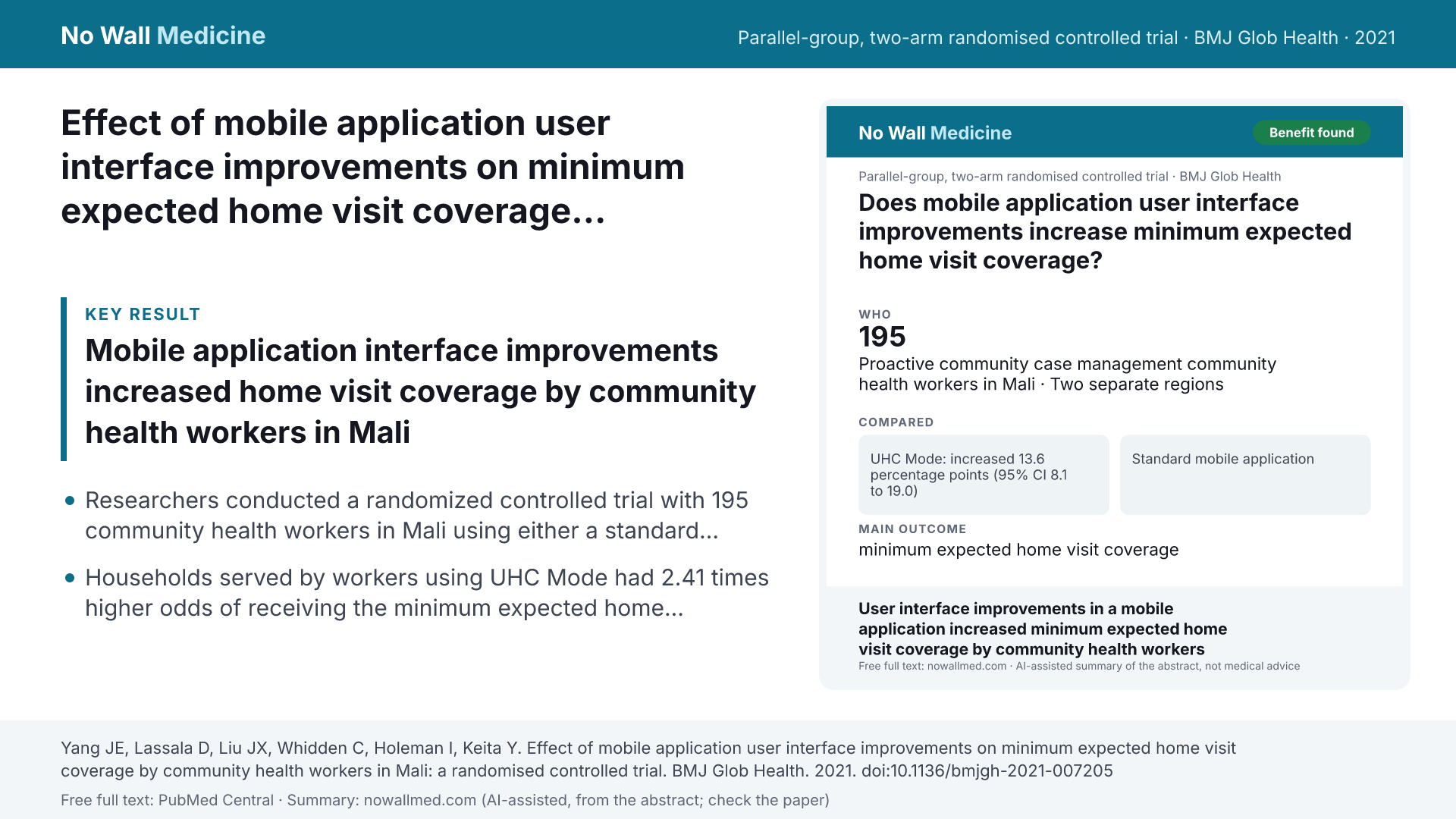
Effect of mobile application user interface improvements on minimum expected home visit coverage by community health workers in Mali: a randomised controlled trial
Key result: Mobile application interface improvements increased home visit coverage by community health workers in Mali
Key points
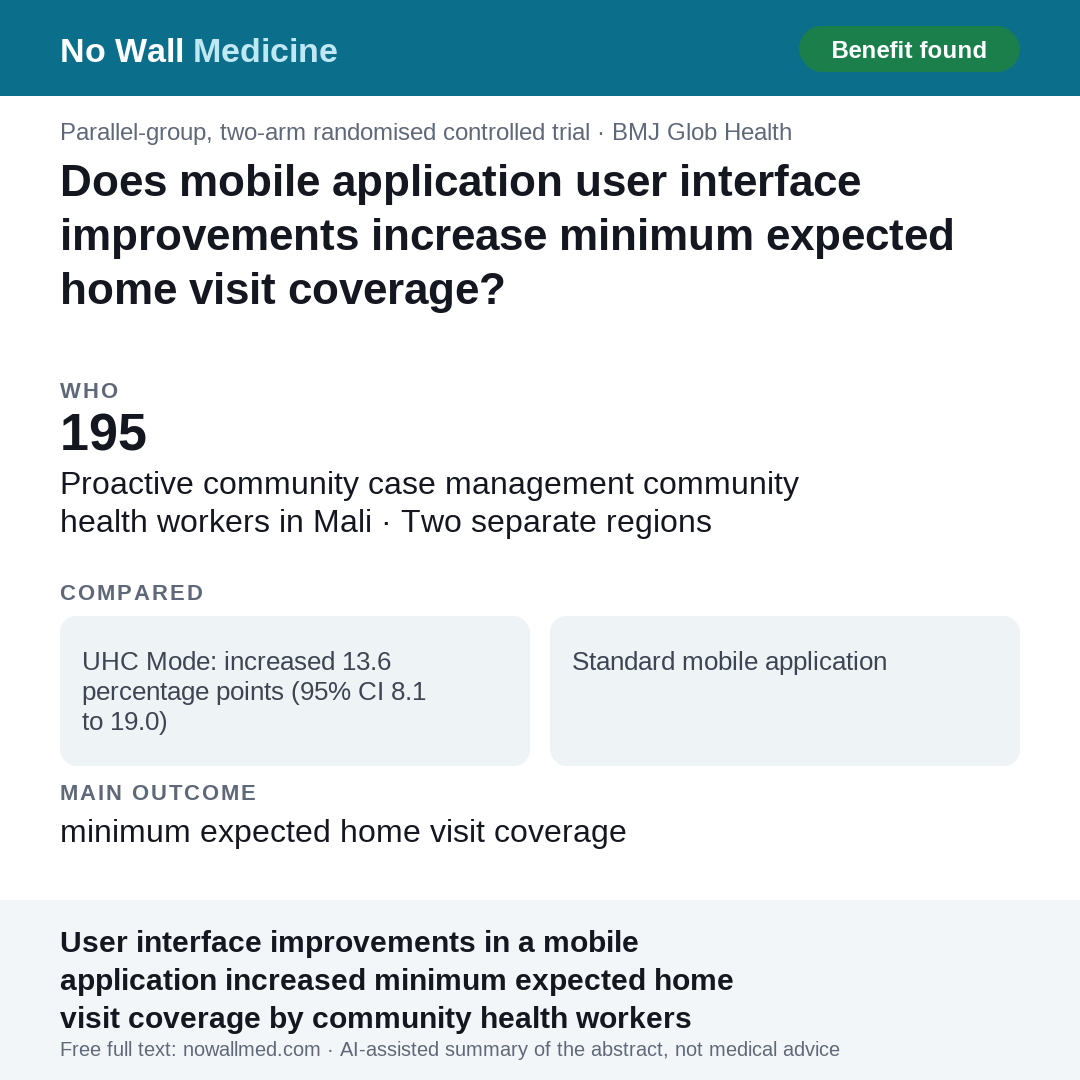
- Researchers conducted a randomized controlled trial with 195 community health workers in Mali using either a standard mobile application or a new software extension called UHC Mode.
- Households served by workers using UHC Mode had 2.41 times higher odds of receiving the minimum expected home visits compared to the control group.
- The UHC Mode group saw an increase in minimum expected home visit coverage of 13.6 percentage points compared to the standard application group.
Why it matters: Community health workers face operational challenges when trying to visit every household in their service area at least twice monthly to find sick patients.
Discussion prompts
- Would these patients look like yours? Who was left out?
- Is the main outcome one that matters to patients?
- Is the difference large enough to change what you do?
Cite: Yang JE, Lassala D, Liu JX, Whidden C, Holeman I, Keita Y. Effect of mobile application user interface improvements on minimum expected home visit coverage by community health workers in Mali: a randomised controlled trial. BMJ Glob Health. 2021. doi:10.1136/bmjgh-2021-007205
Free full text: PubMed Central · Summary and visual abstract: nowallmed.com/a/effect-of-mobile-application-user-interface-improvements-on-minimum-hms96h/ (AI-assisted from the abstract; check the paper before relying on it).