Mobile application interface improvements increased home visit coverage by community health workers in Mali
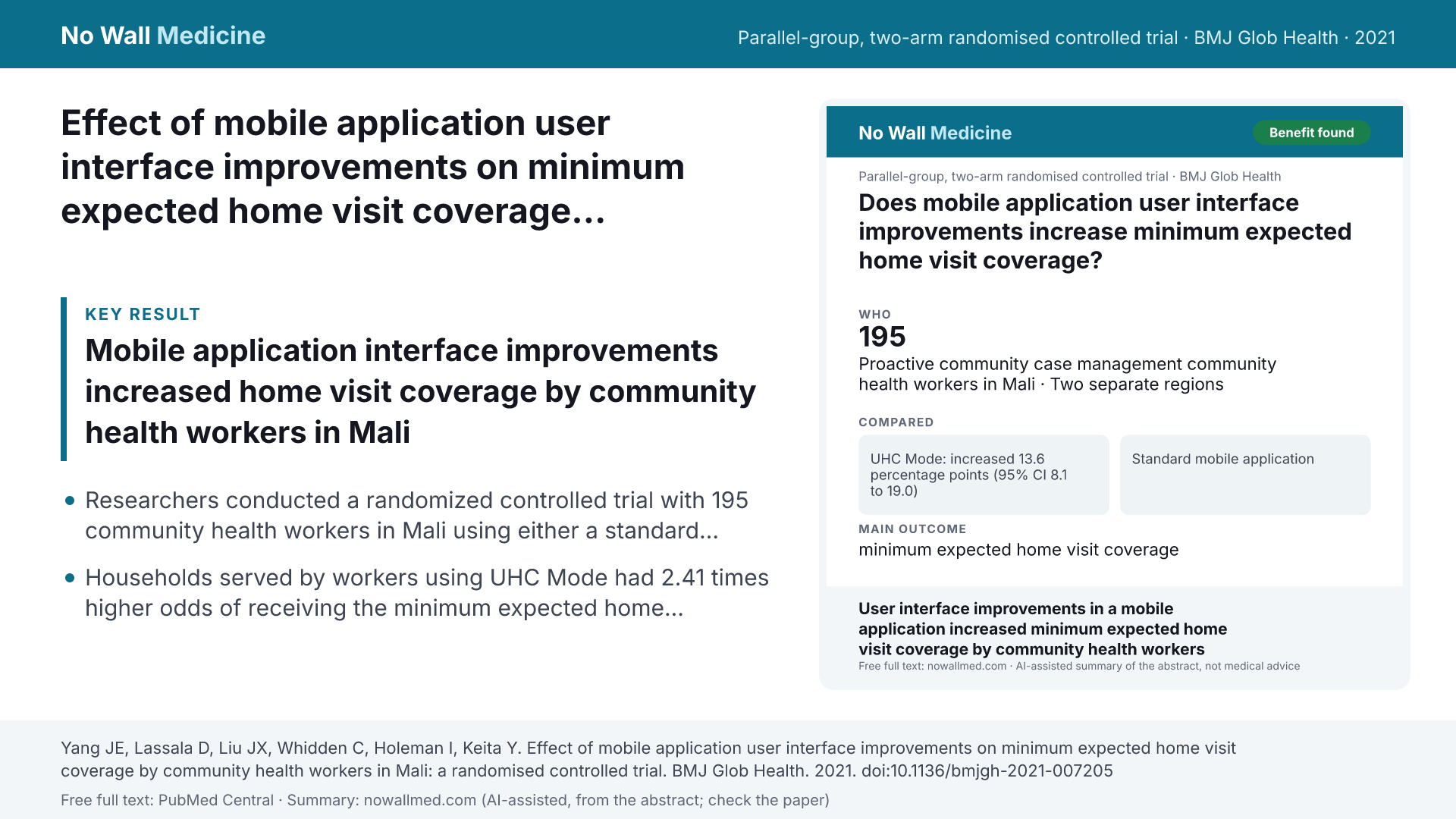
Effect of mobile application user interface improvements on minimum expected home visit coverage by community health workers in Mali: a randomised controlled trial
Parallel-group, two-arm randomised controlled trialBenefit found
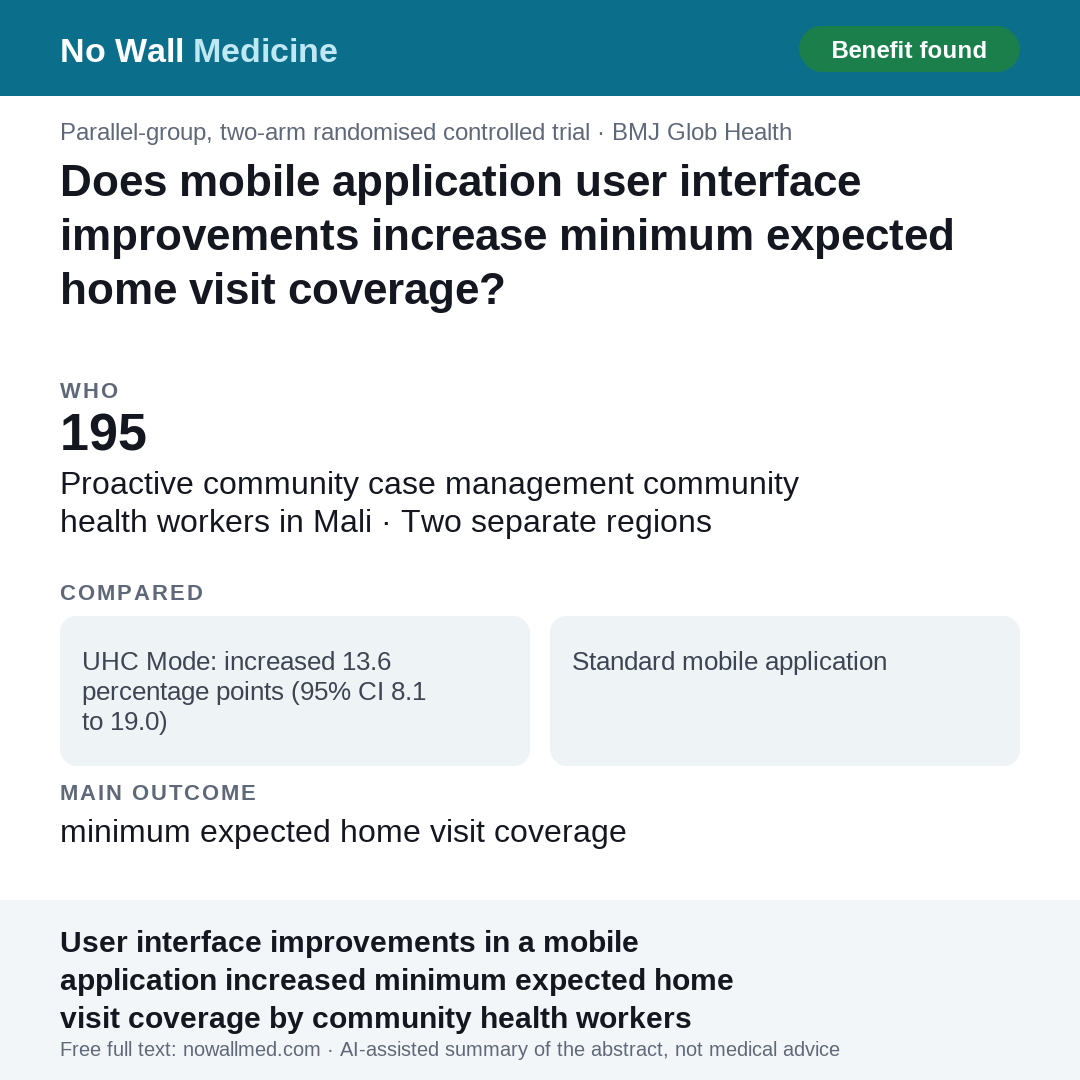
Does mobile application user interface improvements increase minimum expected home visit coverage?
Who
195
Proactive community case management community health workers in Mali · Two separate regions in Mali
Compared
UHC Mode: increased 13.6 percentage points (95% CI 8.1 to 19.0)
Standard mobile application
Main outcome
minimum expected home visit coverage
Result: 2.41 times higher odds (95% CI 1.68 to 3.47)
Bottom line: User interface improvements in a mobile application increased minimum expected home visit coverage by community health workers in Mali.
BMJ Glob Health · 2021-11-24Download image
Clinical question: Does mobile application user interface improvements increase minimum expected home visit coverage?
Why it matters: Community health workers face operational challenges when trying to visit every household in their service area at least twice monthly to find sick patients.
Key points
- Researchers conducted a randomized controlled trial with 195 community health workers in Mali using either a standard mobile application or a new software extension called UHC Mode.
- Households served by workers using UHC Mode had 2.41 times higher odds of receiving the minimum expected home visits compared to the control group.
- The UHC Mode group saw an increase in minimum expected home visit coverage of 13.6 percentage points compared to the standard application group.
Headline and key points written with AI from the paper’s abstract, with every number checked against it. Read the paper before relying on them.
Was this summary helpful?
Abstract
Background
Proactive community case management (ProCCM) has shown promise to advance goals of universal health coverage (UHC). ProCCM community health workers (CHWs) face operational challenges when pursuing their goal of visiting every household in their service area at least twice monthly to proactively find sick patients. We developed a software extension (UHC Mode) to an existing CHW mobile application featuring user interface design improvements to support CHWs in planning daily home visits. We evaluated the effect of UHC Mode on minimum expected home visit coverage. Methods
We conducted a parallel-group, two-arm randomised controlled trial of ProCCM CHWs in two separate regions in Mali. CHWs were randomly assigned to UHC Mode or the standard mobile application (control) with a 1:1 allocation. Randomisation was stratified by health catchment area. CHWs and other programme personnel were not masked to arm allocation. CHWs used their assigned intervention for 4 months. Using a difference-in-differences analysis, we estimated the mean change in minimum expected home visit coverage from preintervention to postintervention between arms. Results
Enrolment occurred in January 2019. Of 199 eligible CHWs randomised to the intervention or control arm, 196 were enrolled and 195 were included in the analysis. Households whose CHW used UHC Mode had 2.41 times higher odds of minimum expected home visit coverage compared with households whose CHW used the control (95% CI 1.68 to 3.47; p<0.0005). Minimum expected home visit coverage in the UHC Mode arm increased 13.6 percentage points (95% CI 8.1 to 19.0) compared with the control arm. Conclusion
Our findings suggest UHC Mode is an effective tool that can improve home visit coverage and promote progress towards UHC when implemented in the ProCCM context. User interface design of health information systems that supports health workers' daily practices and meets their requirements can have a positive impact on health worker performance and home visit coverage. Trial registration number
NCT04106921.
Abstract reproduced under the article’s CC BY licence.
Subject terms
Cite this article
Yang JE, Lassala D, Liu JX, Whidden C, Holeman I, Keita Y. Effect of mobile application user interface improvements on minimum expected home visit coverage by community health workers in Mali: a randomised controlled trial. BMJ Glob Health. 2021. doi:10.1136/bmjgh-2021-007205
Spotted a mistake? Suggest a correction
Top studies every Monday
The week’s key trials and guidelines in your specialties, plus any topics you follow. By email, free.
Get the weekly digest