Mobile video breastfeeding intervention showed no significant difference in exclusive breastfeeding rates compared to standard care
Evaluation of a community-based mobile video breastfeeding intervention in Khayelitsha, South Africa: The Philani MOVIE cluster-randomized controlled trial
Stratified, cluster-randomized controlled trialNo clear difference
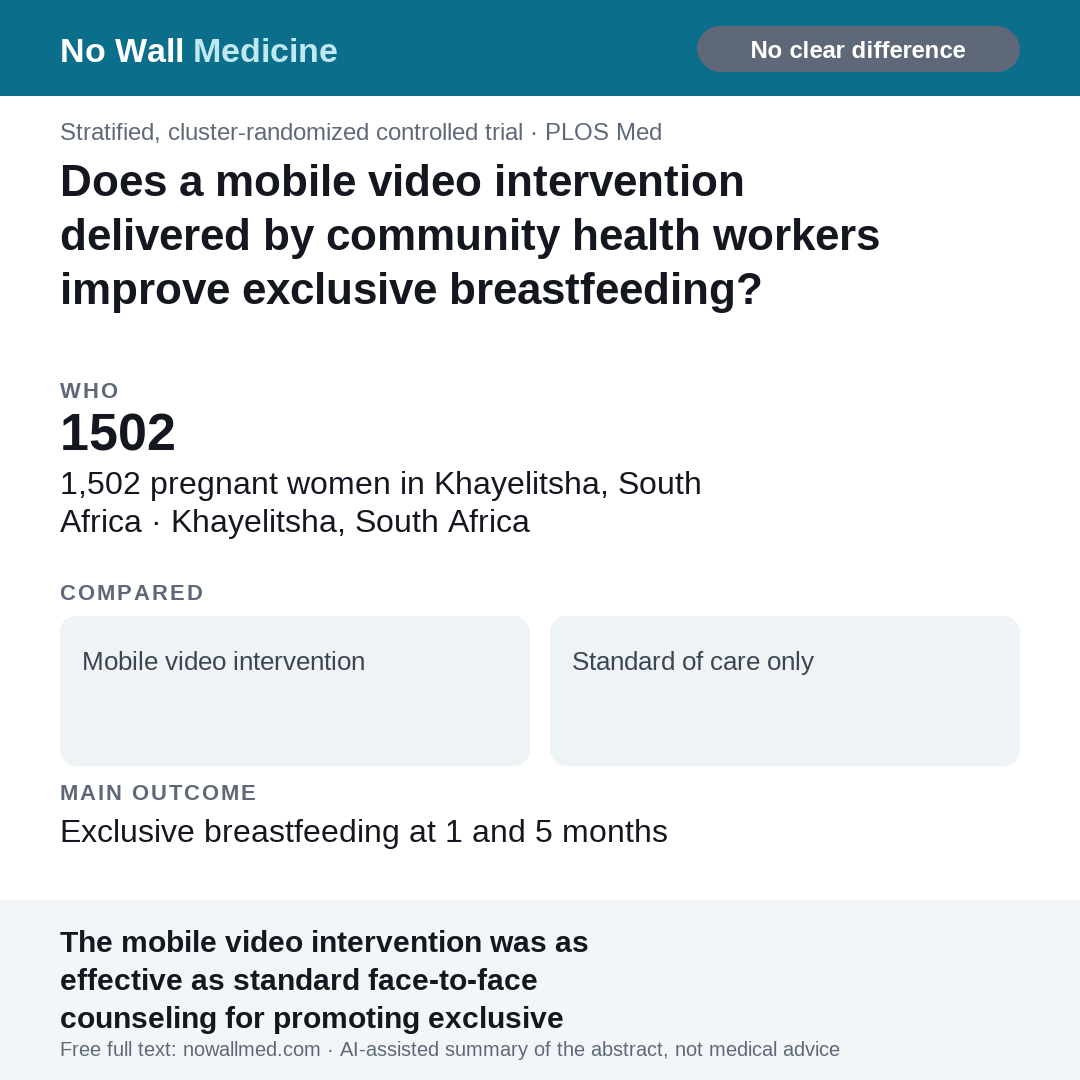
Does a mobile video intervention delivered by community health workers improve exclusive breastfeeding?
Who
1502
1,502 pregnant women in Khayelitsha, South Africa · Khayelitsha, South Africa
Compared
Mobile video intervention
Standard of care only
Main outcome
Exclusive breastfeeding at 1 and 5 months
Result: RR 0.93 (95% CI 0.86 to 1.01) at 1 month
Bottom line: The mobile video intervention was as effective as standard face-to-face counseling for promoting exclusive breastfeeding.
Limitation: High loss to follow-up at 5 months due to COVID-19 pandemic and service changes.
PLOS Med · 2021-09-28Download image
Clinical question: Does a mobile video intervention delivered by community health workers improve exclusive breastfeeding?
Why it matters: It is unknown if using mobile video content delivered by community health workers is as effective as standard face-to-face counseling for promoting exclusive breastfeeding.
Key points
- Researchers randomized 1,502 pregnant women in 84 clusters to receive either standard counseling or standard counseling plus an animated mobile video series.
- Exclusive breastfeeding rates at 1 month (RR 0.93, 95% CI 0.86 to 1.01) and 5 months (RR 0.90, 95% CI 0.77 to 1.04) showed no statistically significant differences.
- Maternal knowledge showed a small, significant improvement at the 1-month follow-up, but this difference was not present at 5 months.
Limitation the authors note: The trial had a high loss to follow-up at 5 months due to premature termination caused by the COVID-19 pandemic and changes in service demarcations.
Headline and key points written with AI from the paper’s abstract, with every number checked against it. Read the paper before relying on them.
Was this summary helpful?
Subject terms
Cite this article
Adam M, Johnston J, Job N, Dronavalli M, Le Roux I, Mbewu N. Evaluation of a community-based mobile video breastfeeding intervention in Khayelitsha, South Africa: The Philani MOVIE cluster-randomized controlled trial. PLOS Med. 2021. doi:10.1371/journal.pmed.1003744
Spotted a mistake? Suggest a correction
Top studies every Monday
The week’s key trials and guidelines in your specialties, plus any topics you follow. By email, free.
Get the weekly digest